

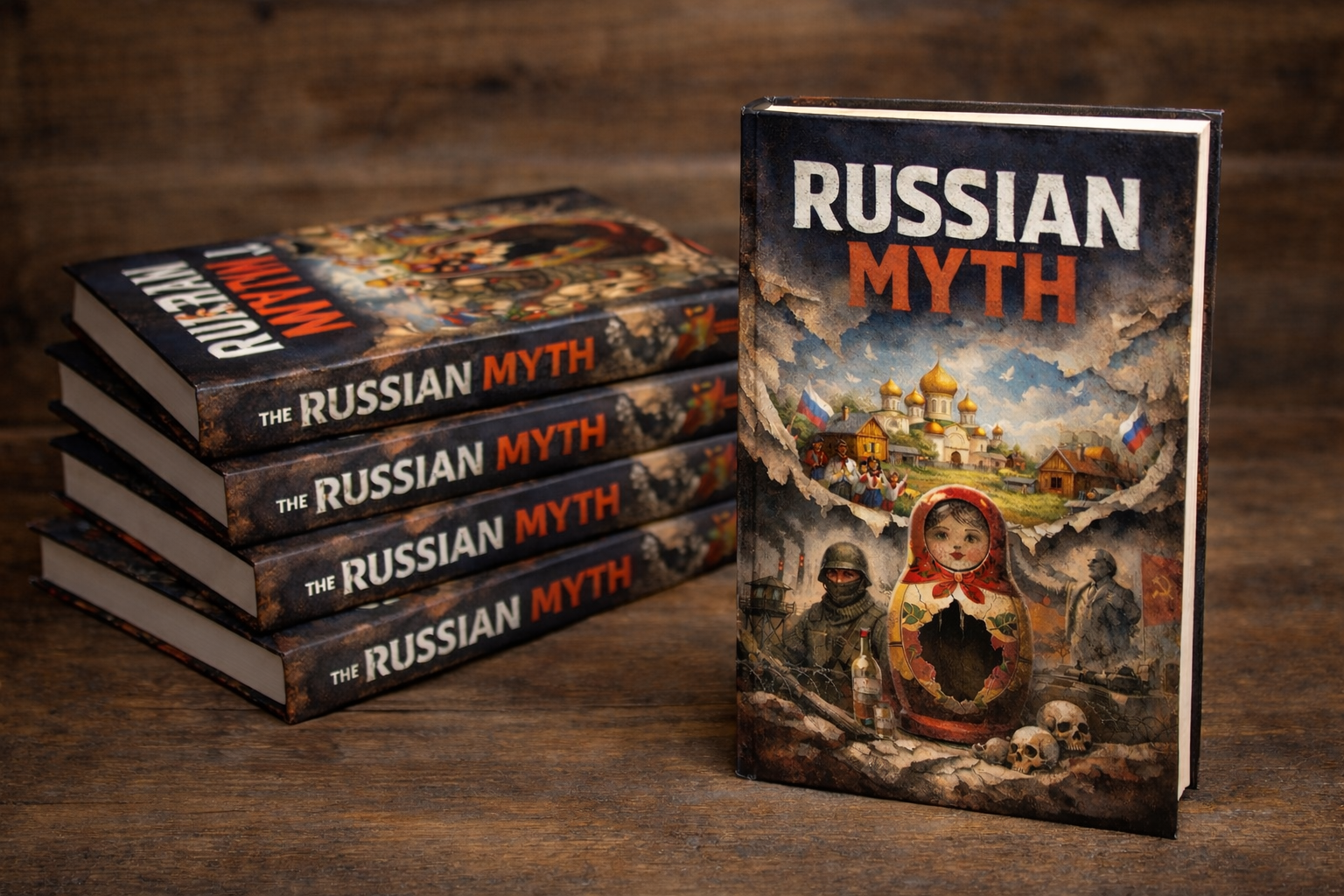
Not what Russia wants — but what Russia is. Cheslavskyi traces the comprador system across 800 years to explain why Ukraine’s existence is a logical necessity to destroy.
Every war produces its library. Books about Putin’s psychology. Books about NATO enlargement. Books about gas pipelines and historical grievances. Most of them answer the wrong question.
Oleh Cheslavskyi asks a different one: not what Russia wants, but what Russia is. And the answer, assembled across eight centuries of Muscovite history, is as precise as it is unsettling. Russia is a comprador system — a structure that does not produce power but rents it. It extracts from its colonies, services its hegemon, and uses ideology to make the population call this arrangement destiny.
The ideological engine was always the same: a sacred ruler, a chosen people, a civilization permanently under threat from the West. The Russian Orthodox Church wrote the catechism. The secret police enforced the liturgy. And for most of those eight centuries, it worked — because the people inside the system had no access to a comparison.
By applying a world-systems model to this historical trajectory, Cheslavskyi demonstrates that every major transformation within Russia was merely a structural adaptation to hegemonic succession. From the Golden Horde to the British Empire, and later to the American-led world order, Moscow never developed internally; it simply rebranded its extraction machine to serve the shifting centers of global capital. The current aggression is the empire’s violent convulsion amid contemporary systemic chaos—a desperate attempt to secure its role as a brutal resource broker before the global hierarchy solidifies once again.
Ukraine became that comparison. Not by accident, and not because of Western interference — but because Ukrainian society made a choice, repeatedly and at enormous cost, to build something different. That choice, more than any military alliance, is what the Kremlin cannot survive. The Russian Myth explains why the destruction of Ukraine is not a war aim. It is a logical necessity for a system that cannot exist alongside its own refutation.
Cheslavskyi writes without diplomatic hedging. He names the mechanism, traces its history, and maps its current collapse – because for the first time in eight centuries, all three load-bearing walls of the system are cracking at once. Understanding how it was built is the only way to understand why it is falling.
Available on Amazon and Apple Books.