



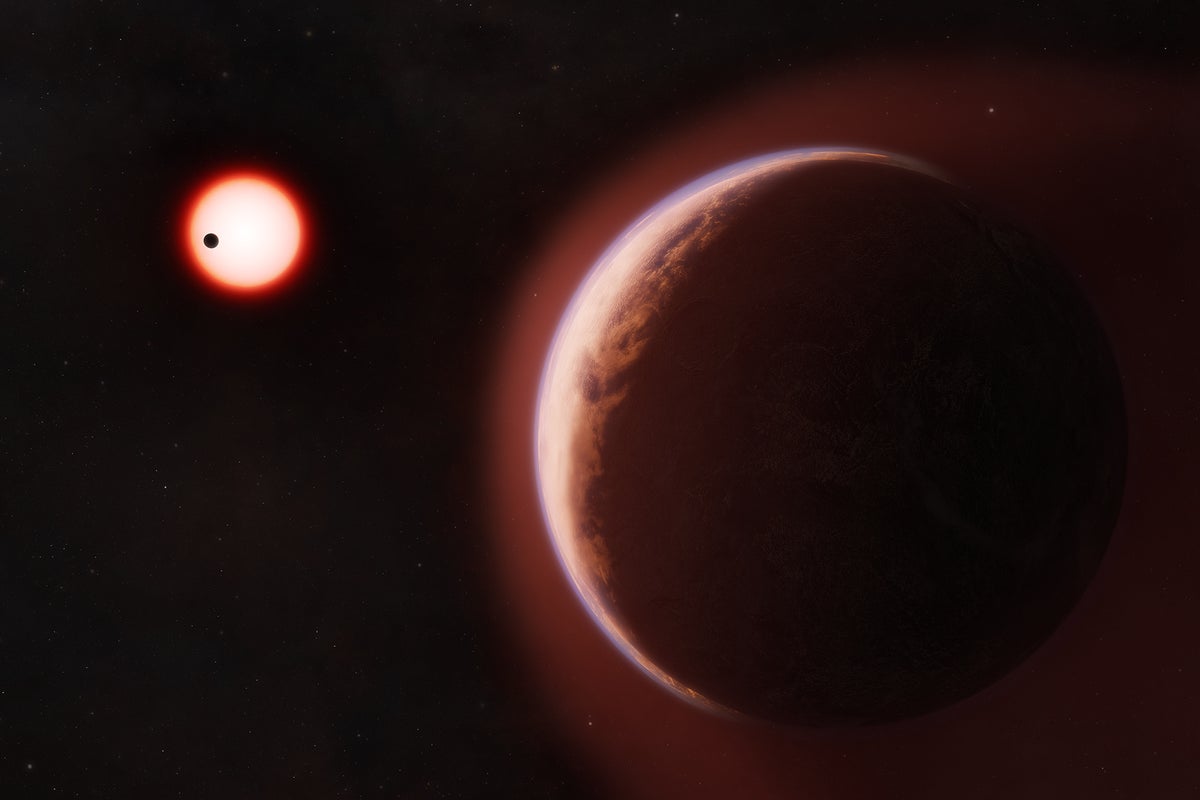
Scientists have seen an atmosphere around a rocky, potentially habitable planet for the first time – marking a major milestone in the search for alien life.
As well as being a major discovery in itself, the research also suggests that there might be many other worlds, similar to our own, that could host extraterrestrials.
“An atmosphere is essential for a planet to support life as we know it,” said Collin Cherubim, from Harvard University, who led the work. “This is the first time anyone has found an atmosphere on a rocky planet in the habitable zone of another star.”
The planet, known as LHS 1140 b, was discovered a decade ago and was already known to be relatively similar to Earth: it is larger, but has a similar composition. It sits within its stars “habitable zone”, the sweet spot between being too hot and too cold, which is thought to be necessary for liquid water and for life to thrive.
But the new work shows that the world also seems to have an atmosphere. That too is understood to be necessary for a planet to be habitable.
For a long time, scientists weren’t sure whether other planets akin to our own even existed. But detailed research in recent years have found that they are actually common, and that some of them are in the habitable zone around their stars.
Until now, however, it has remained unknown whether they would actually have their own atmospheres. The new research shows that at least one does – and suggests that there might be more.
Scientists started with a theoretical model that suggested the world known as LHS 1140 b would have an upper atmosphere that would be rich in helium. That helium would be slowly escaping into space, giving astronomers something to look for.
To test that prediction, researchers looked at the planet using the Warm Infrared Echelle (WINERED) Spectrograph on the Magellan Observatory in Chile. That allowed them to see that helium escaping, and showed that the planet does indeed have an atmosphere.
“This was clear evidence of an atmosphere on a habitable-zone exoplanet,” said Shreyas Vissapragada, from Harvard University, who worked on the new study. “It was an absolute thrill to see the transit spectra and slowly realize the implications of what we were looking at.”
Astronomers have long been searching for atmospheres on small, rocky planets like our own, but have mostly been disappointed.
The new work used a different approach. Rather than looking for the subtle changes in light from a planet as it passes by its star, which can hint at its lower atmosphere, they used telescopes to search the upper atmosphere for helium that would be escaping.
Scientists hope to look further at the planet to confirm that it does have an atmosphere, and get a better look at how it might be composed. That will include using Nasa’s James Webb Space Telescope.
“Because there’s helium there, and because the helium is escaping, the question is: Is it a bare rock with no atmosphere that sometimes burps up some gas that then immediately escapes, or is there a steady-state atmosphere there that will leak out stuff like the Earth does from time to time?” said Jason Dittmann, from the University of Florida, who first found the planet. “JWST data over the next four to five years will look for water, and if there’s water in the atmosphere, then it’s probably a stable atmosphere that will persist.”
The findings are reported in a new paper, ‘Helium escaping from the atmosphere of a nearby rocky exoplanet orbiting in a habitable zone’, published in the journal Science.