


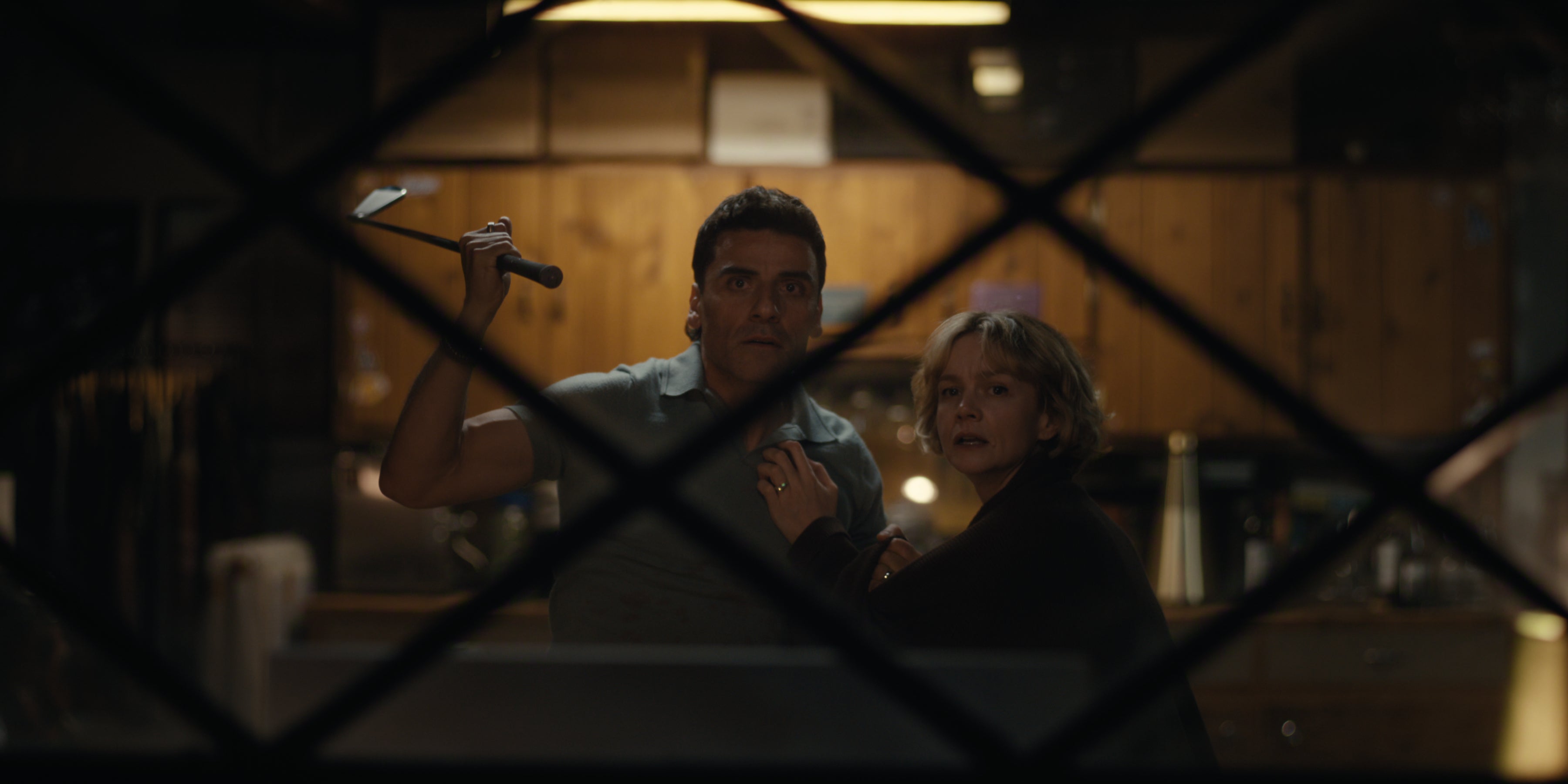
In the first episode of Beef‘s rollercoaster second season, Carey Mulligan’s Lindsay takes a golf club to the pictures in her husband Josh’s (Oscar Isaac) shed. She moves on to his guitar and other precious sports memorabilia, as he claps and eggs her on. “You are an empty, selfish woman!” he barks. “Thank God we didn’t have kids.” Lindsay quickly whirls around, golf club raised, advancing toward Josh. He grabs the club, yanking it away. “That’s enough,” he commands. She screams; their dachshund barks. They lift their heads to spot a pair of young, petrified faces outside the window. “S***,” Josh mutters.
In its much-anticipated return, the Emmy-winning drama anthology from Netflix and A24 swaps strangers for spouses, asking whether screaming matches are healthy outlets or simply destructive forces that can fracture relationships. Lindsay, an interior designer, and Josh, a manager of an affluent country club, are a couple whose marriage has left their dreams unrealized: no children, an unfinished home and a crippling amount of debt. Convinced their dysfunction is normal, Lindsay reassures herself: “Couples fight, it’s normal. We’re normal.”
Fighting may indeed be normal — even healthy — but at what point does it cross the line into toxicity? “We all have a deep desire to feel seen and known by our partner,” Dr. Clay Brigance, a licensed professional counselor, tells me. “And if we feel like we can’t express that, or if we express that in a harmful way, like berating or blowing up and accusing each other with criticism, then it just becomes very divisive.”
After witnessing the fiery exchange, Gen Z couple Austin (Charles Melton) and Ashley (Cailee Spaeny), two of Josh’s employees, flee hand in hand. Assuming their boss was the volatile instigator, the naïve, newly engaged lovebirds become concerned for Lindsay’s safety and promise to bring the footage they’ve captured to the authorities.
The next day, Austin visits Lindsay at her house and offers to help her remove herself from her toxic environment. She laughs, informing him that he’s misread the situation. Instead, she predicts that he and Ashley will one day engage in an all-out verbal brawl and will be stronger for it. Austin bristles at the idea, insisting that explosive arguments aren’t the foundation of a lasting relationship. Lindsay’s cutting response: “All the couples I know that last, they’ve really had at it. And it’s actually the ones that don’t, where someone’s usually hiding something. The bad does have to come out somewhere.”
Unsettled by her theory, Austin returns home and quickly searches Reddit for answers. “Fiancee and I never fight, why?” he writes. Numerous replies indicate that zero friction is less a sign of harmony than of avoidance.

Blanca Cobb, an internationally recognized behavior expert based in North Carolina, agrees. “Of the two extremes, people who are passive-aggressive and avoid conflict, or they throw barbs at each other, you’re not solving anything,” she says. “At least when people argue, they’re getting some emotion out. Where they get it wrong is that a lot of times, people want to win.”
Cobb also questions these so-called argument-free relationships. In many cases, she suggests, partners have simply decided “it’s not worth it to have an argument.”
“People think of an argument as something bad or yelling or screaming or name-calling,” she shares. “No, we can have rules in how we communicate with our partner. We can still be loving and understanding and respectful, but have a tough conversation.”
Austin and Ashley’s PDA-filled romance serves as a direct foil to Josh and Lindsay’s fraught marriage. Where Josh makes direct accusations, Ashley delivers subtle, vicious digs; and where Lindsay openly declares her hatred for her husband, Austin quietly questions his relationship.
What Austin interprets as a frictionless relationship is, in reality, one where tension is bubbling beneath the surface.

Together, Austin and Ashley confront Lindsay and Josh, revealing they caught the heated altercation on camera and intend to use it as leverage for Ashley’s promotion from beverage cart attendant to assistant manager. Their blackmail eventually spirals into a web of lies, as Ashley pushes Austin to falsify physical therapy credentials so he can also move up from his part-time server job. However, worried about the legal consequences, Austin grows withdrawn.
Austin’s behavior is what Dr. Brigance describes as icing, or stonewalling: when a person has emotional needs they need to express but, because of their childhood or because they don’t feel emotionally safe in the relationship, they remain silent. While holding back maintains the peace in the moment, Dr. Brigance likens the outcome to an overstretched rubber band. “Eventually it’s going to get pretty tight, and that’s when we start seeing resentment,” he explains.
Dr. Brigance says both ways of handling conflict are equally destructive, though in different ways. He compares explosive fights to erupting volcanoes, whereas passive aggressiveness, he says, is like rising sea levels — the damage might not be immediately obvious, but it’s no less harmful.

New York-based psychologist Dr. Favaro similarly notes that couples who regularly engage in blowout fights may quickly return to normal. “But baseline might be a hair trigger away from the next blowup,” he warns. “So promises to disagree in a healthy way need to be kept.”
If a conversation turns ferocious, Dr. Favaro insists that “putting space between the parties is essential for avoiding escalation.”
“They must dedicate themselves to disagreeing in a more civil way,” he adds. “Each member of the couple should express what bothers them most. Each must ask, ‘What could I have done differently?’ to prevent repeat performances.”
Dr. Brigance, meanwhile, advises that couples “lean into curiosity,” emphasizing that “it’s hard to have a non-productive conversation with our partner when we’re genuinely curious about their position on any issue.”
And, as a rule of thumb, he urges avoiding accusatory “you” statements. Most of the time, he says, criticism can feel like an “attack on somebody’s character,” resulting in defensiveness from the other party.
He also stresses the importance of therapy. “Find a trusted counselor, because if you really want to do the work, counseling has been shown for decades to be a really great way to uncover the ‘why,’” Dr. Brigance says.
Ultimately, as Beef suggests, the real pitfall isn’t whether couples fight, but how — and whether — they are willing to face what lies beneath it.
‘Beef’ season two is streaming on Netflix