





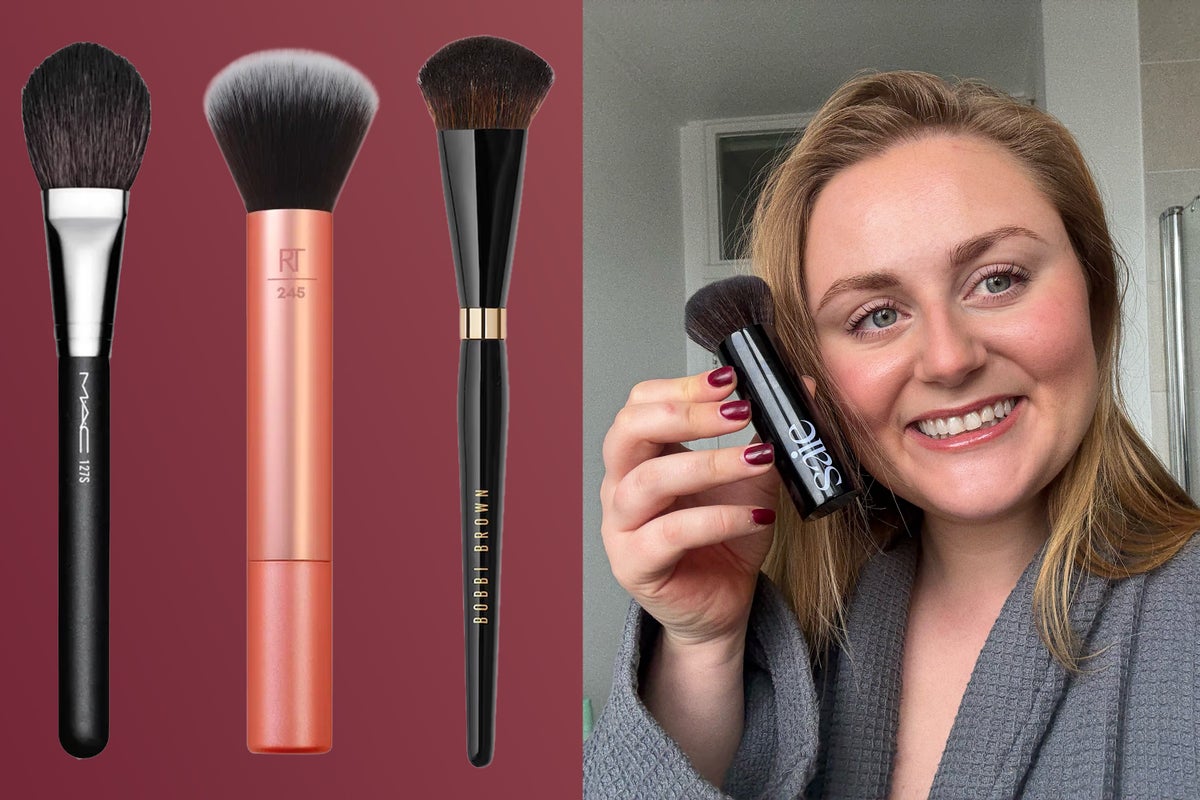
What is the best foundation brush?
If you want the best all-rounder, Saie’s ‘the big brush’ is hard to fault. It delivered the most consistently streak-free finish in testing, blended lightweight and medium-coverage formulas with ease, and its broad, silky-soft bristles made quick work of larger areas of the face.
For something more budget-friendly, the Elf buffing foundation brush punches far above its £8 price tag, while Real Techniques’ everything brush is the one I’d recommend for dry or sensitive skin thanks to its flexible, well-spaced bristles.
Ultimately, the right pick comes down to your preferred formula and finish, but Saie’s balance of speed, softness and seamless coverage makes it the clear winner.
A few brushes also narrowly missed out. The NYX pro multi purpose buffing brush, for example, quickly became weighed down with product, making it tricky to achieve a smooth, streak-free finish. Similarly, I’d hoped Beauty Pie’s seamless foundation buffing brush would rival Hourglass’s premium offering for less, but once its bristles loaded with foundation, they stiffened and dragged across the skin uncomfortably. It’s worth noting that a handful of other brushes became slightly bogged down with foundation and still made the cut – but these two struggled more noticeably than most.
How I tested foundation brushes
Because the right foundation brush depends as much on your skin type and preferred finish as it does the actual foundation you’re using, I assessed each tool for multiple characteristics, including:
- Blendability: I considered how easily each brush buffed, stippled or swept foundation into the skin without streaking, patchiness or obvious brush lines.
- Finish: I assessed whether the result looked skin-like, seamless and even, paying close attention to cakiness, pore emphasis and how the brush handled texture.
- Formula compatibility: I tested the brushes with a range of products, including skin tints, liquids, stick foundations, cream bronzers and powders where suitable.
- Comfort: I weighed up how the bristles felt across my own dry patches, active blemishes, irritation and some more sensitive areas around my nose and under eyes.
- Product absorption: I paid close attention to how much foundation the bristles soaked up, especially with denser brush heads.
- Ease of cleaning: I recorded how quickly product build-up occurred and whether the brush’s performance changed when the bristles became clogged, if at all.
- Value for money: I weighed performance against price, aesthetics, versatility and whether the brush compared to more expensive tools (or in the case of some standout budget brushes, vice versa).
What type of make-up brush is best for foundation?
“If you want more coverage, go for a dense brush with shorter, tightly packed hairs. This helps you layer the product and really work it into the skin,” reveals Arthur. She continues, “For lighter products like skin tints or tinted moisturiser, you should use something a bit less dense so it doesn’t apply too heavily.” Lastly, she finishes, “Stick foundations need a dense buffing brush, otherwise they’ll just sit on top of the skin.”
Is a flat or domed foundation brush better?
For Arthur, these type of brushes have different purposes, with neither one nor the other performing ‘better’, so to speak. “A flat brush is good for getting product onto the skin quickly and building coverage,” she explains, “I still use one sometimes, but it can leave lines if you don’t blend it out properly.” Meanwhile, she elaborates, “A domed, dense brush is what you should use to buff everything in and get rid of any streaks.”
Can any brush be a foundation brush?
“Technically yes,” answers Arthur, “but using the right tools makes the whole process quicker and the finish more polished.”
Breaking this down, she tells me, “If the brush is too soft or not dense enough, you’ll struggle to get an even finish and it’ll take longer to blend.”
Using stipple brushes as an example, she describes, “These are better for very light layers, like moisturiser or a skin tint.” Ergo, every brush has a formula it’s best suited for.
What is the best way to apply liquid foundation on mature skin?
“Work in small sections and keep the layers light,” instructs Arthur, “Don’t apply foundation straight onto the face, put it on the back of your hand first, work it into the brush, then apply.”
“This,” she outlines, “helps control how much you’re using so it doesn’t sit in fine lines – small buffing motions always work best.”
How do I avoid looking cakey with foundation?
“Make sure your skincare has actually absorbed before you start, give it a few minutes,” begins Arthur. Next, she advises you “Build your foundation in thin layers rather than putting too much on at once. Use a buffing motion and take your time with it.”
To finish, she suggests “a light setting spray to melt everything together so it looks like skin.”
Why you can trust IndyBest reviews
As a senior shopping writer for IndyBest, Lucy Smith has compiled a number of features regarding complexion products, from the best concealers to the best bronzers. When it comes to make-up tools, she also spent months testing the best make-up brush sets – so she already had an idea of the foundation brush frontrunners – and, with respect to foundations, her new guide to the best foundations is currently in the works (watch this space). In the meantime, she’s reviewed the Charlotte Tilbury airbrush flawless foundation, the Giorgio Armani luminous silk foundation and more. As such, she’s well versed in how seamless and smooth a good face base can appear with the right formulas and tools. Not to mention she personally wears foundation several times a week, with a brush being her application tool of choice.
This new Charlotte Tilbury product ‘fills a long-standing gap in the market’

