


Millions across Europe are enduring an unseasonably early heatwave this week, with scorching temperatures gripping the continent. Experts attribute these extreme conditions to a meteorological phenomenon known as a ‘heat dome’.
What is a heat dome?
Heat domes are stationary high-pressure systems that trap dangerous heat and humidity for days, according to Mireia Ginesta, a research associate at the Climate Litigation Lab at the Smith School of Enterprise and the Environment. These phenomena result from a northward bulge in the jet stream — a river of fast-moving wind at high elevations — which creates the weather we experience.
“High pressure system means that the air is sinking, and as the air goes down to lower altitudes, it becomes compressed,” Ginesta said. “So the pressure increases and the temperature also increases.”
How does a heat dome play a role in heat waves?
Those “bulges” are what set up the conditions that lead to a heat wave, said Jennifer Francis, a climate scientist at the Woodwell Climate Research Center.
“The heat dome is really what the jet stream is doing,” Francis said. “The heat wave is what we feel at the surface.”
What is happening in Europe this week?
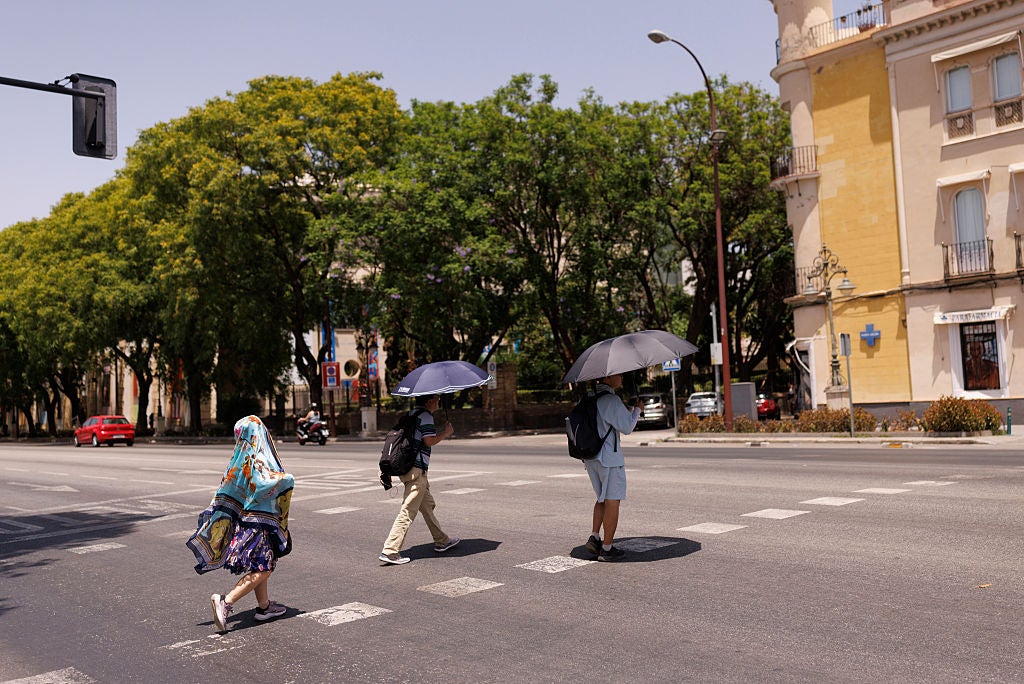
Millions of people across the continent have been experiencing exceptionally high temperatures as an early summer heat wave sears France, Italy, Spain and the United Kingdom.

“In Europe, they’re just not used to this,” Francis said. “It’s really just in the last decade or two where these sorts of really brutal heat waves have been happening and killing a lot of people because they don’t have the means to stay cool.”
France, which has been the most affected so far, doesn’t have widespread air conditioning, and about half the country has been placed under a red heat wave alert by the national weather service. The nation has also reported around 40 fatalities because of drowning, as people sought cooling relief.
Those conditions are expected to last for several days, with temperatures as high as 104 degrees Fahrenheit (40 degrees Celsius).
“We are going to see the June temperature records not just broken, but completely annihilated,” said Liz Bentley, chief executive at the Royal Meteorological Society and a professor of meteorology at the University of Reading.
How is climate change influencing these phenomena?
Climate change is making the conditions for heat domes happen more often, experts say. And more and more nations around the globe are being impacted.
“We’re warming the globe and that means we’re shifting the range of temperatures that any given place experiences,” Francis said. “And as you shift that range of temperature, you’re making the extreme temperatures much more likely.”
Effectively, the world has turned up the thermostat temperature, Bentley said.
“Climate change is definitely having an impact on the fact that they’re more frequent, they’re more intense, and they’re more persistent as well,” Bentley said of heat waves. “They hang around a lot longer than they used to do.”
How can people stay safe?
It is important that people experiencing these extreme temperatures hydrate, avoid exercise in the heat of the day, find shade and safely cool off in nearby streams, lakes or even the ocean if they have access.
In France, for instance, trains, concerts and sporting events have been canceled, and authorities are restricting public alcohol drinking.
Also, “One of the biggest problems is the nighttime heat,” Francis said. “If you don’t give your body a chance to cool off at night, it just starts to accumulate in your body and that can really start to affect your health. And so figuring out a way to stay cooler at night is very, very important.”