


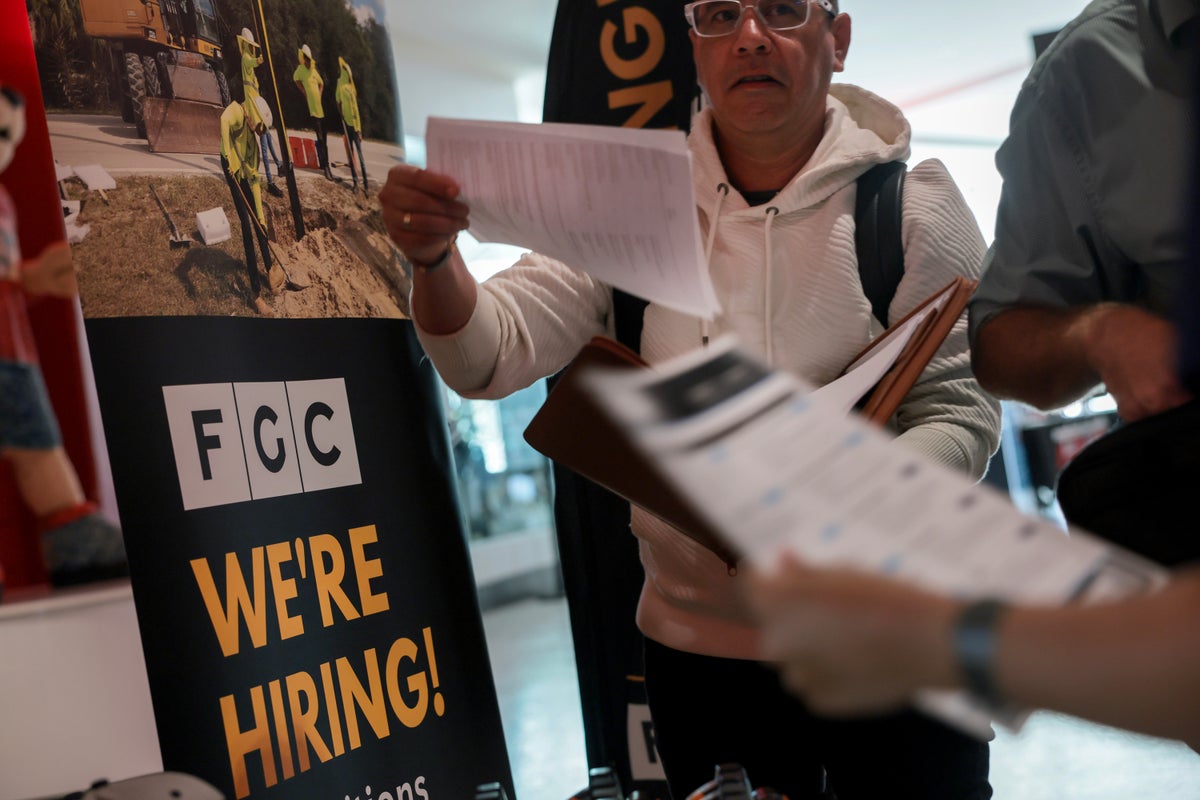
The number of Americans seeking jobless aid increased last week, yet figures remain historically low despite economic uncertainty stemming from the ongoing conflict in Iran.
Applications for unemployment benefits in the U.S. rose by 12,000 to 211,000 for the week ending May 9, the Labor Department reported Thursday.
This figure slightly exceeded the 207,000 new applications anticipated by analysts surveyed by FactSet.
Weekly filings for unemployment benefits serve as a key indicator of U.S. layoffs and offer a near real-time snapshot of the job market’s health.
Despite a relatively low number of layoffs, the labor market appears to be in what economists describe as a “low-hire, low-fire” state.
This has kept the unemployment rate at a low 4.3%, but has left many out of work struggling to secure new employment.
While U.S. employers added a surprising 115,000 new jobs in April, the war in Iran has injected significant uncertainty into the broader U.S. economy and labor market.
The Strait of Hormuz, a critical waterway through which one-fifth of the world’s oil passes, remains closed.

Since the conflict began in late February, oil prices have surged by more than 50%, and the average price for a gallon of gas in the U.S. has climbed to $4.53 from less than $3. These escalating costs not only impact consumers’ finances but can also deter businesses from hiring.
Further data released this week by the U.S. government revealed that consumer-level inflation rose 3.8% from April 2025, marking the largest jump in three years.
Food prices are also on the rise, though analysts suggest they may not yet fully reflect the increased energy costs attributed to the Iran war.
Another report indicated that wholesale prices shot up 6% from a year ago, reaching their highest point in over three years.
The Labor Department’s producer price index, which tracks inflation before it reaches consumers, increased by 1.4% from March to April, the largest monthly gain in more than four years.
This inflationary pressure comes as U.S. inflation already exceeds the Federal Reserve’s 2% target.
Two weeks prior, the Fed opted to maintain its benchmark interest rate, citing economic uncertainty caused by Middle East instability and persistently elevated inflation.
While lower interest rates can stimulate the economy and hiring, they also tend to fuel inflation, prompting several Federal Reserve policymakers to consider an interest rate hike this year.
Adding to the complex landscape, the recent boom in artificial intelligence and the substantial investment required for its development could potentially alter or even displace certain jobs.
Several prominent companies, including Verizon, UPS, Amazon, Disney, and Walmart, have recently announced job cuts.
Weekly jobless aid applications have largely stabilized in a range between 200,000 and 250,000 since the U.S. economy emerged from the pandemic recession.
However, hiring began to slow approximately two years ago and tapered further in 2025 due to erratic tariff rollouts, a purge of the federal workforce, and the lingering effects of high interest rates aimed at controlling inflation. Employers added fewer than 200,000 jobs last year, a stark contrast to the approximately 1.5 million added in 2024, according to FactSet.
The Labor Department’s report on Thursday also showed that the four-week moving average of jobless claims, which smooths out weekly fluctuations, edged up by 750 to 203,750.
The total number of Americans filing for unemployment benefits for the previous week ending May 2 jumped by 24,000 to 1.78 million, aligning with analyst forecasts.
