Is opposition to President Donald Trump’s policies a sincere political stance or the sign of a mental health problem? He seems to believe it’s the latter.
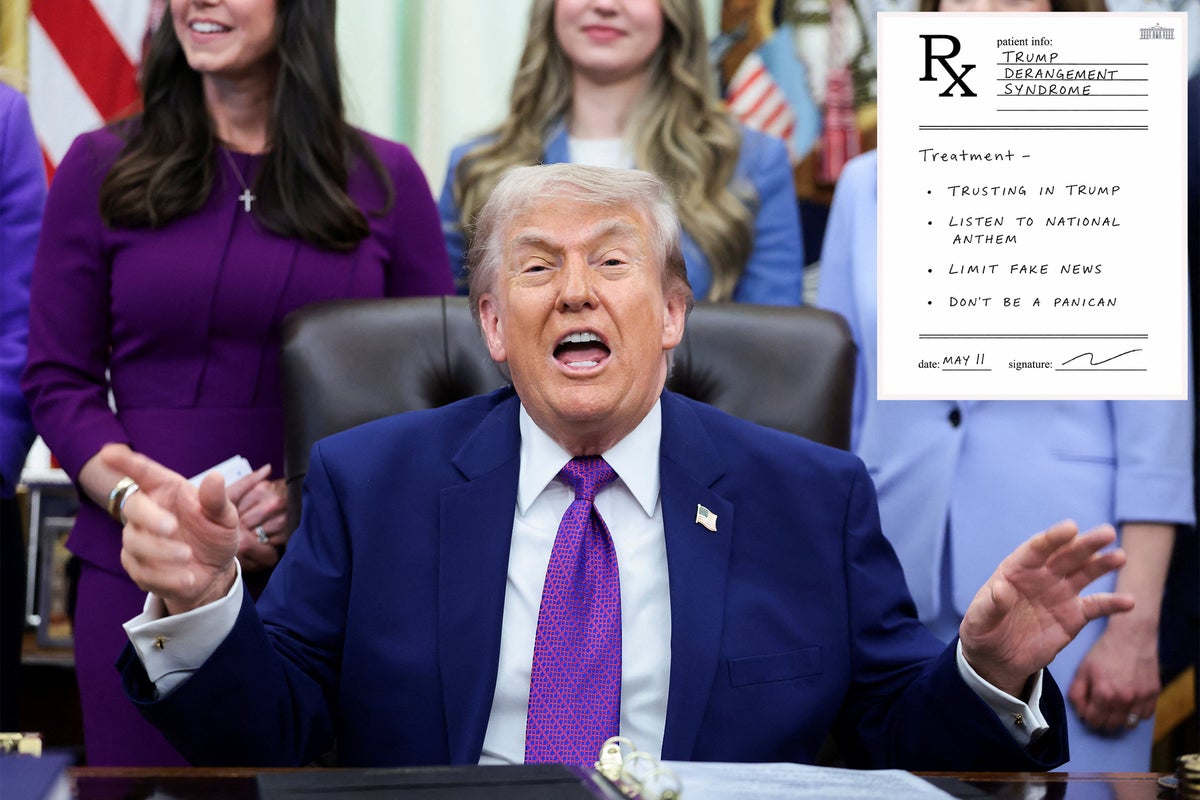
During an Oval Office event focusing on new maternal health initiatives on Monday, the president accused Democrats who voted against his partisan spending package last year of doing so because of “Trump Derangement” and claimed the opposition “can’t even see straight” because of their alleged symptoms.
“They’ve got serious Trump Derangement, which actually is a disease. I’m hearing it is actually a disease. It’s an honor,” Trump insisted.
The president was referring to a fake condition coined by MAGA-aligned media figures who accuse Democrats of opposing him because of what they call “Trump Derangement Syndrome.”
Moments afterwards, the White House official X account posted an ersatz prescription for the non-existent condition advising treatment by “trusting in Trump,” listening to the U.S. national anthem, limiting consumption of “fake news” — the president’s term for legitimate media organizations — and cautioning against being a “panican,” his term for a Republican who doesn’t defend him against all reason.
The pejorative TDS is an adaptation of a similar dig at Democrats, “Bush Derangement Syndrome,” which was coined by conservative columnist Charles Krauthammer during the George W. Bush administration in 2003.
Krauthammer, who was a Harvard University-trained psychiatrist before embarking on a second career as a political commentator in the early 1980s, had defined the fake medical condition as “the acute onset of paranoia in otherwise normal people in reaction to the policies, the presidency —n ay — the very existence of George W. Bush.”
Two decades later, the “Trump Derangement Syndrome” line has been frequently deployed against Democrats — or anyone who isn’t in lockstep with Trump’s political positions — as a way of delegitimizing and denigrating that opposition by intimating that Trump’s opponents are incapable of rational political discussions.
In one notorious example, Trump suggested that the death of the late Hollywood director Rob Reiner and his wife Michelle Reiner was “reportedly due to the anger he caused others through his massive, unyielding, and incurable affliction with a mind crippling disease known as TRUMP DERANGEMENT SYNDROME, sometimes referred to as TDS.”
In fact, the Reiners had been stabbed to death, allegedly by the director’s son Nick, who is currently facing murder charges in Los Angeles, California.
The president’s comments came just a day before he leaves for a sensitive state visit to China and hours after he engaged in an late-night Truth Social posting session in which he spent several hours resharing AI-generated images and other posts on his social media site from MAGA loyalists.
It included messages describing him as “The Greatest of All Time,” declaring “Thank God for Trump,” and amplifying a poll which he claimed as proof that he’d surpassed the late Ronald Reagan as the “most beloved president among Republicans.”
One post depicted Trump’s face being carved into Mount Rushmore alongside George Washington, Thomas Jefferson, Theodore Roosevelt, and Abraham Lincoln. while another attacked Democrats as having “no solutions,” “no policies,” “no joy,” and “no love for America.”