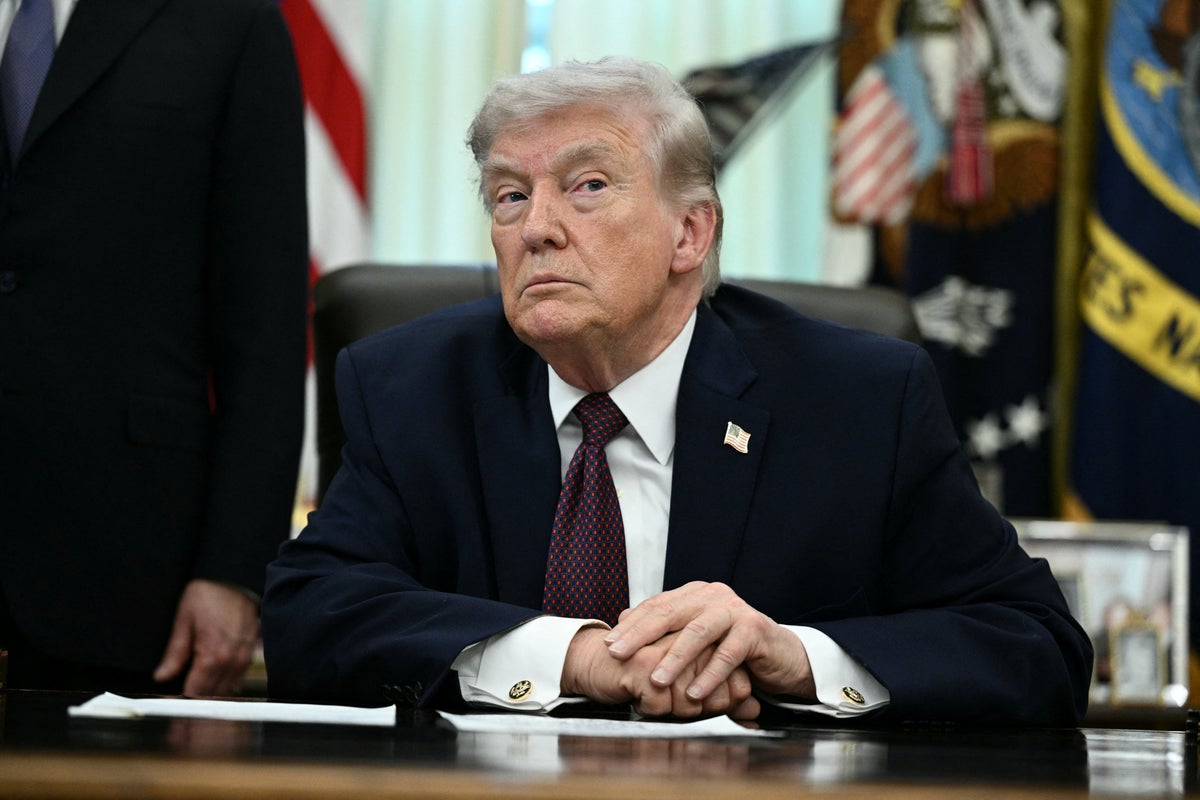
US president Donald Trump seemed uncharacteristically reluctant to talk when The Independent asked him what he would do if the missing American officer were captured or harmed by Iranians. “Well, I can’t comment on it, because…” he said, “we hope that’s not going to happen.”
His reticence might be explained by memories of the Iranian hostage crisis 47 years ago, when a young Mr Trump criticised Jimmy Carter for failing to rescue American diplomats taken hostage during the Islamic Revolution.
“That they hold our hostages is just absolutely and totally ridiculous; that this country sits back and allows a country such as Iran to hold our hostages, to my way of thinking, is a horror,” the 34-year-old Mr Trump said in a recently rediscovered interview.
President Carter eventually approved a rescue mission, in which eight American soldiers died. The humiliation of the crisis and its unhappy ending put an end to his re-election hopes. When US forces abducted Nicolás Maduro, the Venezuelan president, in January this year, President Trump contrasted the successful mission with the “Jimmy Carter disaster that destroyed his entire administration”.
That history may explain the urgency of the current extraction operation, which has rescued the pilot of the F-15 fighter jet that was shot down over Iran on Friday, but left a weapons systems officer missing.
Both sides know the potential value of a hostage, with the Iranian regime offering a big reward for the capture of the missing crew member.
Mr Trump is in an awkward position, having boasted about US control of the skies over Iran. “We’ve taken out their air defence,” he said two weeks ago. “There’s no air defence whatsoever.” Last week, he said: “We literally have planes flying over Tehran and other parts of their country. They can’t do a thing about it.”
No wonder the president sounds increasingly, if erratically, desperate to bring the war to an end, posting a misspelt message on his Truth Social website on Saturday in which he warned that “all Hell” will “reign down” on Iran if its rulers do not make a deal or reopen the Strait of Hormuz.
As we have commented before, Mr Trump has already failed, because the Iranian revolutionary regime is still in place. He appears to have been tempted into this conflict by the prospect – dangled before him by Benjamin Netanyahu, the Israeli prime minister – of toppling the regime in Tehran.
But that was never going to be possible without putting troops on the ground, and now the loss of a single US officer has underlined how difficult that would be. Public opinion in the United States is opposed to this war, and is unwilling to tolerate American casualties.
Without troops on the ground, or secure control of the skies, or control of the Strait of Hormuz, Mr Trump has come up against the limits of US military power.
He has also failed more widely. He has literally blown up the world economy, which will mean higher prices in the US – the irony being that it was inflation under Joe Biden that secured Mr Trump’s second term. He has alienated most of America’s allies – insulting, hectoring and threatening them, including the United Kingdom, whose troops fought side by side with the Americans in Iraq and Afghanistan. And he has strengthened Vladimir Putin by raising the value of Russia’s oil and gas reserves.
Mr Trump wanted a place in history as a president who had made peace, but he is likely to be remembered as one who waged a disastrous war.
He spoke more truth than he knew when he posted: “Time is running out.” Time is on the side of the Iranian regime. It is running out for his war. He needs to declare victory and move on. He needs to do it today.