

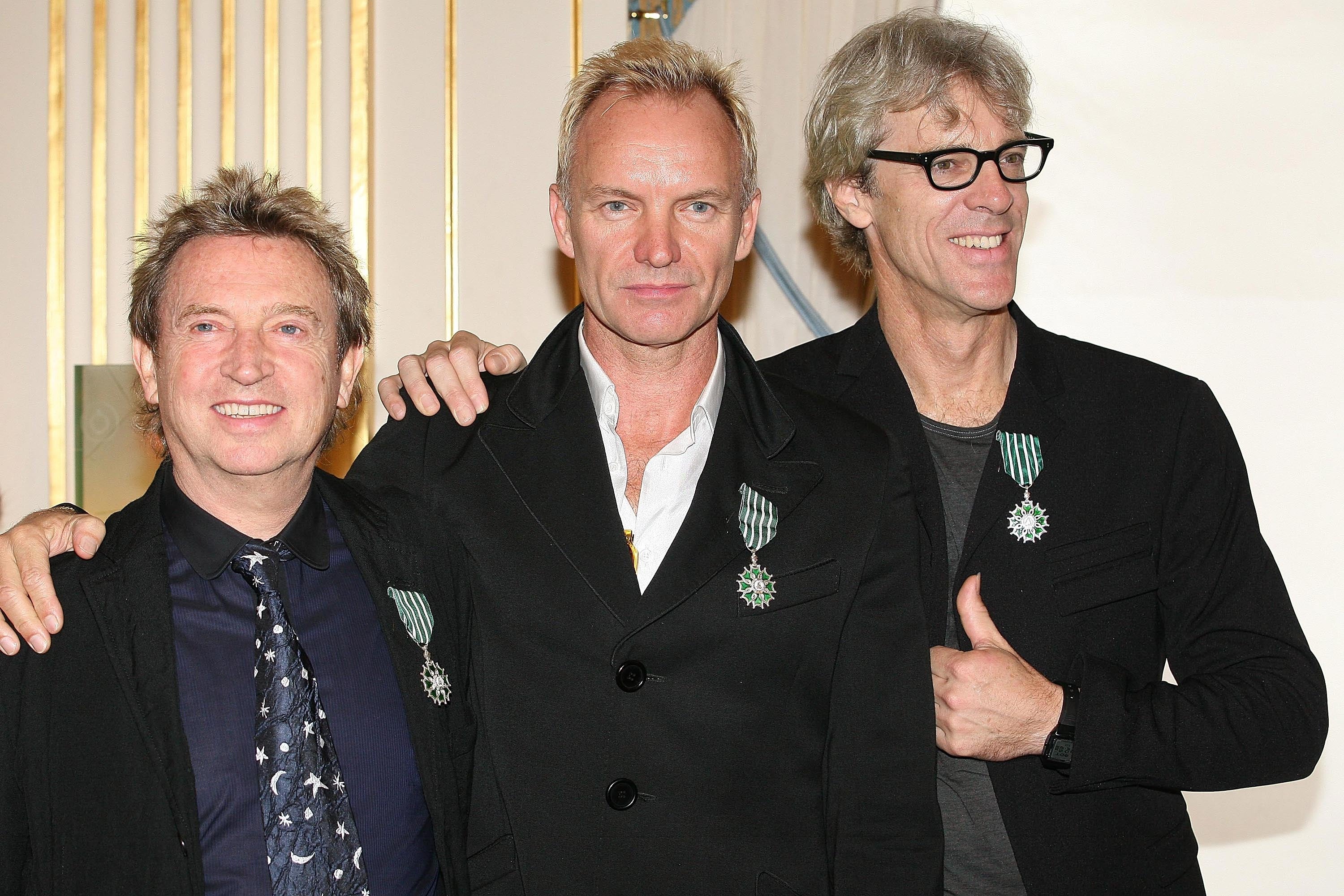
Musician Sting has reportedly paid his former The Police bandmates more than half a million pounds after acknowledging they did not receive sufficient royalties.
Sting, real name Gordon Sumner, was sued by guitarist Andy Summers and drummer Stewart Copeland last year over claims they were owed between £1.5m and £8m in royalties for hit songs such as “Roxanne” and “Every Breath You Take”.
The BBC reports that Sting’s lawyers said the pair have now received a payment of “over $800,000 (£595,000), while denying that they are entitled to a portion of his income from streaming and download sales.
The Independent has contacted Sting’s publicist and a representative for Copeland and Summers, requesting comment.
Copeland and Summers did not receive writing credits on most of The Police’s biggest songs, but argued that they entered an “oral agreement” with Sting to share income in 1977.
This was later formalised, they alleged, in written contracts signed in 1981 then revised in 1995 and 2016.
The agreement apparently acknowledged Sting as the band’s chief composer while also noting that his two bandmates also made crucial contributions, including Summers’ instantly recognisable guitar line on the 1983 song “Every Breath You Take”.

Featured on their last album, Synchronicity, it is one of the band’s most lucrative songs, and has been recognised by the US-based licensing organisation Broadcast Music Inc. as the most-played song in radio history.
According to a 2009 report in CBS News, Sting earns an estimated $2,000 (£1,495) per day in royalties from the original song, after he successfully sued Sean “Diddy” Combs for sampling it without permission for the rapper’s 1997 hit “I’ll Be Missing You”.


Enjoy unlimited access to 100 million ad-free songs and podcasts with Amazon Music
Sign up now for a 30-day free trial. Terms apply.
Try for free
ADVERTISEMENT. If you sign up to this service we will earn commission. This revenue helps to fund journalism across The Independent.
Enjoy unlimited access to 100 million ad-free songs and podcasts with Amazon Music
Sign up now for a 30-day free trial. Terms apply.
Try for free
ADVERTISEMENT. If you sign up to this service we will earn commission. This revenue helps to fund journalism across The Independent.
Yet Summers has repeatedly insisted that his contribution on guitar was crucial to the track’s success: “There wasn’t a guitar part on it when Sting wrote it,” he told Guitar Player in a 2024 interview. “I just went into the studio and I heard the chord sequence for it, and it immediately came to me to play the riff I came up with. It was very much in the Police guitar style, if you like.”
The Police formed in 1977 and disbanded in 1984 after releasing five studio albums. They briefly reunited in 2007 for a world tour to mark the band’s 30th anniversary, but recorded no new music.

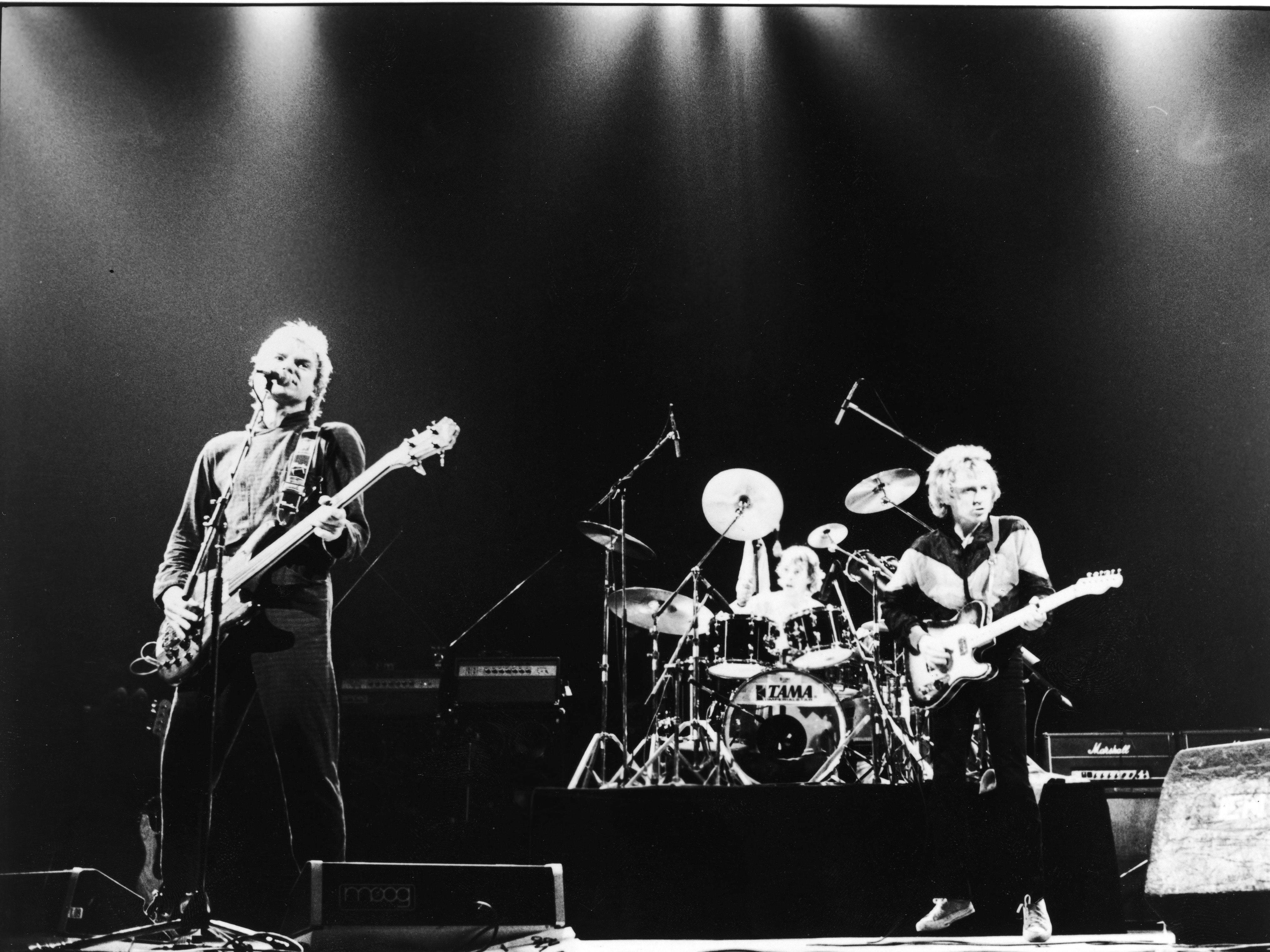
Sting has addressed their difficult working relationship in past interviews, telling Mojo in 2022: “My frustration was I would have written an album’s worth of material but also had to entertain these other songs that were not as good.
“Explaining to someone why their song isn’t working is a bit like saying their girlfriend’s ugly. That pain was something I didn’t want to go through any more.”
That same year, he sold the rights to his songwriting catalogue – for both his solo hits and songs he wrote for The Police – to Universal Music Group in a deal estimated to be worth $200m (£148m).
Despite releasing no new music in decades, The Police remain one of the UK’s most successful bands, with around 75 million records sold and a string of Brit and Grammy Awards. They were inducted into the Rock and Roll Hall of Fame in 2003.
The BBC reports that none of the former band members were in court on Wednesday (14 January) as the two-day preliminary hearing began.
Lawyers for Summers and Copeland are asking the court for permission to bring new and additional arguments that the pair are owed money from all downloads and streaming income, under the terms of their previous agreements.
They are arguing that the language of those agreements should be viewed in light of changes to the music industry, in that streaming income has largely replaced sales of vinyl, CDs and cassettes.
Their lawyers acknowledged a recent payment from Sting and his publishing company of $870,000 (£647,000), but said no interest had been added to the “historic underpayment”.
The total value of their claim, they said, was “not less than £8m” and will be “considerably larger” if their amended case is allowed to proceed.
Sting’s lawyers have said the musician should not have to give them royalties from streaming because this counts as “public performance” rather than a sale, and have asked that the attempted amendment to the case should be thrown out because it has “no real prospect of success”.
The hearing is due to conclude today (Thursday 15 January), with a trial expected to be held at a later date.