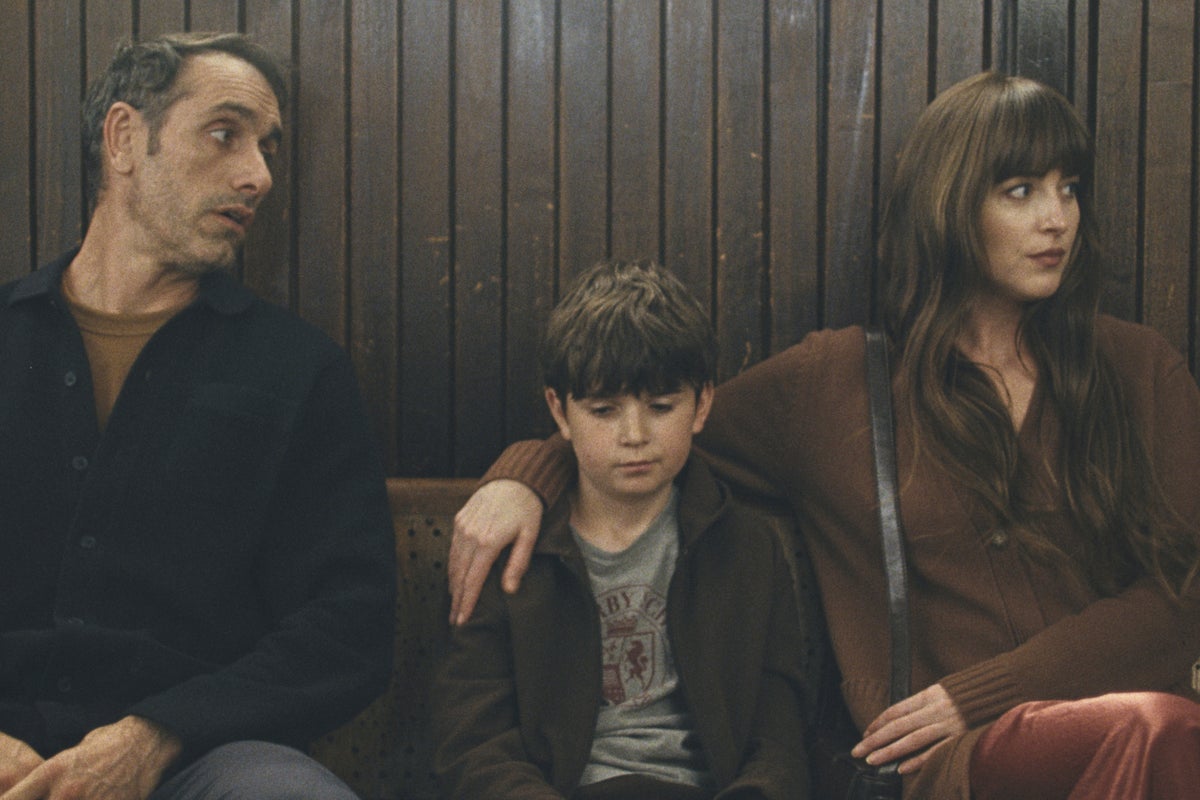
With her playful squint, her knowing smirk, her dialogue delivered as if each line holds a hundred secrets, it sometimes feels as if Dakota Johnson could see through walls if she really wanted to. When she’s deployed in films that are underwritten and underthought (by that I mean Madame Webb), these traits lend her a subversive air that borders on camp. Yet, in a comedy as incisively and hilariously written as Splitsville, she’s able to transform into a human scalpel knife. Johnson turns egotists into clowns; buffoons into adult children; and liars into whimpering, cornered prey.
In the right circumstances, she’s the ultimate straight man. And Splitsville likely wouldn’t work without her. The film is a follow-up to Michael Angelo Covino and Kyle Marvin’s feature debut The Climb (2019). Both men, longtime collaborators, write and star, while Covino directs. Both projects are about friends who have become so emotionally co-dependent that the usual boundaries are obliterated, with violent consequences. Where The Climb was about a man who sleeps with his friend’s fiancée; Splitsville is about a man who sleeps with his friend’s wife.
Ashley (Adriana Arjona) tells Carey (Marin) she wants a divorce. So, Carey arrives to the home of his childhood pal Paul (Covino) looking for reassurance. He and his wife, Julie (Johnson), reveal that the supposed secret to their success is that they’ve opened up the marriage. I say “supposed” because, when the inevitable happens – Carey and Julie hook up – Paul’s reaction isn’t placid acceptance, but a full-blown, wrecking ball brawl that takes out half of his modern-luxe, lakeside home.
It’s as if two drunks were asked to recreate a scene from John Wick. In interviews, Covino and Marvin have cited the Italian comedies of the Seventies as inspiration, namely Lina Wertmuller’s The Seduction of Mimi and Pietro Germi’s Divorce, Italian Style, and their now-rare blend of slapstick, carefully sketched humanity, and cinematic verve.
The entire fight sequence is staged within wide-angle, minimally cluttered shots that would look elegant if it weren’t for the adult children wrestling at their centre. And, Johnson, too, provides a similar counterbalance to male hopelessness – there’s a recurring bit where Carey drinks directly from the tap like a dog – without relapsing into that old, stale maternal scold stereotype.
And while it’s mainly the men who are absurd here, as Ashley experiments sexually with Charlie Gillespie’s Jackson, a bartender with one braincell, and Nicholas Braun’s Matt, a mentalist with a fragile ego, Arjona is handed a few funny sequences of her own. She insists on reading to Carey prepared statements about the nature of their relationship, at one point quoting Malcolm Gladwell’s “10,000-Hour Rule”. She’s so performatively earnest that it’s mortifying to watch.
There’s an argument to be made that Splitsville’s noncommittal on the subject of polyamory. I think that might, in fact, be the point: Covino and Marvin aren’t interested so much in whether polyamory is the solution to, or destruction of, a longterm relationship, but more the fact people’s stated beliefs and innate desires tend to be two entirely different and conflicted concepts. So often, finding contentment does require turning your life upside down, shaking out all the contents, and picking back up only what truly feels right. Not when Dakota Johnson plays it, though. She makes it all look easy.
Dir: Michael Angelo Covino. Starring: Dakota Johnson, Adria Arjona, Michael Angelo Covino, Kyle Marvin. Cert 15, 104 minutes.