


While all the big-hitters around them experience a glut of goals and drama, depending on which way you glance, Spain continue their methodical and altogether stress-free path to the latter stages of the World Cup. Sure, they are lacking France’s all-out firepower. Sure, they are lacking a leading talisman in Argentina’s Lionel Messi or England’s Harry Kane. But as a cohesive unit, ticking over possession and grounding their opposition into submission, there is still no collective well-rounded team better at this World Cup 2026 than La Roja.
In Los Angeles on Thursday, they made a statement. Across the board, the Spanish had too much suave and poise for an Austrian outfit who, after their incredible stoppage-time equaliser against Algeria last Saturday, had run out of steam. For Mikel Oyarzabal, there was another World Cup brace to back up his tally against Saudi Arabia as he ruthlessly capitalised on two pinpoint crosses from Marc Cucurella. In between those goals came a first international goal for Tottenham’s Pedro Porro, who took advantage of his starting pick ahead of Marcos Llorente. A tougher test lies in wait in the last-16, mind: either Cristiano Ronaldo’s Portugal or Luka Modric’s Croatia in Dallas on Monday.
Records continue to tumble for Luis de la Fuente’s unrelenting outfit. They’ve now levelled the 35-game unbeaten run of the 2007-2009 golden generation and are now just two games away from the all-time international record, set by Roberto Mancini’s Italy team who won Euro 2020. For keeper Unai Simón, No 1 over Arsenal’s David Raya, a fifth consecutive World Cup clean sheet, tying Italy in 1990 and Switzerland between 2006 and 2010. And it’s the first time they’ve scored more than one goal in a knockout game since 1994, would you believe? The omens for the Spanish are tantalisingly promising.
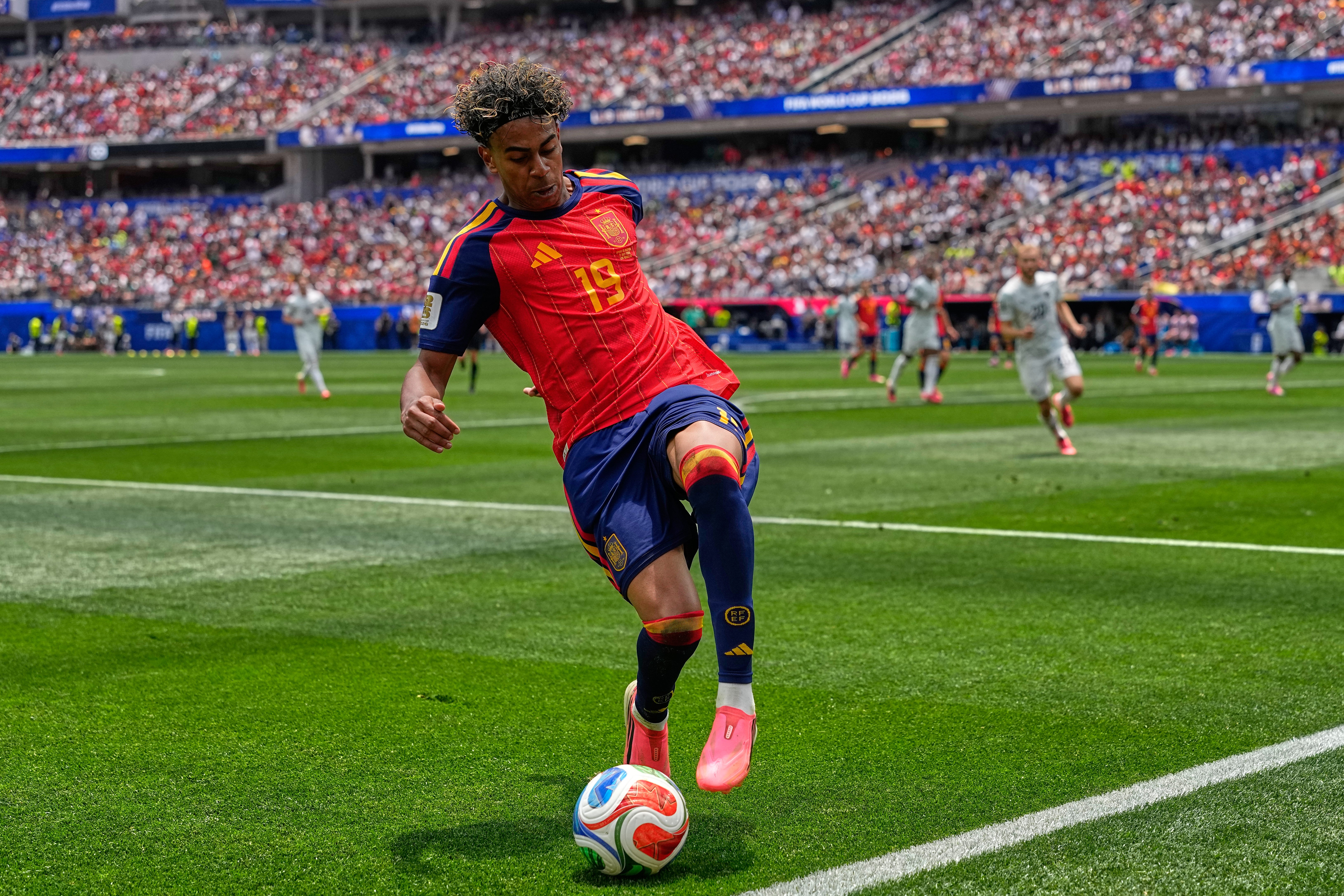
All that was missing, in essence, was a Lamine Yamal goal. The irresistible winger, not 19 years of age for another 11 days, came close on several occasions but, unlike Kylian Mbappe, Erling Haaland, Messi and Kane out in front, a fight for the golden boot looks beyond him. Still, he looked terrific in spurts here; unequivocally the most potent attacking threat for his country.
For Spain, this was a first-ever game in California, nd they could well be back in eight days, with a potential quarter-final against the USA or Belgium. Here, they were met with stiflingly dense conditions, adding to the humidity in this greenhouse-spaceship of an arena. And from De la Fuente’s team selection, a record-breaking faith in youth: in selecting Barcelona duo Yamal and Pau Cubarsi, the pair were the first teenagers to start a World Cup knockout match for 68 years, since a certain Pele and Jose Altafini for Brazil in 1958. That side, of course, won the tournament.
It would be fair to state that out of all the superstars at this tournament, 18-year-old Yamal is the one yet to fully catch fire, primarily due to fitness reasons after his return from a hamstring problem. But this is knockout football – no time for acclimatisation now – and here in Inglewood, the winger was his team’s constant, lightning-fast threat on the right. From minute one, intercepting the ball and finding space in the box, Yamal immediately worked Alexander Schlager with a low shot towards the corner. Suffice to say, it would be a busy day at the office for the Austrian goalkeeper.
Yamal’s battle with forlorn Austria left back Konrad Laimer was the duel of the match. For every exquisite Spanish nutmeg came a pesky clip of the heels from the Bayern Munich defender who, by and large, dealt with the teenager effectively. Yet Schalger was a busy man, denying Yamal from a tight angle before a super save down low to his left from Oyarzabal. And it would be Spain’s leading marksman – an underrated figure across the European continent, despite his Euro 2024 winner – who got the ball rolling 10 minutes before the interval.
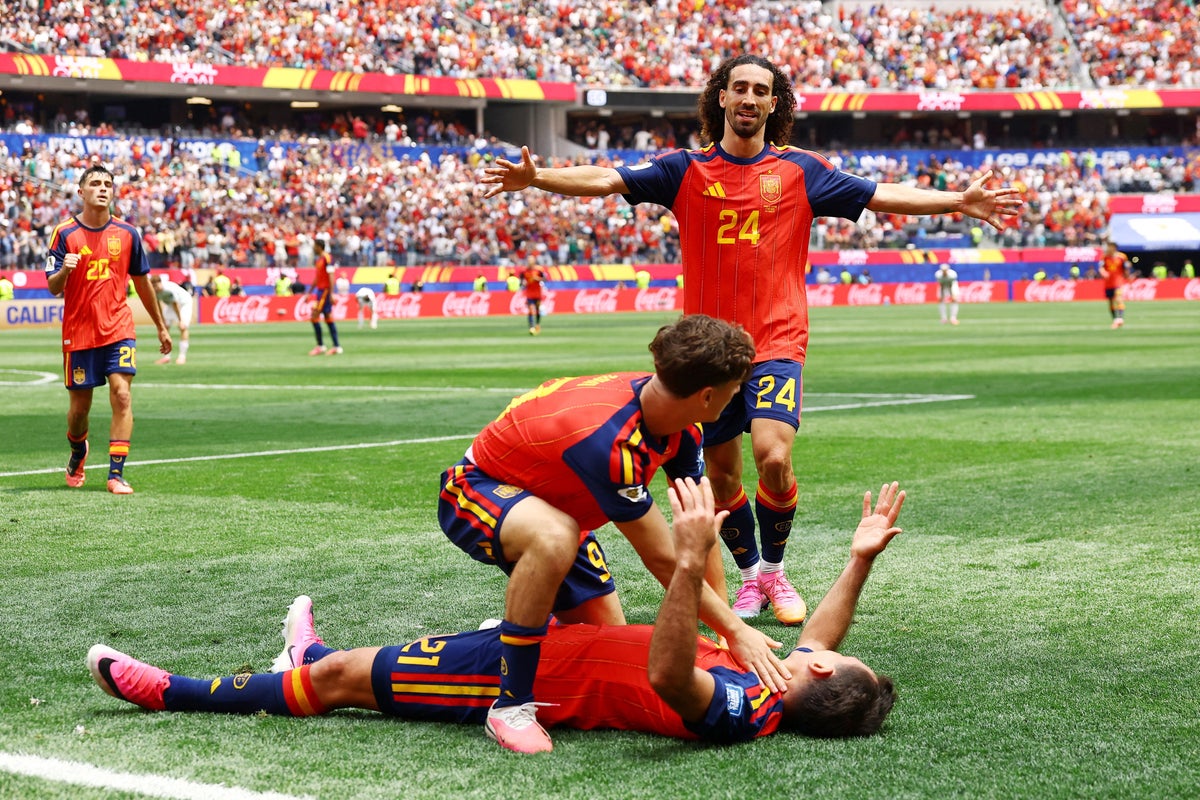
And for all Spain’s aesthetically pleasing interplay, it was the simplest of goals. Cucurella’s cross along the floor was perfect for Oyarzabal, unmarked in the box, to sweep the ball into the corner with his left foot. Astonishingly, it was Spain’s first World Cup knockout goal scored by a Spaniard since Andres Iniesta’s winner in the 2010 final.
Thereafter, the European champions were rampant, with Alex Baena rattling the crossbar with a free-kick and Yamal somehow denied by Schlager following it in. The Austrian goal was living a charmed life; coach Ralf Rangnick would have been satisfied that the deficit was only one. At the other end, Spain keeper Simon was untroubled with a shot on target for the fourth consecutive first-half.
The second-half, however, was much of the same. Rangnick tried his best to tinker, with two early double substitutions, but the Spanish onslaught kept coming with captain Rodri sending a shot a whisker wide and Oyarzabal timidly testing the goalkeeper when he really should have fed an irritated Yamal.
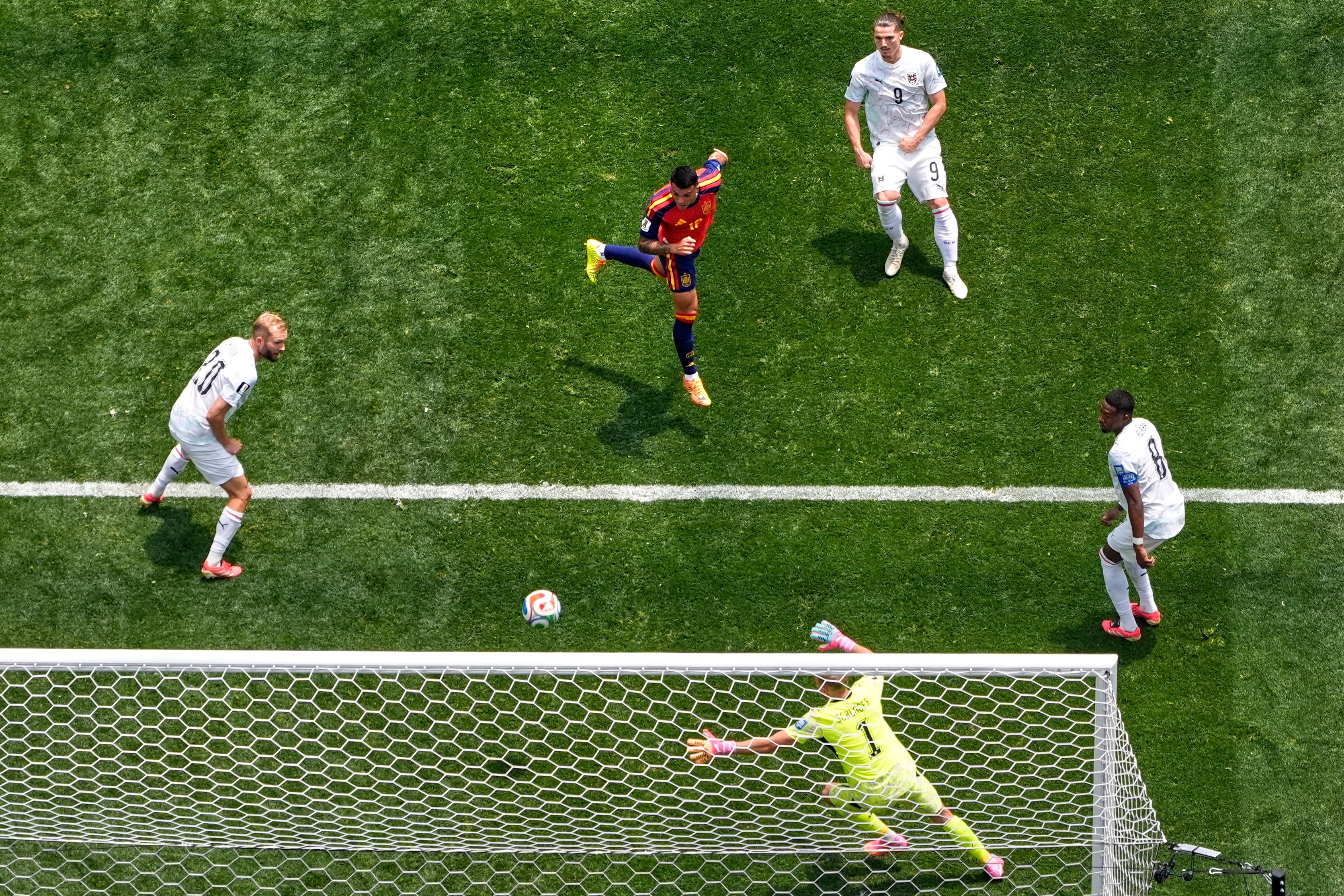
But would Austria have a genuine sight on goal? The answer would be yes: Marcel Sazbitzer, their primary attacking threat on the day, crossed accurately and substitute Sasa Kalajdzic headed over from point-blank range. Five minutes later, Austria would be punished as Baena’s chipped cross found right-back Porro – forever charging into attacking spaces he has no business occupying – in the penalty area to head home his first international goal on his 21st cap.
The finale, from that moment on, felt very inevitable. Very Spanish. Very tiki-taka. Yamal, to his annoyance, had a shot cleared off the line by David Alaba in his last involvement before being replaced with five minutes remaining.
Yet there would be the icing on the cake as, a minute before 90, Cucurella found an onrushing Oyarzabal to perfection in the penalty area and the Real Sociedad forward opened his body up to finish nonchalantly into the corner. No starry-eyed histrionics from the Spanish, no over-the-top lap of honour or sing-song post-match. Their focus is clear-cut – and with sturdier tests on the horizon, they’re peaking at just the right time.