


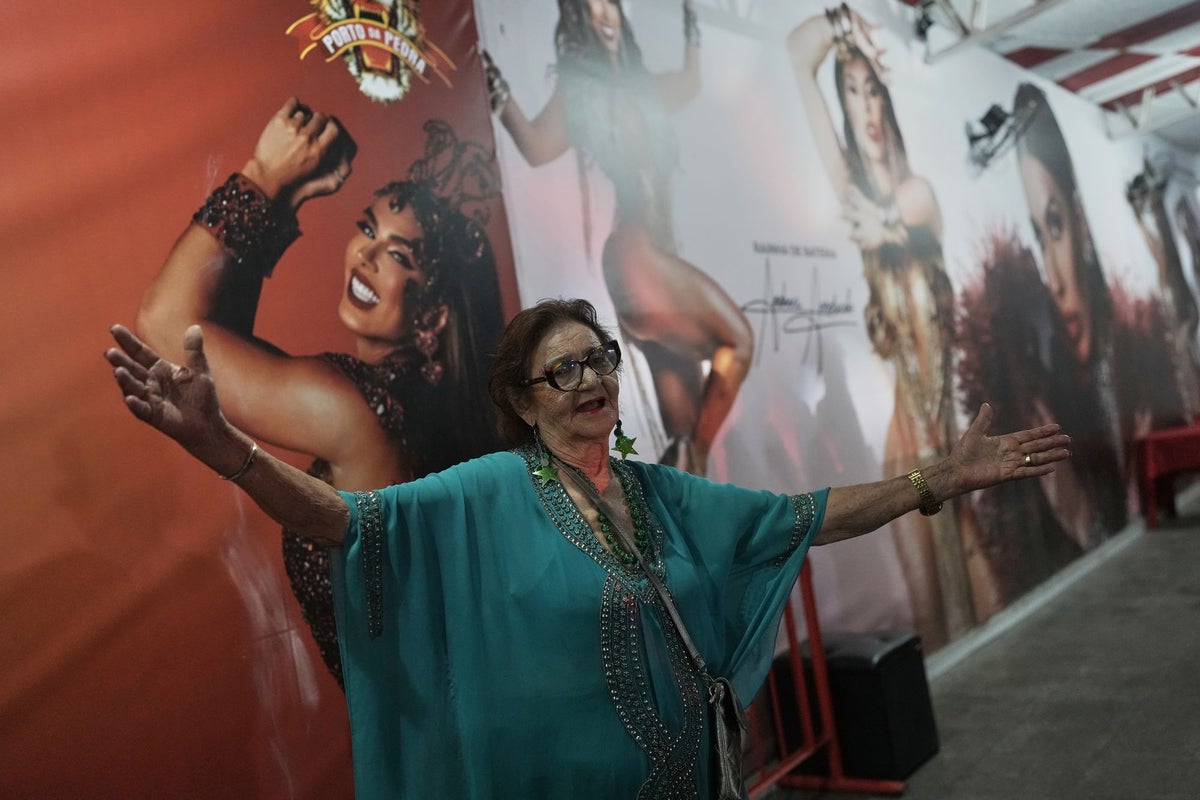
Six decades after fleeing her home in Brazil’s northeastern state of Paraiba, a move that led her into sex work and a lifetime of activism, Lourdes Barreto never imagined a Rio de Janeiro samba school would pay tribute to her journey.
This weekend, Porto da Pedra will do just that at Rio’s famed Sambodrome, as annual Carnival celebrations commence, honoring Barreto and sex workers of all genders in an effort to dismantle the profession’s pervasive stigma.
The samba school, based in the low-income city of São Gonçalo, across the bay from Rio, will dedicate its elaborate parade to this cause. Mauro Quintaes, Porto da Pedra’s creative director, has a history of focusing on marginalized groups, having previously curated parades centered on thieves and individuals with severe mental health issues. This year’s parade, titled “From life’s oldest times, the sweet and bitter kiss of the night,” serves as the final chapter in a trilogy Quintaes envisioned at the beginning of his career.
“Who would have thought that a prostitute would be honored?” the 83-year-old Barreto remarked during a video call from her home in Belem, ahead of her trip to Rio for the parade. Quintaes clarified the school’s intention: “The school is trying to make these women more seen, less invisible. It’s not an apology nor a glamorization.”
In Brazil, voluntary adult sex work is not a crime and has been recognized as an official occupation by the labour ministry since 2002, granting access to social security and other work benefits.


However, the Global Network of Sex Work Projects highlights that police continue to target sex workers and carry out evictions. This discrepancy stems from a lack of explicit legal definitions for prostitution and sexual exploitation (the latter being a crime), which, according to a 2017 report by the nonprofit group Davida, gives police arbitrary discretionary power.
Barreto herself co-founded the Brazilian Network of Prostitutes in the 1980s, fighting for better rights for sex workers. She challenged the military police, campaigned to establish HIV prevention policies, and even ran for a seat as a councilwoman.
Her lifelong dedication was recently acknowledged by the BBC, which included her in its 2024 list of 100 inspiring and influential women globally. Barreto maintains a clear perspective on her work: “I’ve always seen myself as a working woman. Not sinning, not doing anything wrong.”
While sex work has been evoked in previous parades, Porto da Pedra’s central focus and emphasis on class struggle are groundbreaking, according to Juliana Barbosa, a communications professor and Carnival expert.

She notes that samba schools, which emerged from Black communities, have a history of using social issues to spark dialogue. “The theme stays for months within those communities, being sung about and discussed, and then it spreads to a very large number of people,” Barbosa explained. “It can contribute to social change. Not as a rule, not on all subjects, but it has that tendency.”
Andrea de Andrade, 39, who will lead Porto da Pedra’s percussion section as drum queen, echoed this sentiment, recalling how Carnival themes from 20 years ago educated her on issues she had never encountered. “Many people don’t have access to much, not just due to a lack of funds, but also a lack of time. Many don’t read, don’t study — but Brazilians love Carnival,” she said.
More than 50 sex workers of all genders from across Brazil are expected to march on Saturday evening alongside hundreds of others. Thauany Laressa, a 27-year-old sex worker from Rondonia, expressed her hope that the parade would foster greater compassion and acceptance: “I hope that people who see the parade will have more compassion when interacting with sex workers and help them accept it as a profession. I hope that people will start respecting our lives, our way of life and our job.”

.png?trim=0,0,0,0&width=1200&height=800&crop=1200:800 "Norovirus outbreak on Florida-bound cruise ship sickens 115 passengers and crew – UK Times")