

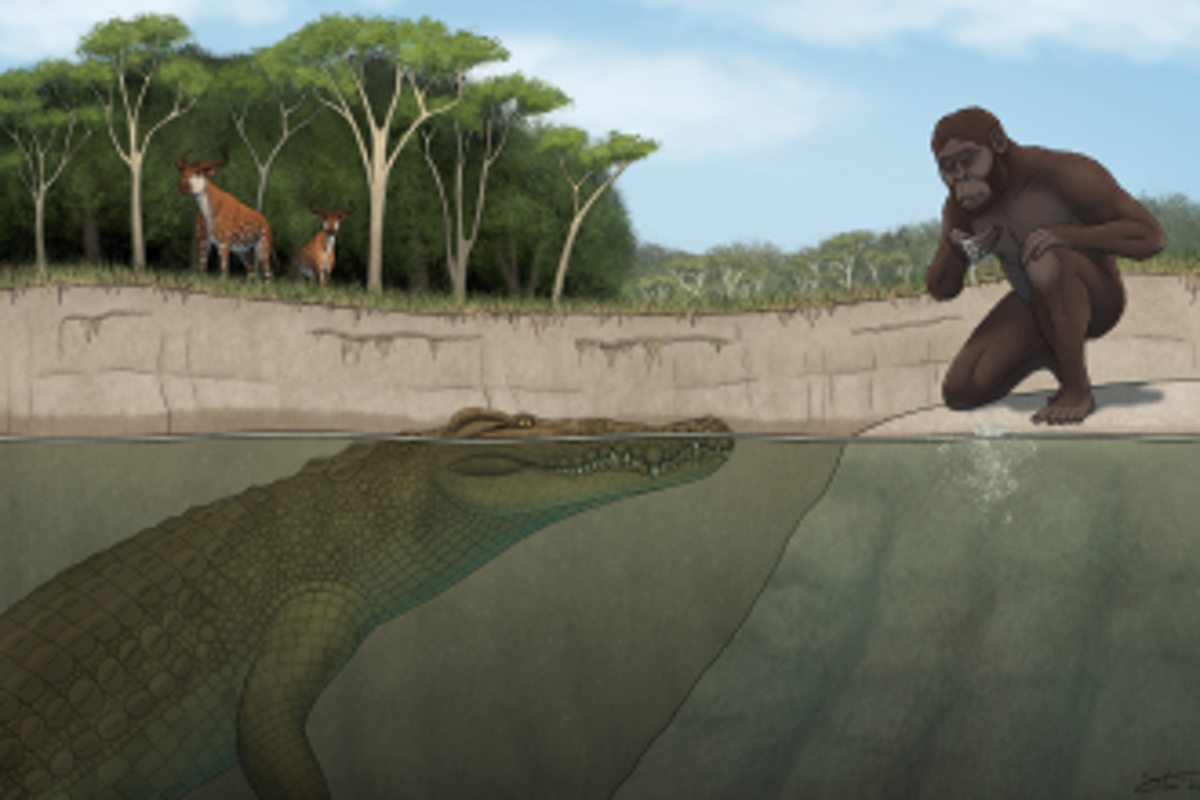
Scientists have discovered a new species of giant prehistoric crocodile that would have weighed half a tonne, grown up to 15ft in length and likely terrorised our ancestors as they roamed the African landscape.
With a prominent lump on its head, this giant relative of modern-day crocodiles patiently lurked in rivers and lakes to attack human ancestors over 3 million years ago.
It has been named Crocodylus lucivenator, or Lucy’s hunter, as it would almost certainly have preyed upon the extinct hominid species Australopithecus afarensis – one of the best studied ancestors of modern-day humans, thanks to the immaculately-preserved, 3.2 million-year-old skeleton known as Lucy.
It was the only crocodile in a landscape covering an expanse of shrubland and wetlands pocked with rivers in modern-day Ethiopia.
The crocodile grew to maximum lengths of between 12ft (3.5m) and 15ft (4.5m), and adults weighed between 270 kg (600 lb) and 590 kg (1,300 lbs), according to the study published in the Journal of Systematic Palaeontology.
Being an ambush predator akin to modern-day crocodiles, Lucy’s hunter would have waited for its prey while submerged in water, poised to spring on those who came for a drink, scientists say.
“It was the largest predator in that ecosystem, more so than lions and hyenas, and the biggest threat to our ancestors who lived there during that time,” said Christopher Brochu, an author of the study from the University of Iowa.
“It’s a near certainty this crocodile would have hunted Lucy’s species. Whether a particular crocodile tried to grab Lucy, we’ll never know, but it would have seen Lucy’s kind and thought, ‘Dinner’,” Dr Brochu said.

Researchers identified the new species based on museum specimens kept in the Ethiopian capital, Addis Ababa, in 2016.
They then analysed 121 catalogued remains, including skulls, teeth, and parts of jaws, representing dozens of individuals.
One of the specimens had several healed injuries on its jaw, suggesting it had tussled with one of its peers.
“I was just blown away because it had this really weird combination of character states,” Dr Brochu said.
The extinct crocodile had peculiar physical traits, including a large hump in the middle of its snout, similar to what is found on the American crocodile but not seen with the Nile crocodile in Africa.
Scientists suspect the hump was used by male crocodiles to attract a mate.
“You see this in some modern crocodiles,” Dr Brochu explained. “The male will lower his head down a little bit to a female to show it off.”
The fossils were excavated from the Hadar site in the Afar region of Ethiopia.
“During the Pliocene, Hadar was composed of a variety of habitats alongside its lake and river systems over space and time, including open and closed woodlands, gallery forests, wet grasslands, and shrublands,” said Christopher Campisano, another author of the study.
“Interestingly, this crocodile was one of only a few species that were able to persist throughout,” Dr Campisano said.