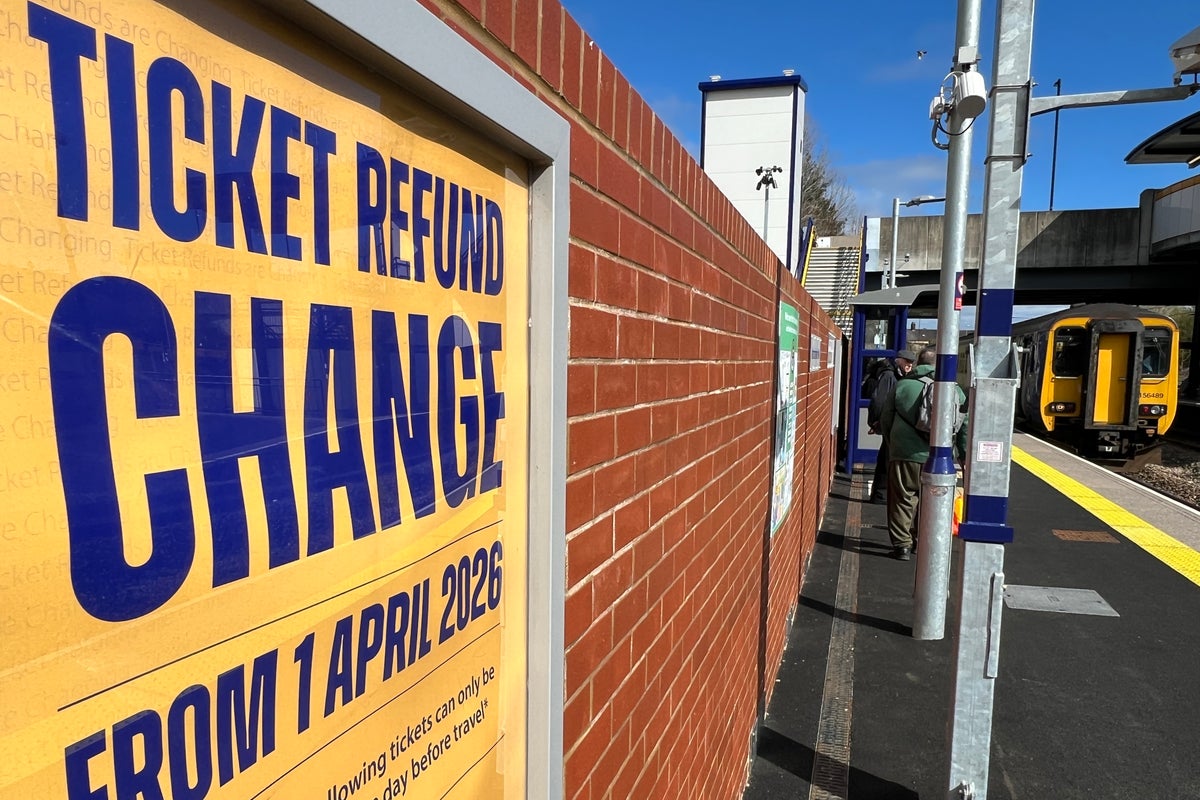
Regular rail travellers will have seen a big poster campaign at stations across the country over the last few weeks. They warn of a change in ticket refund rules, which took effect on April Fool’s Day.
Starting on 1 April 2026, if you buy an “anytime” or off-peak ticket, allowing you to travel on a range of trains, you can only get a refund if you apply before the ticket becomes valid.
Consider someone spending an ambitious £193 on a one-way ticket for the 7am Avanti West Coast express from Manchester to London. If they decide by 11.59pm the night before not to travel, they can claim a refund (minus a £5 admin fee). That’s in sharp contrast to the previous rule, which allowed them to get their money back on the intended day of travel, or during the following four weeks.
The rail industry says the change is essential to crack down on fraud that is costing train operators (and, by extension, the taxpayer) £40m a year.
It was an absurdly easy way to defraud the railway at little or no risk. Someone would buy a ticket and set about trying to make the journey without having their ticket clipped or scanned. This was a trivial prospect at open stations (those without barriers, ranging from unstaffed halts to the huge junction at York). Or they might “tailgate” passengers through the automatic gates.
If the miscreant succeeded in making the journey without their ticket being checked en route, then they would put their ticket in for a refund, which reduced the cost of pretty much any journey to just £5 – the admin fee.
Some regular commuters saw it as a risk-free variant of fare-dodging. Sometimes their ticket would be registered as used, either by clipping or scanning. On that particular day, they therefore paid the appropriate fare – but often, they did not.
The system certainly had some honest beneficiaries: passengers who had bought tickets but then their plans had changed, for personal or professional reasons. They will lose out.
Now, there is no price advantage to buying ahead of time, so you might simply decide to buy on the day, shortly before travel. The ticket will cost the same, and you will eliminate the risk of needing to cancel. The catch is on intercity routes, where one benefit of booking ahead is to get a seat reservation. For some – but not all – journeys, you can get a reservation before you buy a ticket.
Just ahead of the change, I expressed on social media my view: “At last, a gaping loophole in the system will close.”
The response took me by surprise. Some said the real fraud is the ticket prices charged on the railway.
“Did the government pay you to write this?” So asked James Goodliffe, one of many readers unhappy about the accompanying article on tightening up rail ticket refunds.
Neil McG wrote: “Says the bloke who travels for free all over the world.”
Others condemned the move because it would penalise passengers who are ill on the day of travel. But the rail industry insists it will look generously at exceptional circumstances such as sickness. In the event of disruption, you will still be able to claim a refund if you can’t make the journey due to cancellations or excessive delays.
The rail commentator Philip Haigh said: “Perhaps a better answer is for rail companies to check tickets?” Gareth Dennis rejected the assertion that the old rules were open to fraud. “Not remotely a loophole,” he wrote. “The result of the de-staffing of the railway. Instead, an extremely lazy policy change that will result in less overall revenue as stung passengers never again choose rail.”
He may be proved right. In contrast, I have spoken to a number of regular rail travellers who had no idea – until they saw the station posters – that refunds were so easy to obtain.
Perhaps we could settle on one of the continental systems to eliminate fraud. Paper tickets often need to be stamped in a machine on the departure platform to indicate you are starting your journey; presenting an unmarked ticket to an inspector is regarded as fare-dodging. And in Italy, tickets purchases online are for specific trains – and are refundable up to the moment the service departs.
As always, your views are welcome: you can email me at s@hols.tv or tweet @SimonCalder.
Read more: The inside story of fare-dodging on the railways