


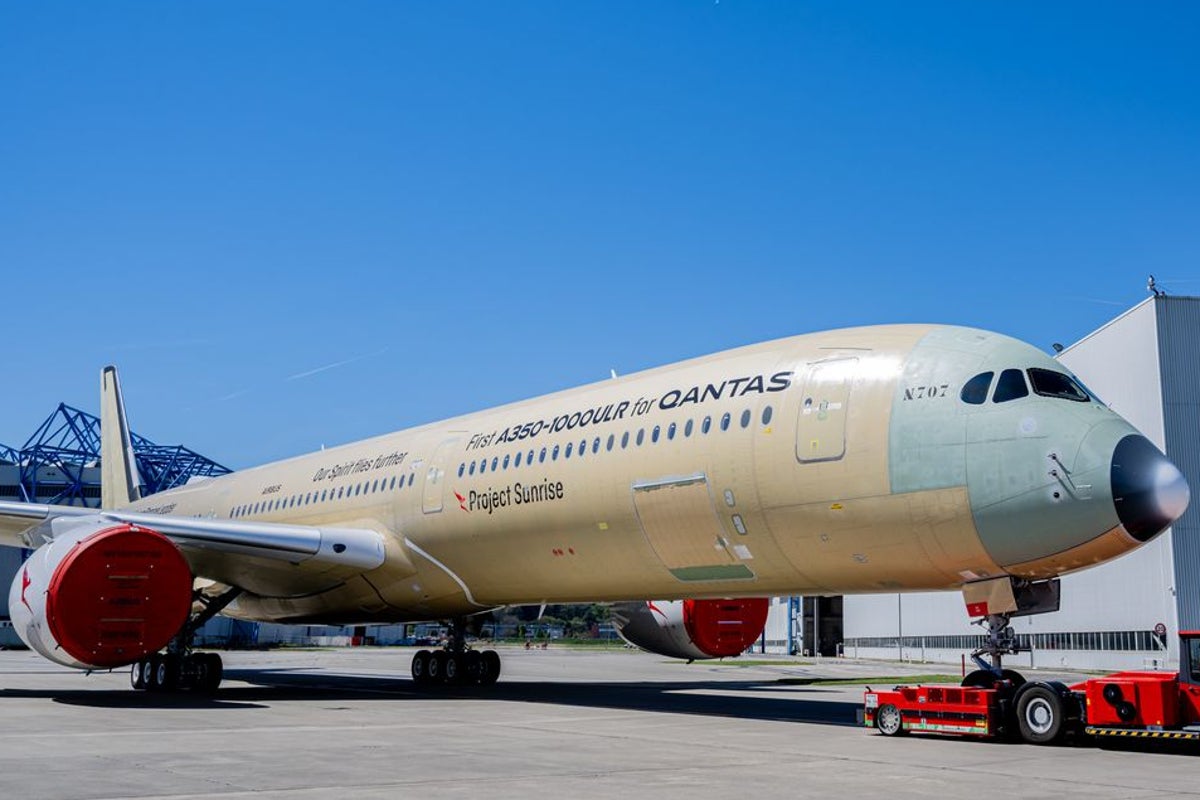
Test flights are about to begin for the longest range passenger aircraft in history.
Qantas of Australia has ordered 12 specially designed Airbus A350s fitted with Rolls-Royce engines for its “Project Sunrise” plan for nonstop flights between London and Sydney. The first plane is currently at the Airbus factory in Toulouse, southwest France.
Qantas says: “All major structural components [are] now fitted including the fuselage, wings, tail, landing gear and engines.”
The plane has an additional 20,000-litre rear centre fuel tank that will make 22-hour Project Sunrise nonstop flights possible.
A dozen A350s have been ordered to allow the Australian airline to start flying “from the East Coast of Australia to London and New York”. Heathrow to Sydney is widely expected to be the first route – covering a distance of over 10,500 miles.
The new flights will cut up to four hours off total travel time compared with one-stop services today. The aircraft will be fitted with 238 seats, less than half the possible maximum – offering a combination of more space and less weight.
Qantas has confirmed the Project Sunrise fleet will be named after stars. The airline did the same during the Second World War when the airline’s Catalina flying boats were named after celestial bodies used to chart the route across the Indian Ocean.
The Australian airline said its nonstop flights between Europe and Australia are proving extremely popular among passengers.
With the UK Foreign Office still warning against changing planes in the key Middle East hubs of Dubai, Abu Dhabi and Doha, air fares have been soaring for trips that avoid the Gulf.
One-way economy flights on the original nonstop London Australia route between Heathrow and Perth have reached £2,000 – about three times the usual fare at this time of year.
Environmentalists say the nonstop flight will increase damage to the enviroment, because so much fuel will be used to carry fuel for later in the journey.
The least damaging way to fly between London and Sydney is with two intermediate stops, breaking the journey into three sectors of 3,500-4,000 miles. Despite the increased fuel burn during take-off, adding en route stops makes the overall trip more fuel-efficient.
Read more: British Airways drops key Middle East route and cuts flights from Heathrow to Dubai, Doha and Tel Aviv