

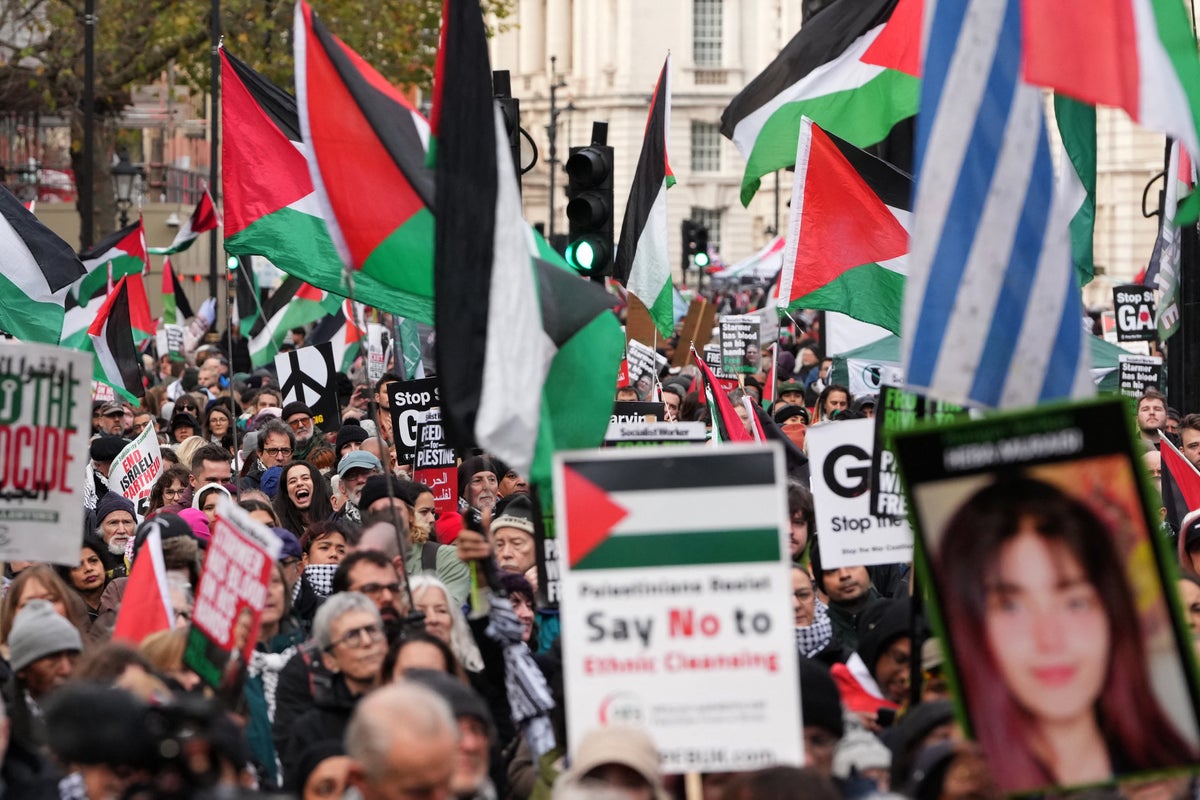
Sir Keir Starmer was careful to distinguish between antisemitic slogans and the right to protest against the actions of the state of Israel when he was asked about calls to ban pro-Palestinian marches.
Jonathan Hall, the government’s independent reviewer of terrorism legislation, called this week for a “moratorium” on such marches because it is “impossible” for them not to incubate antisemitism.
Chief Rabbi Sir Ephraim Mirvis also called for a temporary ban, saying that they had contributed to a “tone of Jew hatred” in Britain.
The prime minister said in an interview with the BBC that he wanted tougher policing of language used during marches, and that he was worried about the “cumulative” effect of repeated marches on Jews’ fears for their safety. He also said there could be instances where it is appropriate to stop some marches from happening, although he was cautious about a more widespread ban.
He singled out the slogan, “globalise the intifada”, which like the phrase “from the river to the sea”, about which there has previously been controversy, is capable of various meanings.
Intifida literally means “uprising”, and usually refers to the violent resistance of Palestinians to Israeli rule. For many of those marching in support of the Palestinian cause, the slogan is a call to mobilise worldwide through boycotts and sanctions to put pressure on the Israeli government and those of its allies.
But for a minority it is a call to violence against Israeli interests and anyone perceived to be complicit with them, including ill-defined “Zionists”, a term often used interchangeably with Jews.
Sir Keir is right to say to anyone on a march who hears the slogan: “You do have to stop and ask yourself, why am I not calling this out?” And he is right, without interfering in operational decisions for the police, to suggest that the slogan should be regarded as potentially intended to stir up racial hatred and therefore is a potentially arrestable offence.
But he is also right to be very careful about banning marches absolutely. He said he would “defend the right of peaceful protest very strongly and freedom of speech”, and so he should.
It is his responsibility as prime minister to strike the right balance between allowing free speech while also clamping down on incitement to racial hatred. That ought to mean more robust policing of the slogans used on these marches. It may mean imposing greater restrictions on where marches are allowed or allowing only static protests because they are easier to police. And it certainly should mean preventing harassment in the guise of protest that has been allowed to occur outside the Palace of Westminster in recent days.
But what it must not mean is restricting the right of citizens to express their opinions about the Middle East or anything else.
In defending the right of free speech, however, we could do without Zack Polanski, the Green Party leader, accusing the prime minister of “using the pain and fear of Jewish people to threaten further authoritarian restrictions on peaceful protest”.
The idea that Sir Keir is exploiting the distress of Jews to restrict the right to protest for unknown reasons is offensive, conspiratorial and silly. After Mr Polanski’s comments on the arrest of a man with a knife in Golders Green, for which he has apologised, fewer interventions for the time being would be welcome.
Let the prime minister and the police grapple with the serious question of where to draw the line between free speech and stirring up racial hatred without heckling from that quarter.