





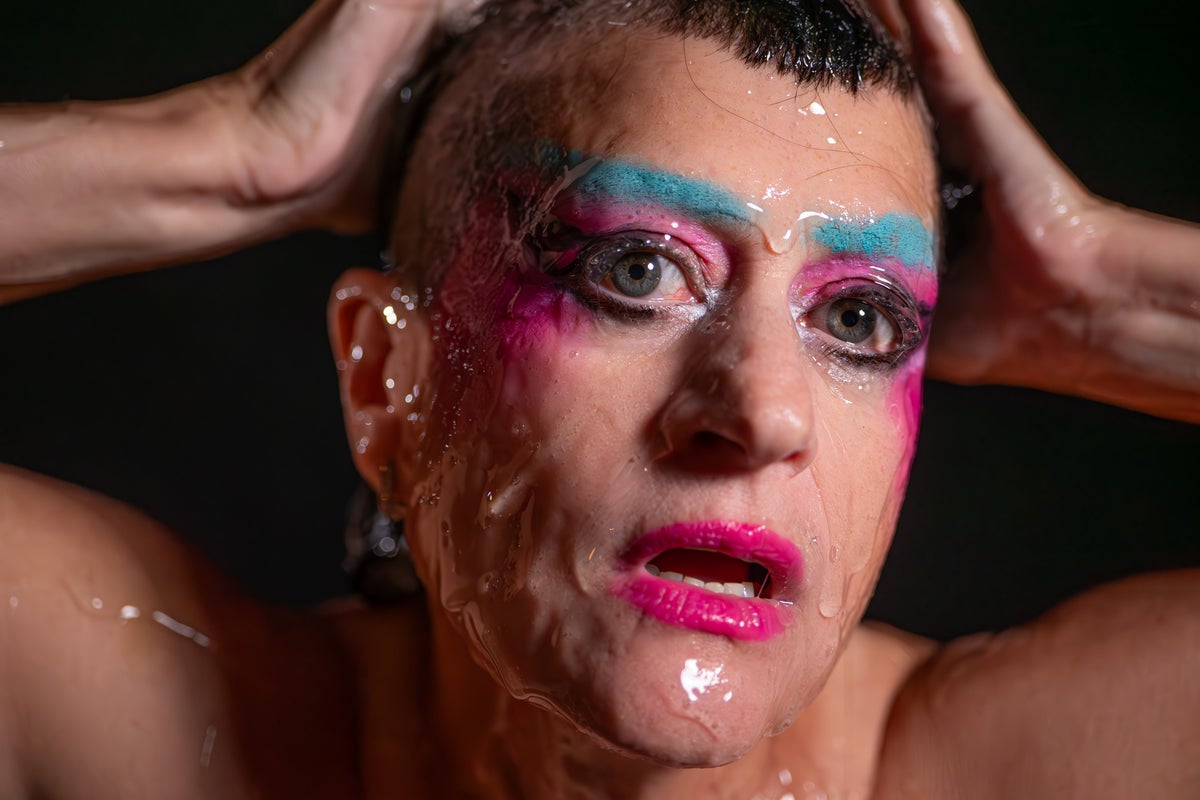
On a rain-sodden afternoon in Soho, the Canadian musician known as Peaches finds herself stunned – no small thing, given that she’s made a career out of shocking others. For more than 30 years, Merrill Nisker has been titillating fans and taunting critics with electroclash hits such as “F*** the Pain Away” and her sex-positive, avant-garde gigs. After all, what’s a Peaches show without a giant flying vagina?
Still, the scene we stumble upon together is enough to give even her pause. “I don’t think that man is alive,” Nisker whispers as we slink past an elderly gentleman on the staircase. “I’m going back up to check… hello?” She approaches him cautiously. He doesn’t move a muscle. Nisker is right: that man isn’t alive, rather he is a life-size, hyperrealistic sculpture. “Whoa…” mutters Nisker under her breath, shaking her mottled mullet in astonishment.
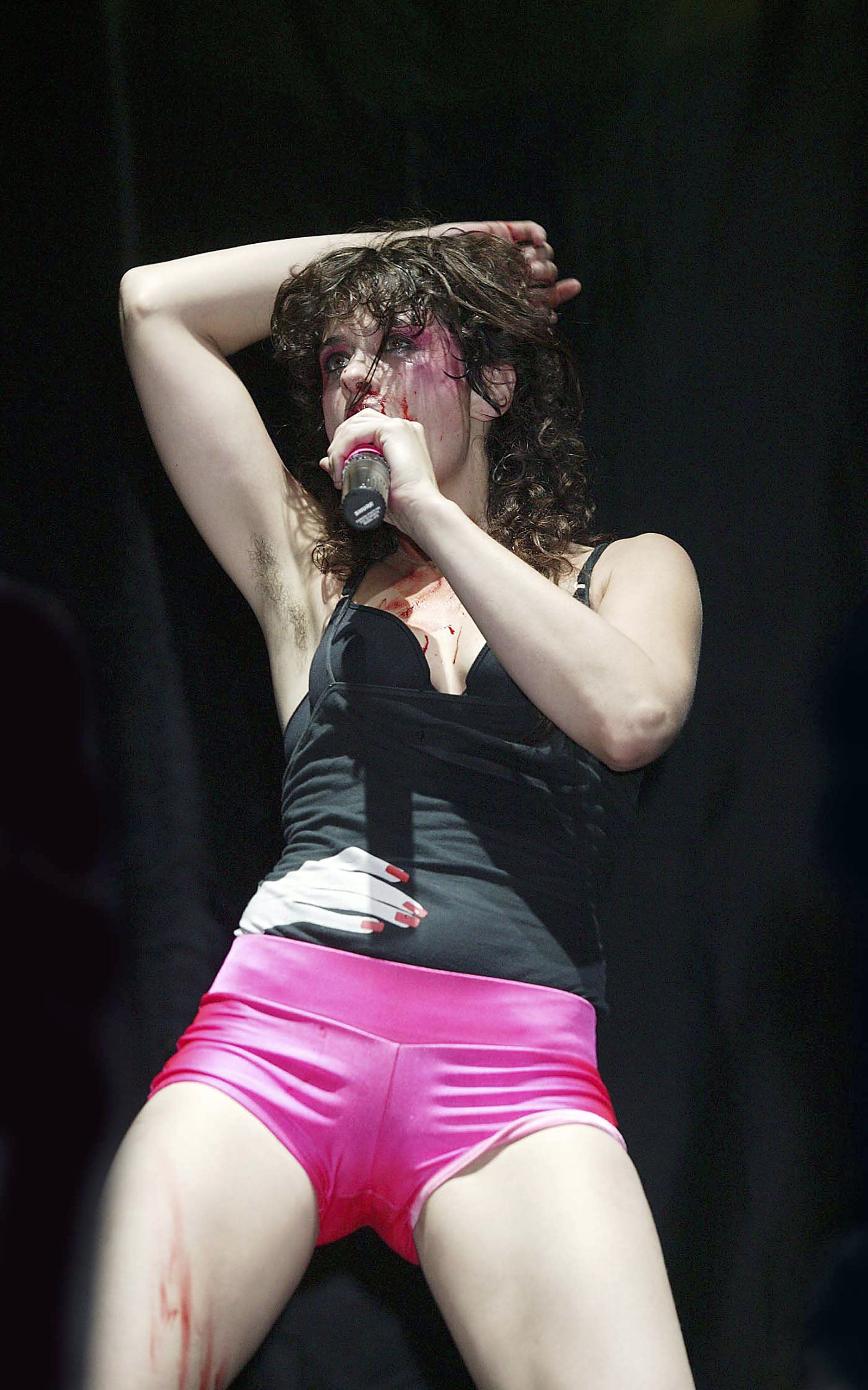
It’s a look that Nisker, now 60 and living in Berlin, is very familiar with. She’ll look into the crowd at her gigs and see raised eyebrows, agape mouths, and eyes blown wide by the sight of her onstage in fishnets, pubic hair on show, as she spits lyrics about gender-bending sex positivity while wearing a prosthetic penis. “I’ve become so comfortable pushing the envelope, it feels like that’s my essence,” she tells me. “Now there isn’t any other way. Sometimes I think, ‘Oh, did I push it enough?’”
She memorably pushed the envelope with her 2000 debut Teaches of Peaches, its title a play on her past life as a schoolteacher. Rooted in Eighties synth-punk sounds, the record was spectacular for its audacity. Released between 2003 and 2015, Nisker’s subsequent albums – Fatherf***er, Impeach My Bush, I Feel Cream, and Rub – expanded her sonic palette while sharpening her voice on matters of war, reproductive rights, gender constructs and queer desire.
Those political concerns are louder than ever on No Lube, So Rude. Many of the tracks stay true to her earlier sound, that brash, bratty mix of electronic, dance and punk, but there is also a conscious effort to move forward. The production is a little more turned up (if you can believe it) and encompasses live sounds – even a horn section.

It’s her first album in a decade – which isn’t to say that she has been hibernating. Far from it: she’s performed a solo rendition of Jesus Christ Superstar, playing all eight roles herself; written and toured an electro opera; appeared in a fashion film directed by John Malkovich; and performed Yoko Ono’s signature performance artwork Cut Piece so superbly that the artist herself said it “will never be performed again with such eloquence”. Through it all, Nisker has remained remarkably consistent, steadfast in those same ideas she was espousing in her twenties.
“It’s funny because at the beginning people called me a one-trick pony, but this isn’t a trick, it’s a way of life,” she says, having to raise her voice over the coffee machine cacophony of the busy London deli we’ve taken refuge in. “It’s politics and it’s something we need to focus on now more than ever.” For someone so bold and blunt in her music, Nisker is shockingly soft-spoken in person – just another way she defies expectation, I suppose.
Already out is the album’s lead single “Not In Your Mouth None of Your Business” – a declaration of bodily autonomy built around an unyielding electronic pulse and Nisker’s signature deadpan delivery. “I wish it wasn’t a protest song but it is,” she says. “This whole conversation around who gets to define what a woman is… Listen, if they say they are a woman, they are a woman. If they say they are a man, they are a man. They are whoever they say we are, and we need to respect that.” A chunk of the profits from her forthcoming tour, including a show at The Great Escape sponsored by The Independent this summer, will go to the Trans Funding Project.
I wonder whether Nisker herself, who has upended gender norms and espoused fluidity for as long as I can remember, ever feels drawn to pronouns that aren’t she/her. “I’m not concerned with it,” she shrugs. “I could be called ‘they’ and I would be fine with that too. But personally, and I guess it’s because I grew up in a different time, it’s not as important to me – but I understand why it is for others.”


Enjoy unlimited access to 100 million ad-free songs and podcasts with Amazon Music
Sign up now for a 30-day free trial. Terms apply.
Try for free
ADVERTISEMENT. If you sign up to this service we will earn commission. This revenue helps to fund journalism across The Independent.
Enjoy unlimited access to 100 million ad-free songs and podcasts with Amazon Music
Sign up now for a 30-day free trial. Terms apply.
Try for free
ADVERTISEMENT. If you sign up to this service we will earn commission. This revenue helps to fund journalism across The Independent.
Ten years on from her last album, she finds, “I don’t give as much of a f*** any more. I’m just going to say the s*** that I want to say and slip in all my ideas about what’s going on in the world.” While she’s never been one to mince words, she finds herself speaking up more about ageism, something she has encountered since the earliest days of her career. Back in 2001, NME ran a review of one of her first UK gigs with the title, “Grandma, you’re scaring the kids.” Nisker was 33 at the time.
“We’re only now really understanding there’s life for older women,” she says, pointing to the many different generations of fans she sees at her concerts. “People are not what you think. It’s a lot of 50 and up. They want to go out! They want to go out more than the younger ones. Gen Z just wants to stay home.”
And as for the NME review, she was unbothered. She’s dealt with worse. Like when she opened for Marilyn Manson on tour in 2003: “His fans would spit on me. I wanted to cry,” she says. On what it was like touring with Manson, who has since been accused of sexual abuse by multiple women (he denies the allegations), Nisker says she wasn’t aware of any wrongdoing. “I know how it sounds to say ‘I didn’t see anything,’ but I was too busy,” she says. “We were in our van and they were on their tour bus doing whatever they do.” She and Manson didn’t spend time together: “He’d pat me on the head and say, ‘Go get ’em,’ but I did not want to hang around them.”

.jpeg)
It’s funny to think that Nisker’s first proper foray into music, relatively late in her twenties, was as part of a folk trio with a whimsical name, Mermaid Café. That said, their cult hit song “Gabey and Mike” was about two boys in love so, in a way, it was very Peaches indeed.
In 1995, Nisker released an album under her own name, Fancypants Hoodlum, which came and went. “Then I developed my own band,” she says. “We all came from a bit of a disgruntled place and we just decided to throw it all away, smoke lots of weed and say a lot of sexual s***, whatever came to our minds. It really set me free creatively and it connected with people.” Behind the scenes, though, Nisker had been diagnosed and treated for thyroid cancer – something she only disclosed to the public much later. “I wasn’t interested in using any of that to get attention,” she explains. “What was important to me was the actual message of my music getting through on its own, so it’s only in retrospect that I started talking about it.” She lets out a little exhale. “Really, thyroid cancer is the luckiest cancer but at the time, it just shifts your head into thinking about immortality and intention. That’s what it did for me.”
The diagnosis prompted Nisker to break up with her husband – and also to go solo and record Teaches of Peaches, which is in its own way a break-up album. Ostensibly, it’s a record of party songs but as Nisker reminds me now: “People can party because they have a lot of pain.”

-Photo-Credit_-The-Squirt-Deluxe.jpeg)
In the year 2026, a Peaches song may not seem as scandalous as it once did – not because she has dulled her edge or lengthened her hot pants (if anything, they’re even shorter) – but because gradually she has bent the mainstream to her will. Nisker points to artists like Billie Eilish and Chappell Roan, who have achieved No 1 hits with songs explicitly about their queerness. “I love that all these huge pop stars are openly, lyrically queer,” she says. “Sometimes it doesn’t come off as authentic with other people… but it’s better than hiding.”
Nisker’s infiltration into the mainstream has no doubt been helped by her participation in pop culture’s biggest moments. Her songs have soundtracked Mean Girls, Lost in Translation, 30 Rock, The Handmaid’s Tale, The Simpsons, South Park, and Sex Education. But her greatest achievement remains the transformative magic that happens in the room of a Peaches concert. The transgender actor Elliot Page once reminisced about how seeing Nisker live changed his life as a teen: “She stands tall and she is fearless. That is my definition of a hero, heroine, progressive, icon – locked in, and ready to rumble.”
But Nisker’s reputation for being fearless is misplaced, she tells me. “I fear. I fear for the world. I fear for our future. But I want to be of service and express that it’s OK to be who you need to be, even though it’s tough and it’s not easy.” There’s a lot of friction in life, she says, hence the title of her new album. “There’s an idea that lube is for menopausal women or whatever, but lube is actually for everybody!” she says, suddenly impassioned. “We should think of it as something to carry with us the same way we used to carry dental dams or condoms. You know, bring the lube!” The world’s rough enough as it is.”
‘No Lube, So Rude’ is out on Kill Rock Stars on 20 February


.JPG?width=1200&height=800&crop=1200:800 "Orphaned injured baby mountain lion rescued and will be raised at California zoo – UK Times")