


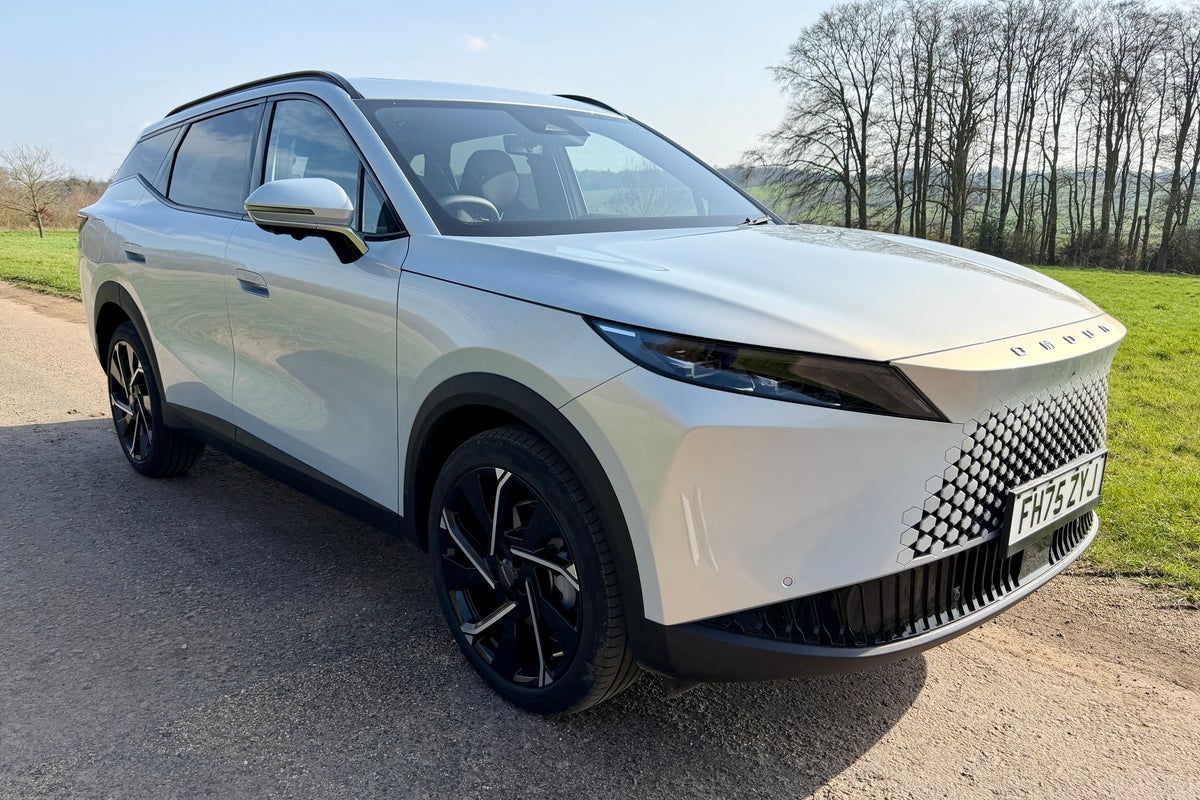
The Omoda 7 sits in an interesting place within Chery’s growing UK lineup. It shares plenty with the Jaecoo 7 underneath, yet the positioning is very deliberate. Where Jaecoo leans into a more traditional SUV look – with more than a hint of Range Rover about it – Omoda is pushing a more futuristic, design-led identity. The company’s “drive a new future” tagline is apparently aimed at modern, trend-savvy, eco-minded buyers who want something that stands out in the supermarket car park rather than blends in.
The Omoda 7 is 4.66m long, making it 160mm longer than the Jaecoo 7 – but the differentiation is more visual than dimensional. Up front there’s an X-shaped signature graphic that I completely missed, while the hexagonal detailing within the borderless grille is more of a standout statement.
Crucially, though, Omoda hasn’t gone overboard with lighting theatrics. As Omoda designer Michael Duerr put it: “We don’t want a Las Vegas show.” That restraint is welcome; it’s modern without being gimmicky. Around the back, the zigzag lights and thick black surround around the rear window give it a distinctive look.
Price is central to the pitch. Omoda quotes an average retail price of £41,410 for PHEVs in this sector. The Omoda 7 SHS Knight undercuts that massively at £32,000, while the better-equipped Noble I drove comes in at £35,000. There’s also a petrol-only version from £29,915, meaning the step up to the plug-in hybrid is £2,085. On paper, then, the Omoda 7 is offering a lot of size, tech and electrification for the money.
How we tested
I spent a day with the Omoda 7 plug-in hybrid driving on familiar roads around Buckinghamshire and Oxfordshire. They ranged from bumpy country lanes to fast-flowing A-roads and a long blast down the M40 motorway. I checked on all the things most important to buyers of family SUVs, including the space on offer in the back and the usability of the boot, while the on-board tech also got a thorough test – including the Sony audio system.


Independent rating: 7/10
- Pros: Impressive total range; generous standard equipment; competitive pricing; large boot
- Cons: Fidgety ride quality; vague steering; mixed interior plastics; disappointing Sony audio
Omoda 7 SHS specs
- Price: from £32,000
- Battery size: 18.4kWh
- Maximum EV range: 56 miles
- Engine: 1.5-litre four-cylinder engine
- Claimed battery and engine range: 745 miles
Battery, range, charging, performance and drive
The Omoda 7 SHS uses the Chery Group’s familiar Super Hybrid System. It pairs a clever and efficient 1.5-litre petrol engine with an 18.4kWh battery and a dedicated hybrid transmission featuring a dual-motor architecture. One motor primarily acts to power the car, the other works with brake regeneration to recharge the battery. The whole system can operate in series, parallel or pure electric modes depending on speed, load and battery state. Total output stands at 201bhp.


Omoda claims up to 56 miles of electric-only range and a total combined range of 745 miles. In a class where anything north of 40 electric miles is considered decent, 56 miles is genuinely useful. For many drivers, that means the daily commute, school run and evening errands can be completed for a couple of days without the petrol engine firing up at all – provided you charge it regularly.
Technically, the system is sophisticated. There’s intelligent thermal management, advanced combustion control and fast electronic switching between power sources. In everyday use, that translates into a drivetrain that feels smooth and well integrated. Around town the Omoda 7 glides along quietly on electric power, and even when the petrol engine joins in, the transitions are largely seamless. It feels modern and impressive from a powertrain perspective.
However, the driving experience is let down by the chassis. The ride quality is probably the biggest disappointment. It’s never harsh enough to be genuinely uncomfortable, but it’s persistently fidgety. Even on smoother motorway surfaces there’s a constant underlying movement that stops it from feeling truly settled. On poorer roads the suspension seems busy, transmitting more bumps through the cabin than you’d expect from a family-focused SUV.

Tyre noise is also noticeable at speed, which chips away at the refinement you’d hope for in a plug-in hybrid that can run silently on electric power at lower speeds. The steering is light and, if I’m honest, a bit vague. It doesn’t inspire much confidence or connection, although for the majority of buyers in this segment that’s unlikely to be a deal breaker. This is not a sports SUV, and it doesn’t try to be one. The hybrid system is the real highlight, delivering the efficiency and smoothness that justify choosing SHS over the petrol-only model.
Interior, practicality and boot space
Step inside and you’re met with a contemporary layout dominated by a wide horizontal dashboard design and a 15.6-inch central touchscreen. In front of the driver sits a smaller 8.88-inch digital display. It’s all clean, modern and instantly familiar if you’ve sat in other recent Chinese SUVs.

Material quality is a bit of a mixed story. Everything in the top third of the cabin feels genuinely impressive. The surfaces are soft to the touch, and the vegan leather upholstery is convincing enough that you’d struggle to tell it apart from the real thing. The design looks premium and, at first glance, you could easily believe this is a car costing several thousand pounds more.
Look lower down, though, and the picture changes. In the lower two thirds of the cabin, particularly around the glove box and lower door trims, the plastics become noticeably cheaper. It’s a clear contrast and slightly undermines the strong first impression created by the upper dashboard.
The Noble model is generously equipped. You get heated and ventilated front seats, a panoramic roof, multicoloured ambient lighting with a claimed 256 settings, and even a fragrance system. The gaming-inspired front seats are comfortable and a noticeable improvement over earlier Omoda and Jaecoo efforts. They provide good support over longer journeys.
Rear space is decent rather than class leading. I can sit comfortably behind my own driving position, but knee room isn’t exceptional. The integrated headrests in the front seats restrict forward visibility from the back, and the rising window line means the view out isn’t as open as in some rivals. The panoramic roof does help prevent it feeling gloomy.
The rear screen is quite letterbox-like, and I’d personally trade some of the surrounding black trim for a little more glass – rear visibility isn’t great, but at least a good camera system supports the all-round view. I’d have preferred the steering wheel to feature a bit more adjustment, too – I felt it needed to come a little closer to me.

Boot space is one of the Omoda 7’s real strengths. You get 639 litres with the seats up and 1,417 litres with them folded – considerably more than in the Jaecoo 7. The load floor is flat from the sill with no awkward lip, and there are useful storage wells either side. For family duties, holidays or bulky loads, it’ll make life easy.
Technology, stereo and infotainment
Technology is clearly a big part of the Omoda 7’s appeal. The 15.6-inch central touchscreen is bright and generally responsive, and it feels like an evolution of previous systems from the brand. Wireless Apple CarPlay and Android Auto are standard, which will be a key feature for many buyers.

However, the ergonomics aren’t perfect. The screen sits slightly low in the dashboard, and the steering wheel obscures part of the right-hand edge. If you’re using Apple CarPlay, which places icons down that side of the display, they can be partially hidden. It’s a small thing, but one you notice daily. There’s also the occasional need for a second tap on the screen to register an input, which slightly dents the premium feel.
Below the infotainment is a row of physical shortcut buttons for drive modes and key climate functions, which is welcome in a world increasingly dominated by touch-only controls. There are two spaces to hold smartphones, one powered and one not, plus generous central storage with a sliding knurled metal cover that adds a touch of class.
The Sony audio system, though, is underwhelming. Despite the badge, it struggles to deliver a balanced sound. There’s plenty of bass and plenty of treble, but the mid-range feels hollow, meaning vocals and instruments can get lost in the mix. It’s usable, but it’s not a standout feature.
On the safety side, the Omoda 7 includes 19 advanced driver assistance systems and up to eight airbags. As with many modern systems, some drivers may find certain alerts overly enthusiastic, but the breadth of technology is competitive for the price.
Prices and running costs
Pricing is one of the Omoda 7 SHS’s strongest arguments. With the Knight starting at £32,000 and the Noble at £35,000, it significantly undercuts the £41,410 average PHEV price in this segment quoted by the brand. That gap alone will attract buyers who want plug-in hybrid capability without stepping into premium-brand territory.
The claimed 56 miles of electric-only range is a key part of the running cost equation. If you charge regularly at home, where electricity is cheaper than petrol on a per-mile basis, many short journeys can be completed without using fuel. Over time, that has the potential to reduce overall running costs, particularly for drivers who predominantly cover urban or suburban miles.
The petrol-only version at £29,915 provides a lower entry point, but the £2,085 premium for the SHS brings significantly more flexibility, lower CO2 emissions and the ability to run as an EV for much of the week. For company car drivers in particular, the plug-in hybrid’s lower emissions should translate into lower benefit-in-kind tax compared with the petrol model.
Servicing and long-term ownership costs will inevitably be under scrutiny given the relative newness of the brand in the UK, but on pure purchase price and fuel saving potential alone, the Omoda 7 SHS makes a compelling financial case.
The verdict
The Omodo 7 makes a strong impression. A 745-mile combined range, 56 miles of electric driving and a price comfortably below the segment average are all persuasive arguments. The hybrid system itself is smooth, efficient and technically impressive.
But the overall package isn’t quite as cohesive as the numbers suggest. The ride quality never fully settles, the steering lacks precision and some lower-cabin plastics undermine the premium aspirations. In a crowded market – including competition from its own Jaecoo sibling – the Omoda 7 feels like the bold, fashion-forward choice. Whether that’s enough to outweigh its dynamic shortcomings will depend on how much buyers value style and specification over polish.
Geely Starray EM-I rivals
FAQs
How far can it go on electric power?
Omoda claims up to 56 miles of electric-only range and real-world driving suggests more than 50 miles is achievable with a full charge.
How much does the Omoda 7 SHS cost – is it worth it?
With the Knight starting at £32,000 and the Noble at £35,000, the Omoda 7 SHS is a good deal cheaper than what Omoda says the £41,410 average PHEV price is.
Does Omoda replace batteries for free?
Yes. All Omoda models are covered by a seven-year or 100,000-mile vehicle warranty, with the Super Hybrid battery covered for eight years or 100,000 miles
Why trust us
Our team of motoring experts have decades of experience driving, reviewing and reporting on the latest EV cars, and our verdicts are reached with every kind of driver in mind. We thoroughly test drive every car we recommend, so you can be sure our verdicts are honest, unbiased and authentic.
With more than 30 years of experience, Steve Fowler is one of the UK’s best-known automative journalists. Steve has interviewed key industry figures, from Tesla’s Elon Musk to Ford’s Jim Farley, and is a judge for both Germany’s and India’s Car of the Year Awards, as well as being a director of World Car of the Year. When it comes to electric vehicles, Steve reviews all the latest models for The Independent as they launch, from Abarth to Zeekr, and he uses his expert knowledge of car buyers’ needs to provide a comprehensive verdict.

.png?trim=0,0,0,0&width=1200&height=800&crop=1200:800 "Norovirus outbreak on Florida-bound cruise ship sickens 115 passengers and crew – UK Times")