




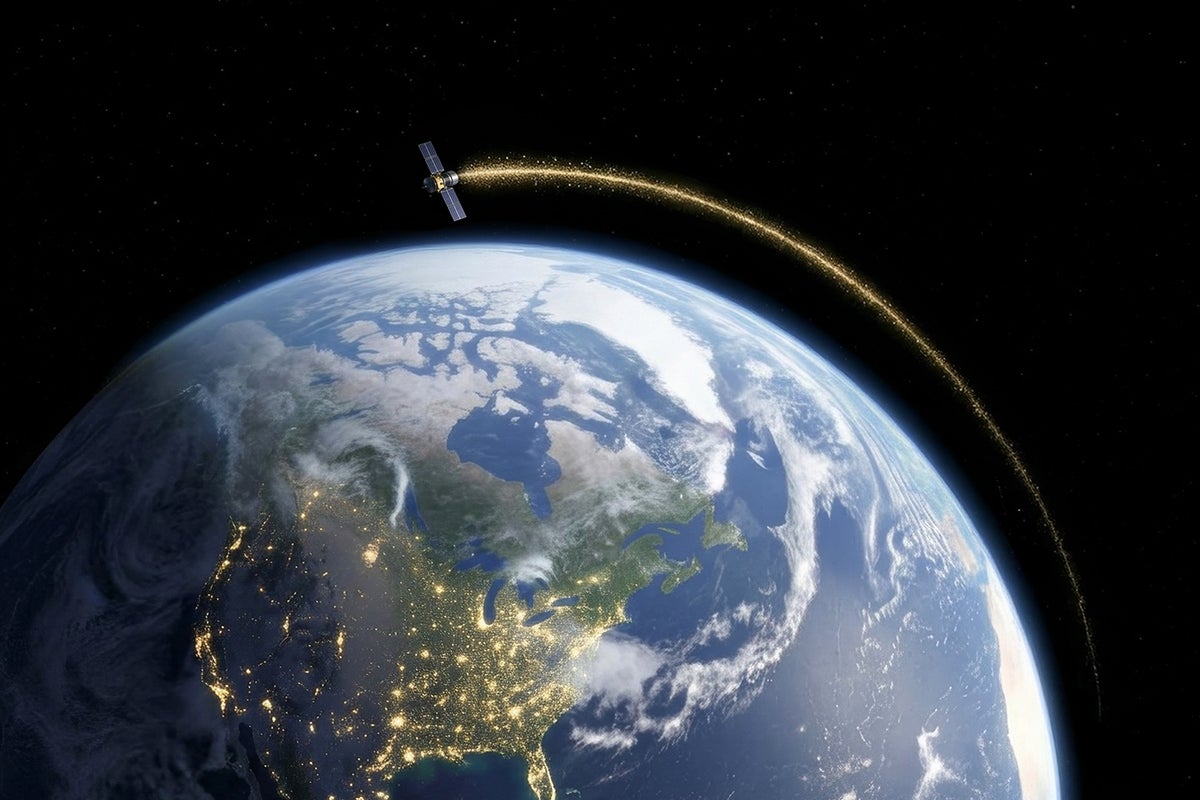
Leading AI chip maker Nvidia has announced plans to help build artificial intelligence data centres into space.
The California-based company said that its new Space-1 Vera Rubin Module will be used by partners for orbital data centres and provide AI analysis for satellite constellations.
Nvidia CEO Jensen Huang said the initiative would “take intelligence where it’s never gone before” through space-based AI infrastructure.
“Space computing, the final frontier, has arrived,” he said. “As we deploy satellite constellations and explore deeper into space, intelligence must live wherever data is generated.
“AI processing across space and ground systems enables real-time sensing, decision-making and autonomy, transforming orbital data centres into instruments of discovery and spacecraft into self-navigating systems.”
Orbital data centres have become a new arena in the space race, with SpaceX and Microsoft also exploring plans to set up operations in low Earth orbit.
Benefits include abundant and free energy, with solar panels in space offering up to eight times more efficiency than those on Earth. They also offer lower latency, with laser links between hubs able to move data around the globe much faster than ground-based cables.
“Nvidia Space-1 Vera Rubin Module delivers high-performance, energy-efficient AI at the edge in orbit, powered by solar energy,” said Baiju Bhatt, founder and CEO of Aetherflux, who have partnered with Nvidia to used its processors in space.
“This enables autonomous operations and mission-critical services, and unlocks scalable, space-based AI infrastructure beyond Earth.”
In a keynote address at Nvidia’s annual GTC conference in San Jose, Mr Huang acknowledged that several technical obstacles still need to be overcome before orbital data centres become a reality.
“We have to figure out how to cool these systems out in space, but we’ve got lots of great engineers working on it,” he said.
Other challenges include protecting computer servers from the huge amounts of radiation exposure in low Earth orbit.
One of Nvidia’s partners that is working on solving these issues is Starcloud, which is building purpose-designed orbital data centres to deliver cloud and AI infrastructure directly in space.
“With Nvidia, we can bring true hyperscale-class AI computing to orbit – processing data at the source, reducing downlink dependency and enabling customers to run training and inference workloads in space for the first time,” said Starcloud CEO Philip Johnston.
“This is a critical step toward making space a seamless extension of the global cloud.”


