

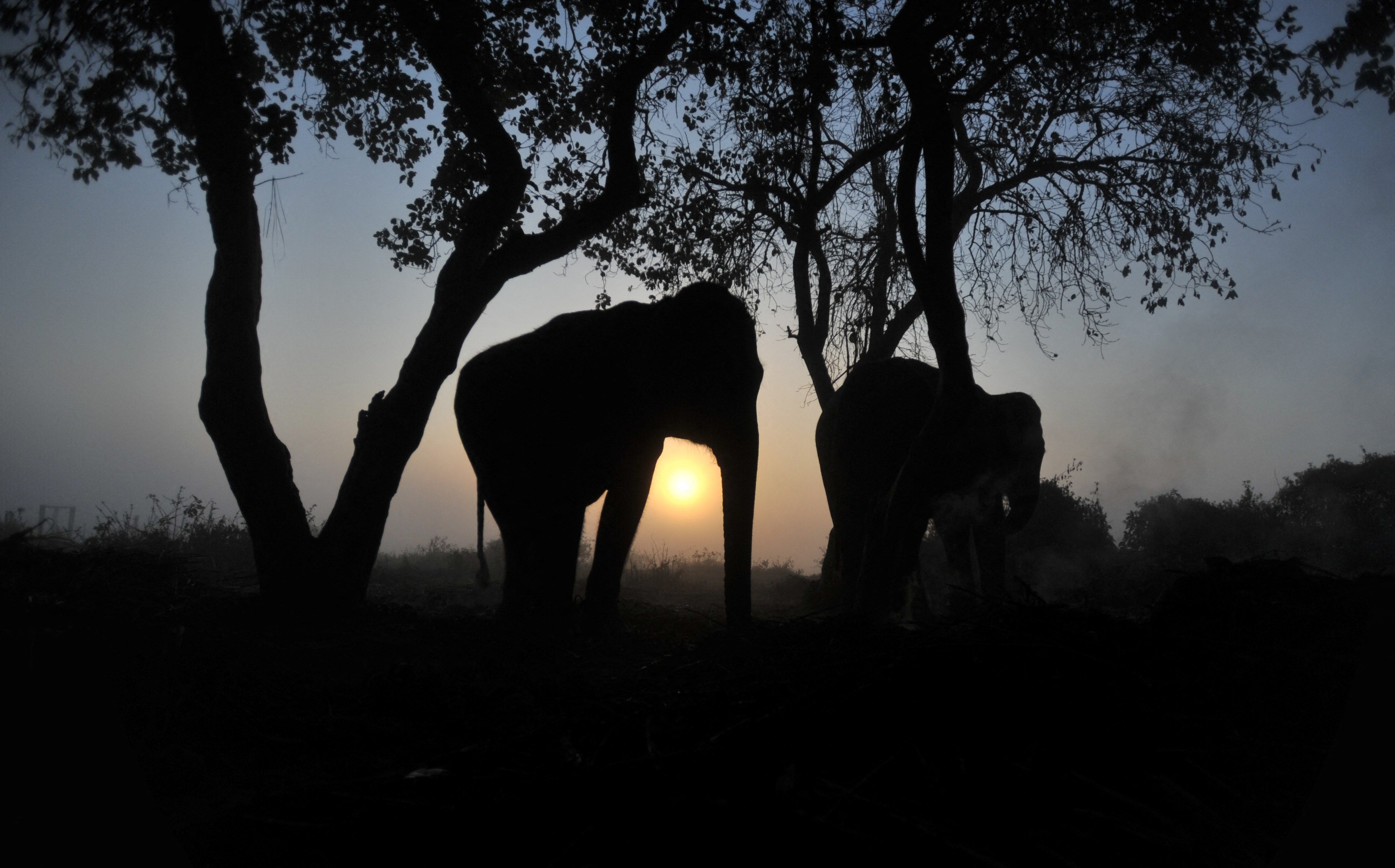
A wild elephant that kept returning to a human settlement in Nepal killed four members of a family over 14 years, prompting questions about wildlife management in a country grappling with growing human-animal conflict.
The animal, known as Dhurbe, killed Shanichara Bote’s parents near the Chitwan National Park in 2012.
Fearing another attack, Mr Bote relocated with his family to the Jagatpur area, crossing the Rapti river and moving several miles away.
But earlier this month, Dhurbe entered their new settlement and killed Mr Bote’s daughter-in-law Ashika Bote, 25, and his four-year-old grandson Bharat Bote.
“We believed that moving across a major river would keep us safe. But after all these years, the exact same elephant found us again, raided our home, and took my daughter-in-law and my little grandson,” Mr Bote told the Kathmandu Post. “There is nowhere left for us to run.”
Abinash Thapa Magar, information officer at the Chitwan National Park, said Dhurbe had killed at least 25 people since 2010, making him one of the most closely monitored problem elephants in the region.
Among Dhurbe’s victims were two military personnel deployed for counter-poaching operations inside the park.
“We’ve been utilising a satellite tracking collar to monitor the movements of this highly aggressive male elephant,” Mr Magar said. “Our data logs show his location coordinates were pinned directly around the perimeter of the incident site on 4 July.”
Experts note that Dhurbe’s behaviour reflects a wider challenge in areas where expanding human settlements overlap with traditional elephant habitats.
Male elephants often leave their herds after reaching maturity. Young bulls can be pushed away by dominant males, and begin living alone on the edges of forests and villages, where encounters with humans become more likely.
Nepal’s Chure-Tarai region has seen increasing overlap between human communities and elephant habitats. The Elephant Conservation Action Plan of 2025-35 found that more than half of potential elephant habitat in the region was outside protected areas.
In the Chitwan area alone, 127 people have died in wildlife attacks over the past 11 and a half years.
After Dhurbe killed Mr Bote’s parents 14 years ago, authorities launched an operation to capture or kill the elephant. They deployed 93 soldiers, who shot Dhurbe twice, and injured him. But the elephant was never found.
He resurfaced in 2016 and was later fitted with a tracking collar. It stopped working, however, and the animal was given a second collar in 2020 and a third in 2023. The tracker sends location updates every hour.
Mr Bote and fellow villagers said Dhurbe had been moving around the settlement for days before the latest attack.
“This animal follows a cyclical path and returns to the villages every year, meaning that his presence is entirely predictable to the park authorities,” Lal Bahadur Dawadi, head of the Ghailaghari Buffer Zone Consumer Committee, told the Kathmandu Post.
During the attack, Mr Bote’s wife reportedly managed to save other members of the family by setting fire to dry thatch near their home, although the house was destroyed in the process.
Mr Bote’s family has nine people now and they say they have nowhere else to go.