


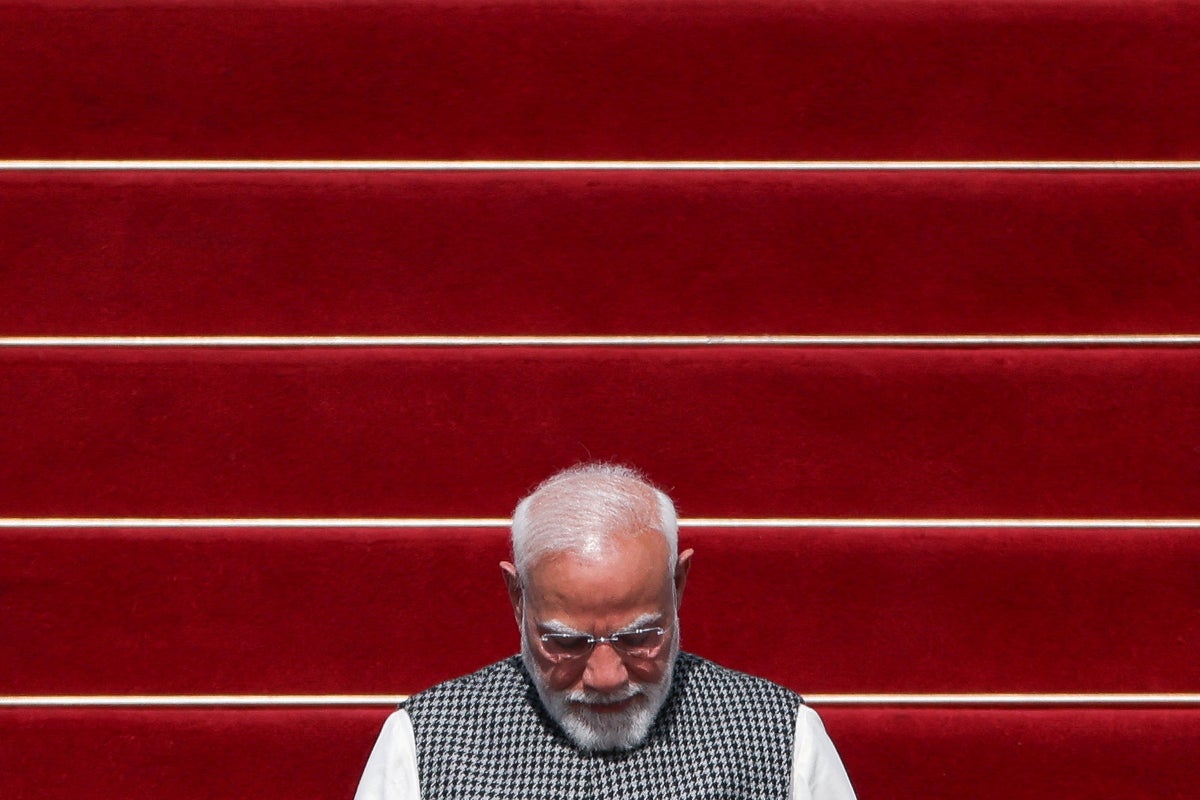
Indian prime minister Narendra Modi compared the defeat of a women’s reservation-linked delimitation bill to “female foeticide”, launching a bitter attack on his political rivals a day after his ruling party suffered a rare setback in parliament.
The Modi government’s plan to redraw India’s parliamentary map was defeated in parliament on Friday after opposition parties blocked a constitutional amendment centred on delimitation, the process of reallocating seats, and redrawing constituencies by population.
The delimitation bill is linked to the implementation of a 2023 law mandating that 33 per cent of all seats in federal and state legislatures must be filled by women. Parliament had unanimously passed the Women’s Reservation Act in September 2023, but its provision for 33 per cent quotas in the Lok Sabha and state assemblies was made contingent on the next census and a subsequent delimitation exercise.
The Constitution (131st Amendment) Bill, 2026, failed to secure the two-thirds majority required for the constitutional change. The defeated package proposed increasing the Lok Sabha, India’s lower house of parliament, from 543 seats to 850, with similar expansion in state assemblies. It also sought to change the legal framework governing when delimitation takes place and which census data should be used.
A total of 298 MPs voted in favour and 230 against the bill.
Addressing the nation, the PM “sought forgiveness” from the women of the country after the bills failed to clear the floor test in the Lower House.
“Every citizen of India is watching how dreams of our women have been crushed,” the prime minister said during his address. “Fight for empowering India’s women has been stalled due to selfish politics of opposition parties,” he added.
Mr Modi compared the opposition’s move to “bhrun hatya” (female foeticide), saying the opposition political parties of Congress, DMK, Samajwadi Party and Trinamool Congress “killed” the idea of women’s reservation at its inception, according to reports. “A woman may forget many things, but she never forgets her insult,” he said.
Opposition parties said they supported women’s reservation, but objected to linking it to a nationwide boundary redraw based on older data while the 2026-27 census is underway. They also argued that using 2011 figures could reduce the relative representation of southern and north-eastern states, where population growth has slowed faster than in parts of northern India.
Critics also warned that one or two larger states could gain greater influence because they would send more MPs to the House.
Leader of opposition, Rahul Gandhi, on Friday targeted the prime minister, calling the proposed bills to amend the women’s reservation bill alongside the delimitation exercise a “panic reaction” to change the country’s electoral map, as he added that the “magician has been caught”.
Mr Gandhi said the bills had little to do with advancing women’s empowerment, as he accused the BJP of being “scared of erosion” of its electoral strength. The government is trying “rejig” country’s political map, he said.
“Some truths need to be told here. This is not a women’s bill; this has nothing to do with empowerment of women. This is an attempt to change the electoral map,” he said.
After the result, federal minister, Kiren Rijiju, withdrew two linked measures – the Delimitation Bill, 2026, and the Union Territories Laws (Amendment) Bill, 2026.
During the debate, home minister Amit Shah defended the overhaul, saying constituency sizes had become highly uneven. Stressing the need for the delimitation exercise, Mr Shah said that in the 543-member House, the number of voters is 4.9 million in some constituencies, while it is at 60,000 in others.
“And there are many seats that were frozen in the 1970s. Since then, they have grown so large that an MP cannot even show face to voters, because how can one handle such a huge population,” he said.
Mr Shah said the freeze dated back to decisions taken under Indira Gandhi’s government and accused Congress of opposing the resumption of delimitation.
In 1976, when India’s population stood at about 550 million, the number of Lok Sabha seats was frozen at 543. The move was meant to ensure that states which reduced birth rates were not punished with diminished representation as the size of constituencies was pegged to population. That freeze was due to end after the 2001 census, but was extended until at least 2026 by the previous BJP government of Atal Bihari Vajpayee.
Slamming the attempts to block the passage of bill, Mr Shah said: “In 1976, during the Emergency, the process of delimitation was formally suspended through the 42nd Amendment, again under Indira Gandhi’s leadership. At that time, the Congress government enacted laws to halt delimitation. Today, even while in opposition, the Congress continues to oppose the resumption of delimitation. Thus, the Congress originally denied the people the benefits of delimitation, and it is the same party that continues to do so today.”
He also rejected what he called a divisive regional framing.
“Let me make this clear once again: the southern states have exactly the same rights in this House as the northern states. In fact, even a small Union Territory like Lakshadweep has the same rights as Uttar Pradesh, Gujarat, and Bihar,” he said.
Mr Gandhi said: “The amendment bill has fallen. They used an unconstitutional trick in the name of women to break the Constitution.”