



If Mad Cool’s name could be distilled to a single gesture, it would be the shaka: that thumb-and-pinkie surfer salute, deployed here without a hint of irony. But move past that and you’ll be rewarded with a lineup this year that is second to none.
The festival opens with Wolf Alice, prize-laden leading lights of a generation whose decade-long mastery of genre-fluid rock is unimpeachable. Fusing pristine melodies to snarling guitar work, the London quartet never disappoint.
Here, “White Horses” careers from psychedelic verse to canyon-wide chorus; “Yuk Foo” is pure serrated punk fury; “Don’t Delete the Kisses” is a shimmer of glistening space pop so gorgeous that it briefly stops time. Playing to a swooning if slightly subdued crowd, Ellie Rowsell is a hugely charismatic presence, her voice pivoting on a sixpence between tenderness and ferocity.
Later, on the main stage, the Foo Fighters grind through their amalgam of classic rock tropes. “Do you love rock and roll music?” Grohl bellows before a chest-thumping “Pretender.” “Do you worship rock and roll?”
Far more interesting is Moby, the New York electronic pioneer and veteran of 23 albums. Flanked by a five-piece band and supported by soulful singers, he ricochets around the stage, thrashing at his guitar. As the sound from Grohl’s stadium behemoth bleeds into Moby’s set, he reveals that they’ve known each other since 1986, when both were cutting their teeth in punk bands.
Finesse has never really been in Moby’s locker – the dial swings between the thunderous and the delicate, with little in between – but tonight it matters not a jot. His set is a blast of adrenaline: “Extreme Ways,” the Bourne films’ pulsating signature, erupts into a drum’n’bass rave, the crowd coalescing as the beat surges; “Porcelain,” from The Beach, is turned into a rousing hit of ecstasy. Meanwhile, the beautiful balladry of “Why Does My Heart Feel So Bad” is accompanied by cute images of drifting cows: that’s Moby, one of music’s most visible animal rights activists, making his convictions impossible to ignore.
Thursday belongs to three powerhouses. First up is CMAT – Ciara Mary-Alice Thompson – whose country-tinged, darkly witty pop ballads have propelled the Irish singer to international renown. With a vocal range that swoops and soars, she holds the crowd in the palm of her hand. “This is physically one of the hardest gigs we’ve ever had,” she tells the crowd in the sweltering heat, “but thank you for making it so easy.”
Then Lorde, making her Madrid debut, arrives twiddling knobs at a bank of synths. The New Zealand singer has been unpicking the awkwardness and longing of adolescence since her 2013 debut, Pure Heroine. The current era, darker and more electronic than anything that preceded it, finds her at her most compelling. For long periods she lies supine, her legs a cyclone; later, she’s in pugnacious mood during the feverish “Buzzcut Season,” throwing punches at invisible enemies. “Missing You” is balmy and intoxicating, with its aqueous synths and sighing refrain. “Supercut” finds intimacy and nostalgia colliding in the night air. The magnificent “Green Light” pops off as the sun finally sets over the city, the crowd genuflecting before their Lorde and saviour.




Enjoy unlimited access to 100 million ad-free songs and podcasts with Amazon Music
Sign up now for a 30-day free trial. Terms apply.
Try for free
ADVERTISEMENT. If you sign up to this service we will earn commission. This revenue helps to fund journalism across The Independent.
Enjoy unlimited access to 100 million ad-free songs and podcasts with Amazon Music
Sign up now for a 30-day free trial. Terms apply.
Try for free
ADVERTISEMENT. If you sign up to this service we will earn commission. This revenue helps to fund journalism across The Independent.
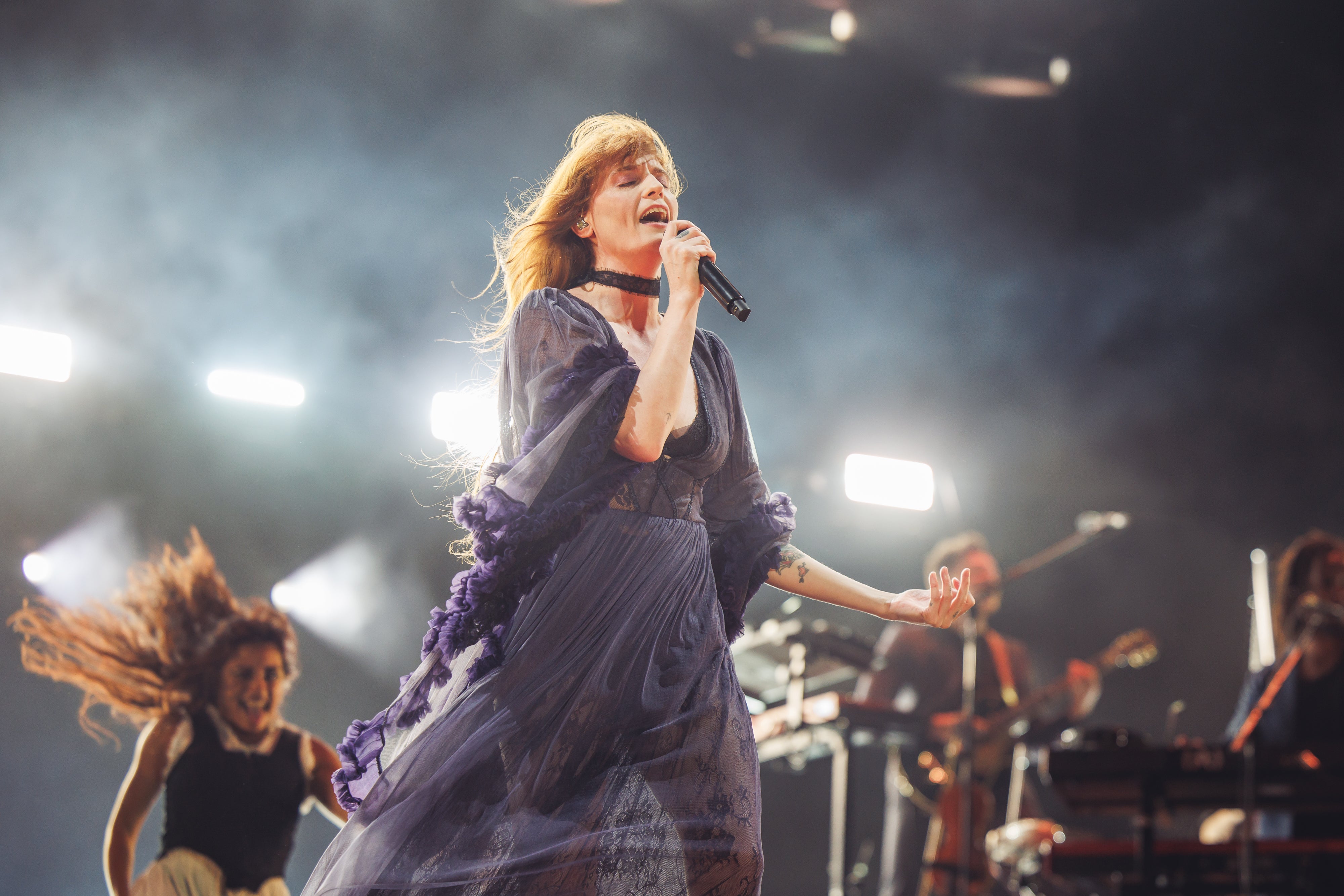
Florence Welch closes the evening with a fusillade of baroque pop that shakes the ground. Something between a high priestess and a woman possessed, Welch is shadowed by dancers coiling and contorting, a coven of implausibly agile witches. As is now customary for her, she persuades 50,000 people to pocket their phones for the rapturous “Dog Days Are Over.” The effect is exhilarating.
If Thursday was all about the women, Friday was dominated by the Pixies, the Boston four-piece whose alternative mythology – steeped in magical realism, biblical myth and surrealist nightmare – helped blueprint the entire rock landscape of the 1990s and beyond. Frank Black, dressed to befit his surname and sipping what appears to be a mug of tea, deploys his voice elastically and unpredictably, mixing up his cadences mid-song. From the Samson legend of “Gouge Away” to the sliced eyeballs of “Debaser” and the jaunty surf-grunge of “Wave of Mutilation”, the set is a masterclass in controlled derangement. “Hey,” a seductive lament about prostitutes, is deviant and gorgeous in equal measure, while on “Vamos” Joey Santiago uses his cap to coax an evil din from his guitar. Finishing with the beatific ballad “Where Is My Mind?” – best known for demolishing a bank of skyscrapers at the end of Fight Club – the Pixies nonchalantly remind everyone why they’re still one of the great live bands, no matter the absence of crowd interaction.
Elsewhere, Kings of Leon drift through their set like men haunted by their own back catalogue. The Nashville four-piece emerged in 2003 as a feral blur of hair, whiskey and southern gothic swagger, before “Sex on Fire” made them a Topman band readjusted for stadium rock. “Molly’s Chambers”, from that hirsute early era, is a reminder of past glories. Sigrid, competing with a live screening of the Spain-Belgium game on an adjacent stage, sounds impeccable as ever – particularly on “Strangers,” her clarion voice slicing through the groaning and whooping of football fans.
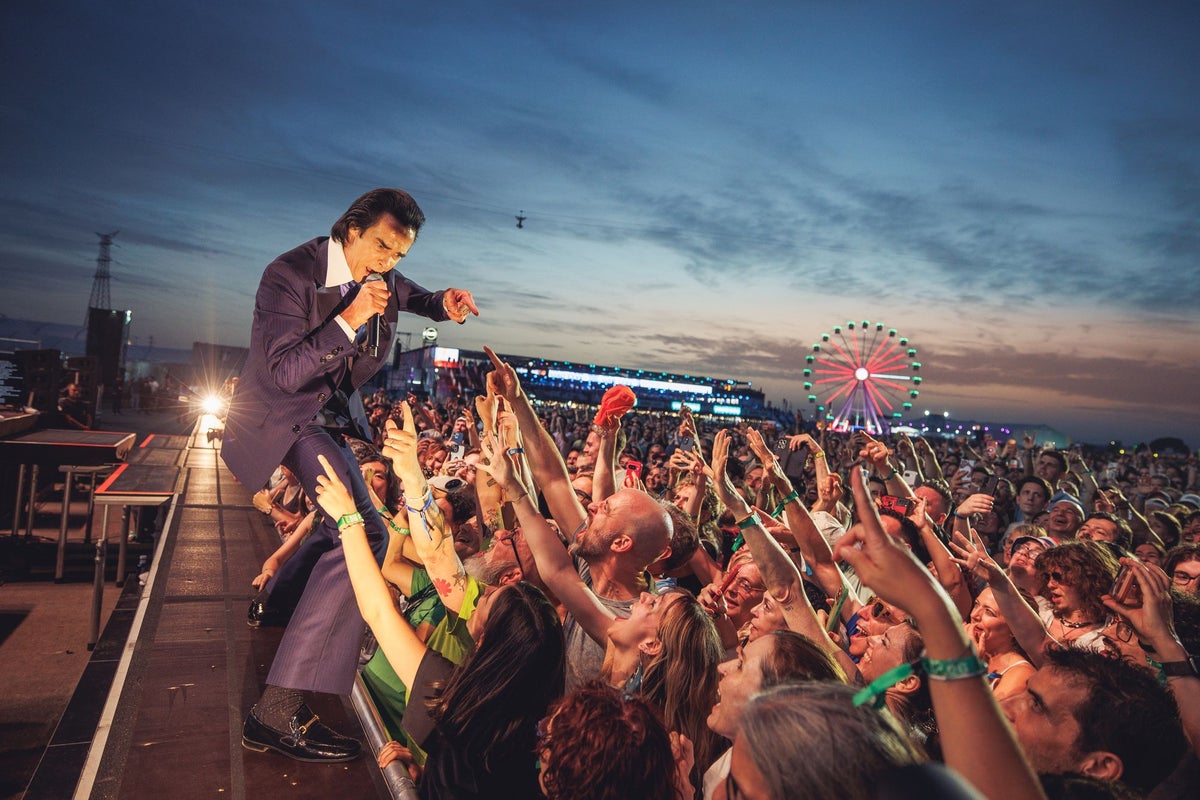
Come Saturday, the crowd for Mad Cool’s 10th anniversary is blessed with a supreme set by Nick Cave & the Bad Seeds. Like a preacher who has spotted a sinner in the front row, Cave hammers out the opening chords of “Get Ready for Love” before launching himself into the crowd – arms flung wide, a shaman pressing his hands to foreheads, working the faithful into a frenzy. Resplendent in a suit and tie, despite the punishing heat, he’s joined by a formidable ensemble, including his lieutenant Warren Ellis, high-kicking on violin behind him.
Few artists can shift between the elegiac and the ecstatic with Cave’s ease. Over two hours, he moves through four decades of material without a single misstep. On “Rings of Saturn”, Cave is undone by lust and wry about it: “I’m spurting ink all over the sheets, but she remains, completely unexplained.” “The Weeping Song,” that mournful father-and-son call-and-response from 1990, draws the crowd into joyful participation. Then “Into My Arms” – hymnal, devastating in its simplicity – closes it. His congregation are in bits.
Clashing with Cave for at least an hour is David Byrne, whose euphoric Talking Heads classic “Once in a Lifetime” has theatricality to spare, the 74-year-old as restlessly inventive as ever. I catch that before Pulp. The Sheffield Britpoppers, whose leader Jarvis Cocker turned awkwardness and class anxiety into art, open with two belters, “Sorted for E’s & Wizz” and “Disco 2000”. Later on, just as the full-time whistle blows on England’s passage to the semi-finals, Cocker bursts into “Common People.” The timing couldn’t have been more perfect.