




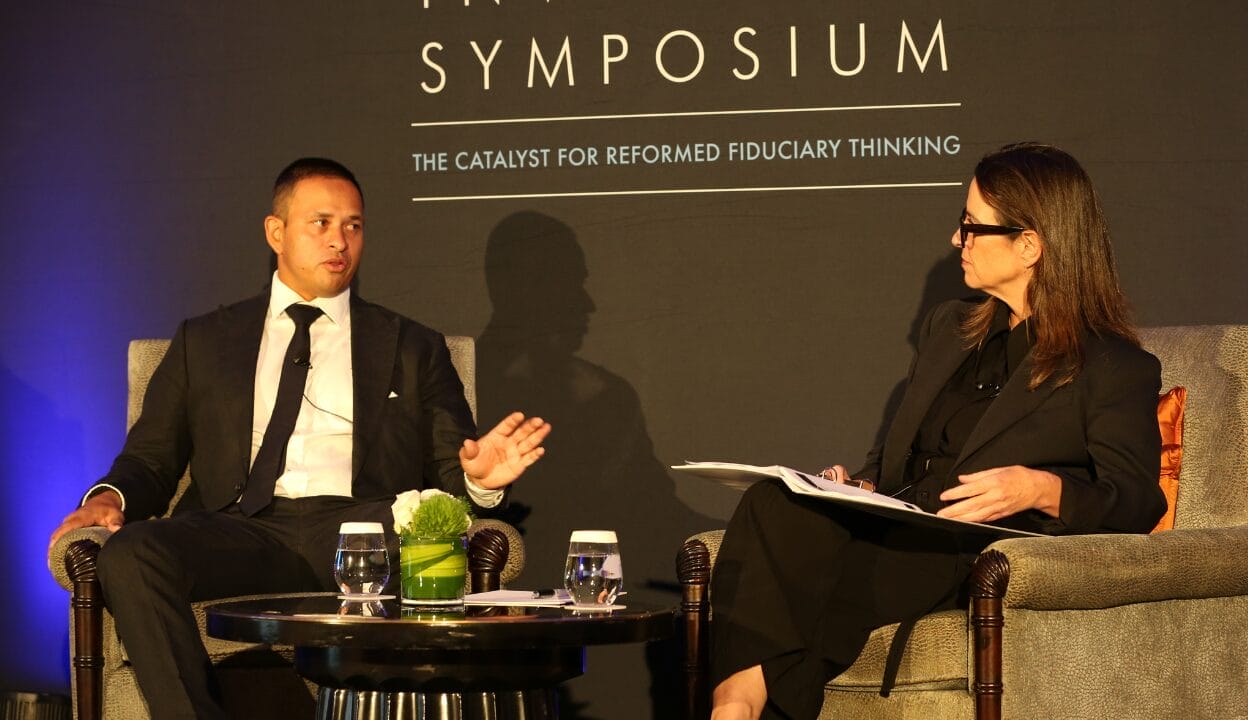
Over the course of a 15-year, 88-test match cricket career, batter Usman Khawaja was dropped from the Australian team no fewer than seven times. But each time, he persevered and fought his way back into the side. His career formally came to an end earlier this year when he played his final test match, fittingly on his home ground of the Sydney Cricket Ground.
Khawaja told the Fiduciary Investors Symposium in Singapore that the keys to success in sport as in any area of endeavour include focusing on the process rather than the outcome and seeking to control only those things you can control; understanding that actions speak louder than words; and fostering strong relationships with those you lead.
“With sport in general, as soon as you stop trying, as soon as you give up, that’s the only time you really lose,” Khawaja said.
“There’s so many failures in cricket in general, you want to try… even when things aren’t going your way, to hang in there. Usually things come up and things get better.”
In conversation with Top1000funds.com editor and Conexus Financial director of international, Amanda White, Khawaja said that as his career progressed, he realised that an outcome is the result of a reliable process, and that focusing on the process is what matters most.
“When I was young, I was all about the outcome: I want to score 100; I want to do this. I used to put down goals and stuff, but I stopped doing that later on because I realised, number one, they boxed me up; and they made me a bit tense too, because I’m like, ‘Oh, I need to get this many runs to achieve my goal’, rather than focusing on what actually matters. And it’s the process.”
Khawaja said the second half of his career was clearly more successful than the first, and that coincided with his starting to rely on his process, and realising it’s pointless trying to control things that can’t be controlled.
“I wanted to control things [over] which I had no control,” he said.
“In cricket, you have no control over the weather, and if it’s an overcast day, it can be very hard to bat. If the wicket’s got a bit of moisture and it’s rained a little bit, it can be very hard to bat. Sometimes the umpire gives you a bad decision, which I have no control over. Sometimes a bowler bowls really poorly, and I get lots of runs.”
Observed actions
Khawaja said that in positions of leadership, actions always speak louder than words. It’s the observed actions of a leader that shape the behaviour of those they lead, rather than what the leader says – especially when those words and actions don’t mesh.
“When people say one thing and do another, you just can’t respect that. And leaders always seem to act, and everyone follows those actions,” he said.
“I’m the same with my [daughters]. I can say anything I want to them, but they see everything we do, and a lot of the actions revolve around what they see us do, consistently on a daily basis.
“The second bit with leadership, which I think is extremely, extremely important for me… was always about creating relationships with those that I was leading.”
Khawaja said that as teammates, everyone was focused on the same objectives, but away from the game, “we weren’t all really friends”.
“As a leader, you can’t be friends with anyone anyway, and you’re not always going to please everyone, but what I did try to do with the people that I wasn’t mates with, who I wasn’t really good friends or close with, [was] I [went] out of my way to give them more time,” he said. Knowing that he would spend more time with the teammates he was friends with anyway, his aim was “all about creating relationships and making sure that I’m getting the best out of those [other] guys as much as I can”.
Typically, the leader of a team has been a high-performing individual – often the highest-performing individual – in the team, and that can’t change once in a position of leadership. A leader cannot allow their personal performance to drop off.
“It’s very hard to follow someone [if] you don’t fully respect them and what they do,” Khawaja said.
“If you look at sport in general, usually the leader is the best player in the team, if not one of the most respected players in the team. There are outliers to this, but your performance is as important as anything else. So, even though you’re a leader, you can’t let your performance drop, because if you do, you’re letting everyone down.”
As he progressed through the ranks of cricketers to establish himself as one of the best in the world, Khawaja said he realised that the players he’d idolised growing up were in truth just like everyone else.
“They seemed so far away, how good they were. They seemed like these supernatural people. But once I met them, I realised they were just people like us, everyday people. And that was really nice to see,” he said.
“They say, ‘Don’t meet your heroes’, and some of the time, that’s true. But meeting your heroes, and they’re humble, and they’re respectful, it’s a really, really cool feeling.”
This has shaped his approach to relationships with teammates and other players, and to fans of the game, while he was a player; and it continues to shape his approach to life now his test career is over.
“I am an immigrant from Pakistan who immigrated to Australia. I’m a Muslim. I’m all these different things, but I’m very much [an] Aussie,” he said.
“And so… I don’t care what religion you are, what race you are, what sexual orientation you are; I don’t care about that. Treat everyone as equals, that’s the motto of my life. And I think if the world did that, it’d be a lot better place, in my opinion.”


