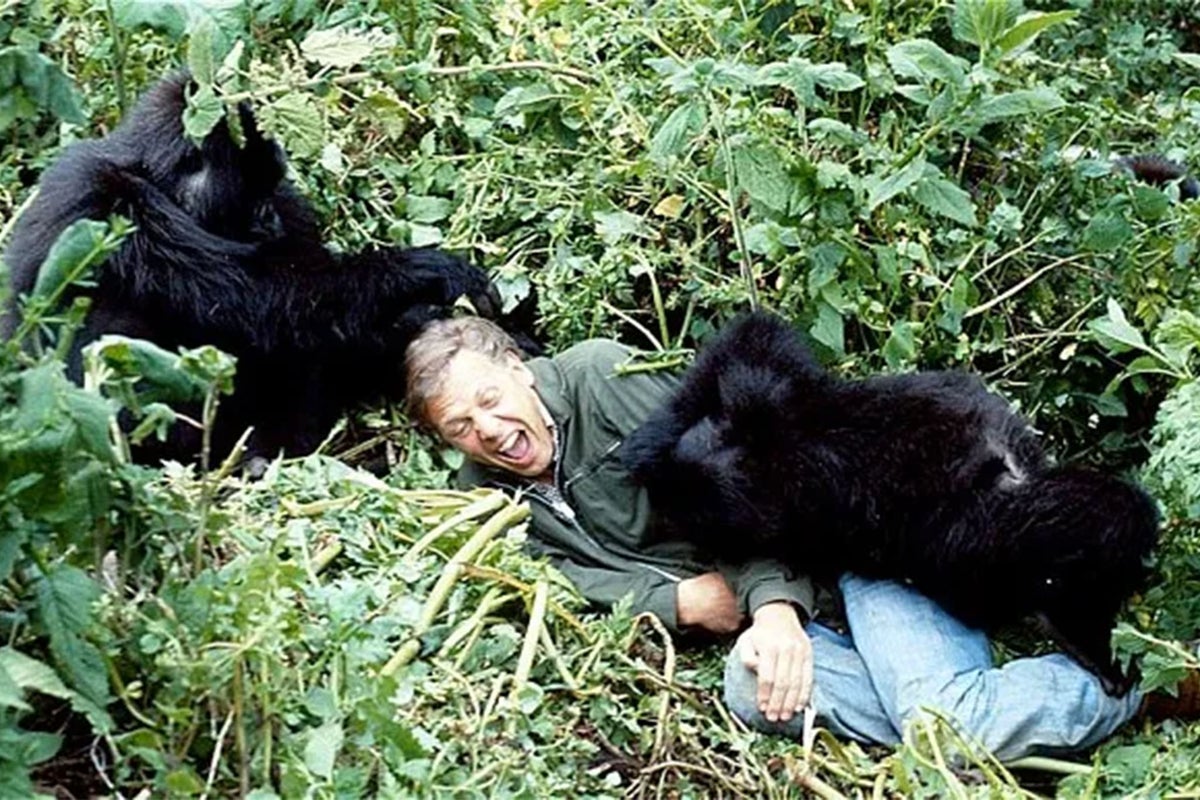
Grainy footage shows a fifty-something man in jeans and a shirt, with a flop of blond hair, climbing through the dense rainforest. He’s been spotted by a lookout – a silverback gorilla.
Carefully, the presenter approaches, and what happens next is one of the most-viewed moments in British television history.
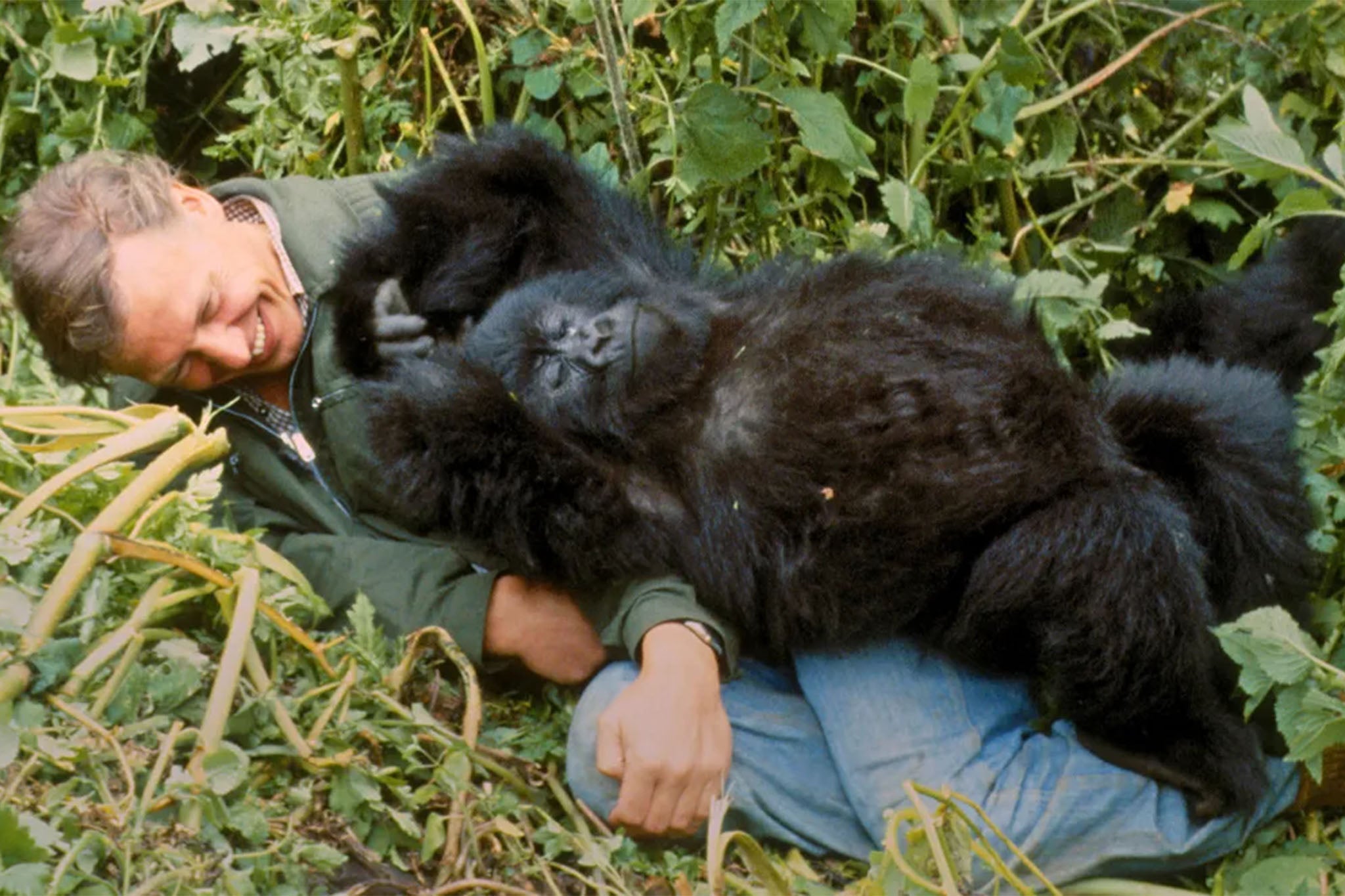
Not only do the gorillas go over to our intrepid explorer, but an infant, Pablo, playfully climbs on top of the awestruck, whispering host: a beaming Sir David Attenborough.
Even now, almost 50 years on, the original footage of the naturalist frolicking with the gorillas is incredible – perhaps even more so, as nowadays human interaction with subjects is a strict no-no. But this famous TV moment wasn’t even supposed to happen.
In a new Netflix documentary, David Attenborough: A Gorilla Story, the 99-year-old national treasure revisits his most famous and celebrated on-screen moment, revealing new details of the encounter that not only cemented his career, but helped invigorate conservation efforts that would ultimately see Rwanda’s silverback population more than quadruple in the decades that followed.

It was in January 1979 that Attenborough and his crew travelled to the Virunga mountains in Rwanda to film a segment for Life on Earth, the ambitious, pioneering natural history series that saw its presenter traverse the globe to explore the beginnings of life on this planet.
Flicking through his meticulously kept diary from the time, Attenborough reads his own words aloud in the documentary. “We start the one-and-a-half-hour walk up the mountain,” he says. “Slowly the nondescript bush transforms into the high altitude rainforest. Long-branched trees loaded with cushions of epiphytes. Green ribbon-leaved ferns with wispy pallid Spanish moss everywhere.
“We found a group of females and juveniles in a small clearing and to my astonishment, they allowed me to approach.”
Attenborough, both at the time and in this retrospective, gives due plaudits to Dian Fossey, the primatologist who spent years living alongside and studying the Virunga mountain gorillas. Fossey, keen for the BBC to join her in highlighting the species’ plight due to poaching, gave permission for Attenborough to film a group of silverbacks she had been tracking.


Watch Apple TV+ free for 7 day
New subscribers only. £9.99/mo. after free trial. Plan auto-renews until cancelled.
Try for free
ADVERTISEMENT. If you sign up to this service we will earn commission. This revenue helps to fund journalism across The Independent.
Watch Apple TV+ free for 7 day
New subscribers only. £9.99/mo. after free trial. Plan auto-renews until cancelled.
Try for free
ADVERTISEMENT. If you sign up to this service we will earn commission. This revenue helps to fund journalism across The Independent.

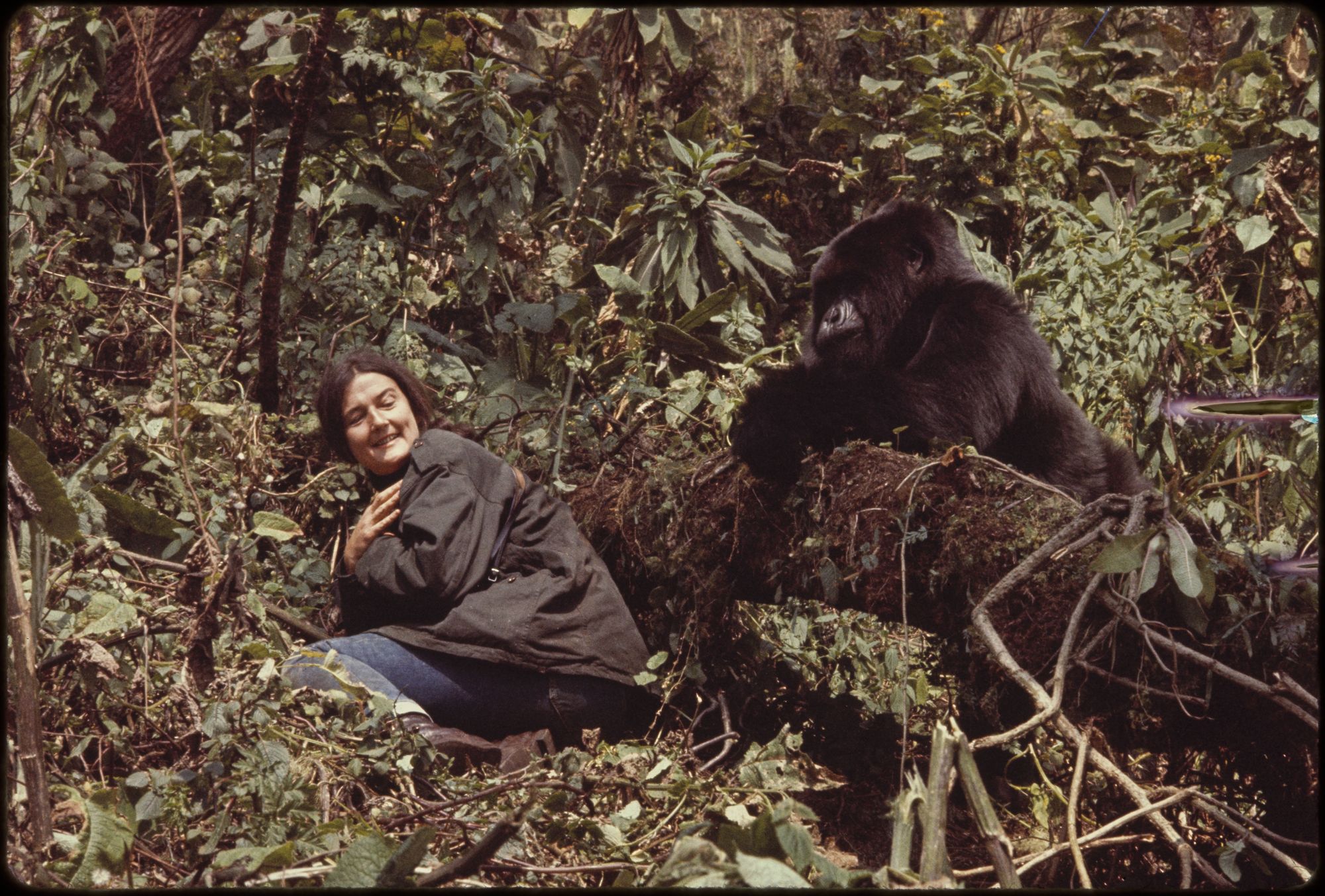
The American primatologist had dedicated her life to studying and protecting the species, and when Attenborough arrived, she was heartbroken by the brutal murder of her favourite gorilla, Digit, by poachers. Eight years later, Fossey herself was murdered in a machete attack. Nobody was ever convicted over her death.
“Because we did as we were instructed by Dian, [the gorillas] accepted us on those same terms,” Attenborough says. His diary entry adds: “I had to pause and exchange a deep-throated grunt. The reassurance noise meaning, ‘I’m here.’”
What happened next is etched in the mind of not just Attenborough, but the millions (and millions) of people who have seen the extraordinary footage since – which was quite the coup for a crew that had been planning to film a short segment about opposable thumbs.
“What I don’t say there is that this wasn’t supposed to be a film of meeting gorillas directly,” Attenborough says. “The function of the sequence was the importance of the thumb and forefinger, the opposable thumb and forefinger. We didn’t think we were going to be in touch with them.”

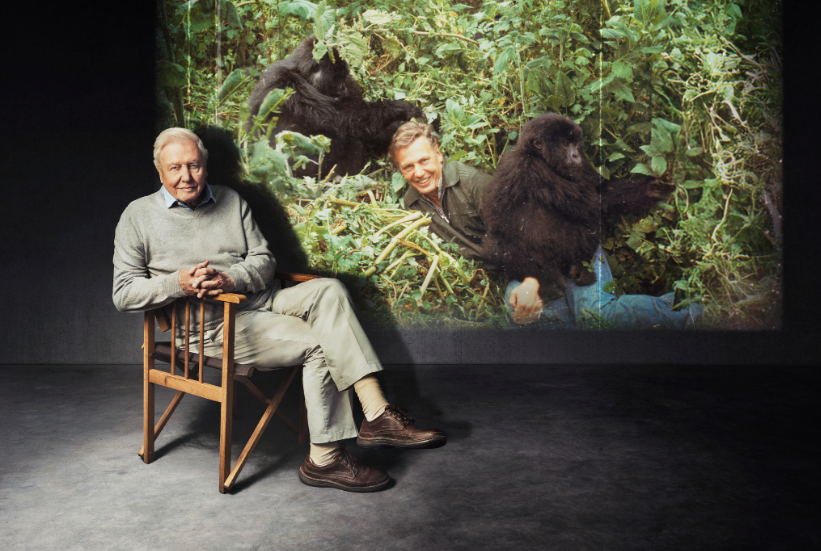
The gorillas soon put paid to that plan, though. “I turned to look back at the camera, I felt a weight on my feet and I looked down, and there was little Pablo,” Attenborough explains. “I couldn’t talk about the evolution of the thumb and forefinger, I just sit back and let it happen. Look at this lovely little creature. Absolutely engaging, you want to hug him. Just sheer bliss, really. Many people would think it was the most important sequence in that series, if not in my filmed life.”
There is one split second where Attenborough’s expression briefly drops. Thankfully, he’s explained what sparked this before. “I was only grimacing because out of shot, these baby gorillas started taking off my shoes,” he told The Independent in 2006. “And well, you can’t talk about the opposable thumb and the importance in primate evolution of the grip if somebody’s taking off your shoes, particularly if that somebody is two baby gorillas.” That’s impossible to argue with really, isn’t it?
This fresh look back at Life on Earth comes just weeks before Attenborough’s 100th birthday, and while almost 50 years have passed since that magical, career-defining moment, it’s clear the memory of the day has never faded. “I will never forget him,” Attenborough says of Pablo, “or the impact he had on me.”
Now Attenborough has explored the world countless times over, there’s no doubt where the encounter ranks for him. “The words I used are, ‘There’s more meaning in exchanging a glance with a gorilla than any other animal I know’,” he remembers. “And I stick by that. I think that’s true.”