

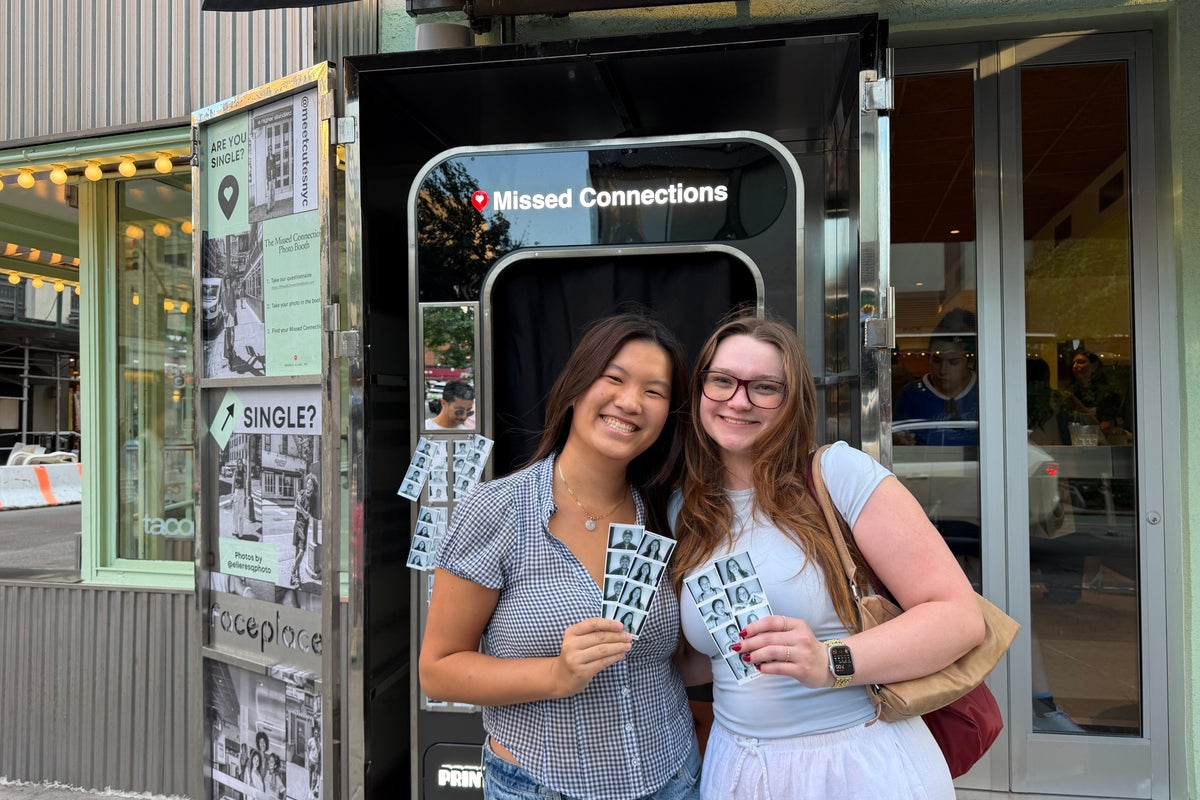
Somewhere in New York City, a man I’ve never met is carrying around a vintage-style photobooth strip with my face on it. He has four tiny exposures of me smiling and pouting in various awkward poses, except he doesn’t know my full name, where I’m from, or if he will ever meet me.
Meanwhile, I’m holding onto a photo strip of a smiley stranger — he’s flashing a peace sign in one frame, closing his eyes in the next. He wears an England cap, which is a bizarre coincidence since that’s where I’m from.
We are linked because sometime in the past few days, each of us stepped inside the same nondescript Union Square photobooth designed to match up singles looking for a connection.
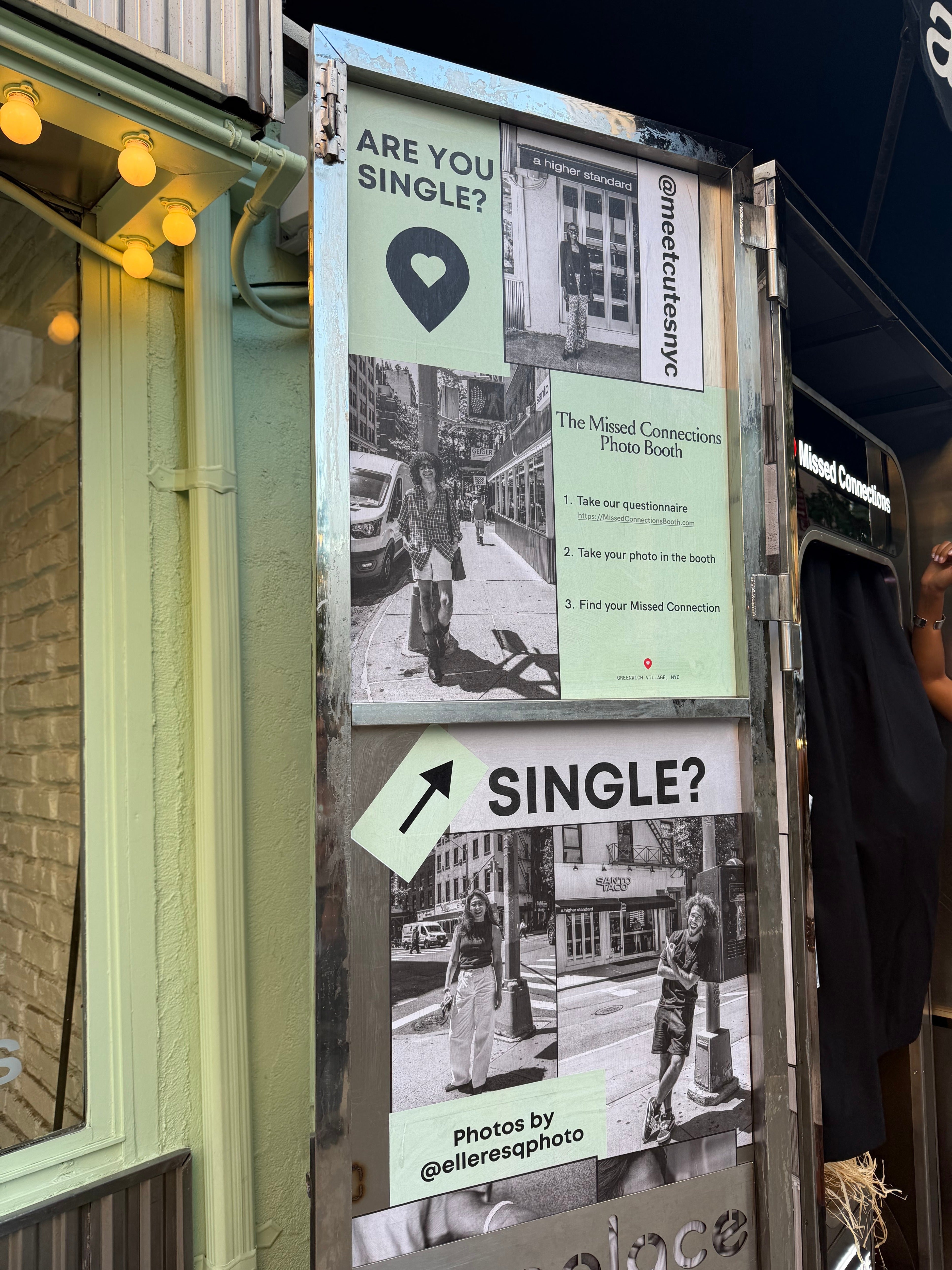
One evening this week, I joined a line of twenty-somethings — all dressed in various Y2K-style outfits — waiting for a turn inside the matchmaking machine. The photobooth is situated on the corner of East 12th Street and University Place, right in the heart of the NYU campus; territory of the young and uber-trendy. The location is extremely purposeful. This is matchmaking for a photobooth-loving, chronically online generation.
Before entering the photobooth, we were instructed to scan a QR code and fill out a personality questionnaire about our age, sexual orientation, views on religion, how ambitious we are and whether we like to dance, scoring the answer on a scale of one to seven (one being the lowest you resonate with the statement).

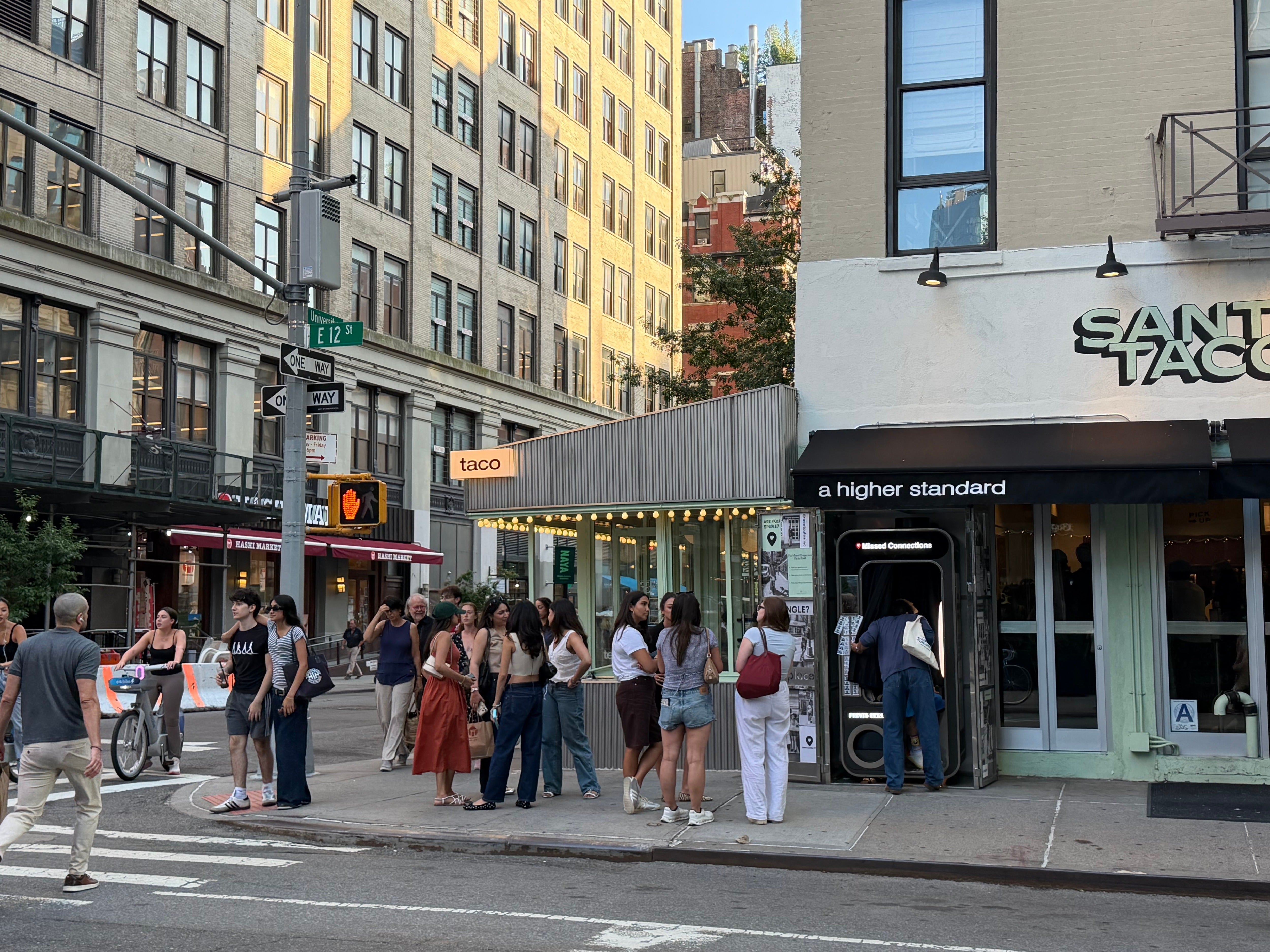
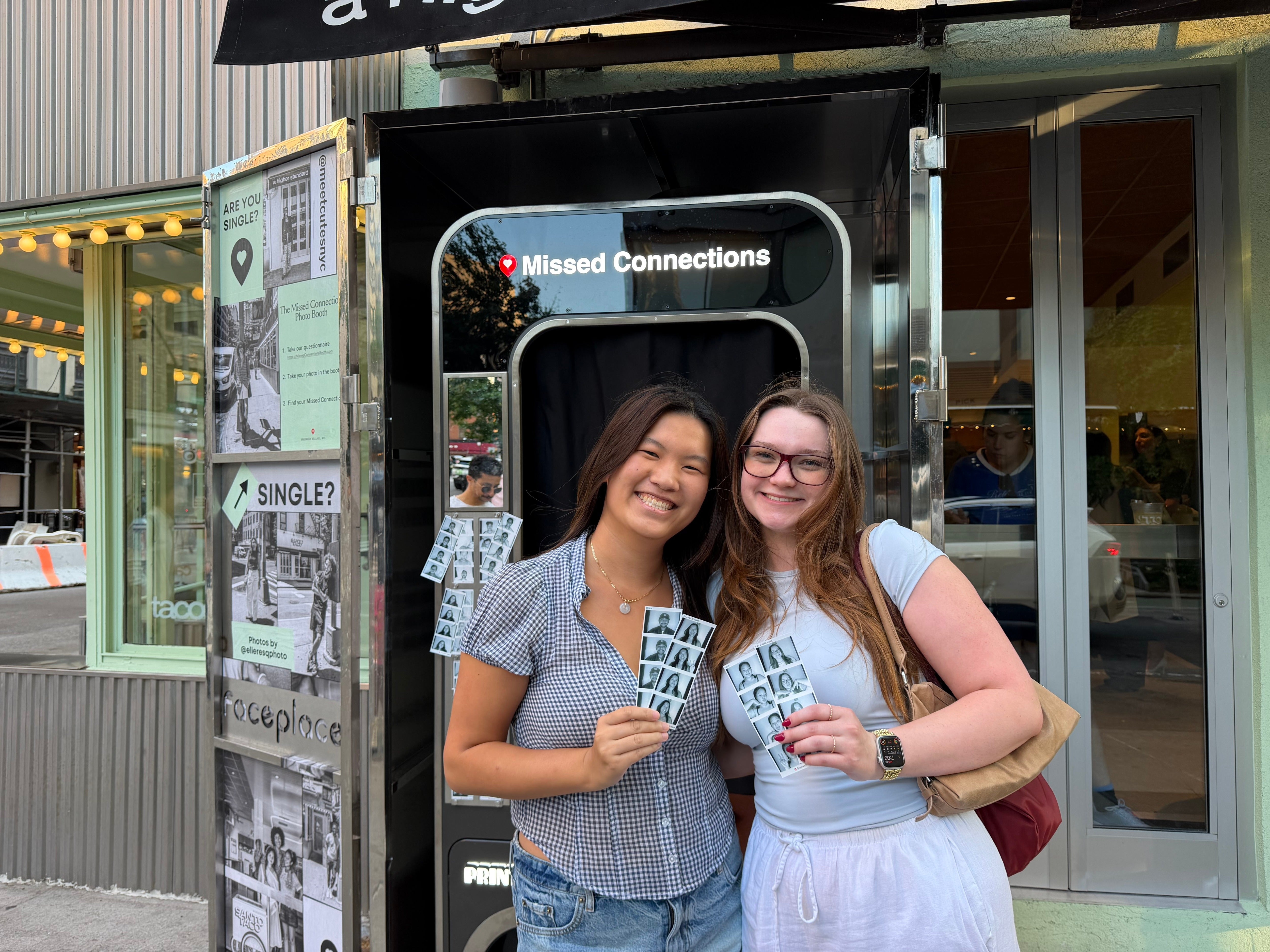
A tap of your card and $10 later, the photobooth churns out two physical strips of photos: one of you, and another of the stranger you’ve been paired with based on your answers.
But there is a catch.
Finding them in-person is improbable among New York City’s 8.5 million residents — unless you have some impressive social media sleuthing skills and hunt them down. The flaws of this operation do make me wonder: isn’t modern dating already hard enough that single people don’t need to be frantically running around the city, holding a photostrip up to a stranger’s face, screaming, “Is this you?! Are you my match?” Surely, we’ve been through enough?
Outside the photobooth, I meet Julieana, a 22-year-old supermarket worker from the Bronx, who journeyed downtown after seeing videos about the matchmaking machine on TikTok. She had a positive experience: she thought her match was good-looking and said she’ll attempt to track him down online.

“If I find him, I would message and be like, ‘Hey, you’re my match,’” she laughs. “It’s a bit scary.”
Julieana is a self-professed romantic, so she would choose this vaguely analogue-style meet-cute over Hinge any day. “I’m iffy about dating apps,” she says. “I’ll meet somebody, and then it doesn’t work out, and then I take a break from it. And then it’s a continuous cycle. I haven’t had any luck with that.”
“Not everybody wants to be in love right now,” she says. “They’re either not ready or they want other things.”
It’s no secret that dating apps are pretty hellish right now. According to Forbes, 80 percent of millennials report dating app burnout, while 79 percent of Gen Z experience it, too. The figure is slightly lower for Gen X (78 percent) and Baby Boomers (70 percent). Even when you do meet someone organically, ghosting — the act of suddenly vanishing from someone’s life in a very emotionally avoidant manner with no prior warning — seems to plague the dating scene. You may get a first date, but whether you’ll ever hear from them again is a roll of the dice. It is so hellish that Vogue reported last month that women are even being ghosted by their long-term partners.
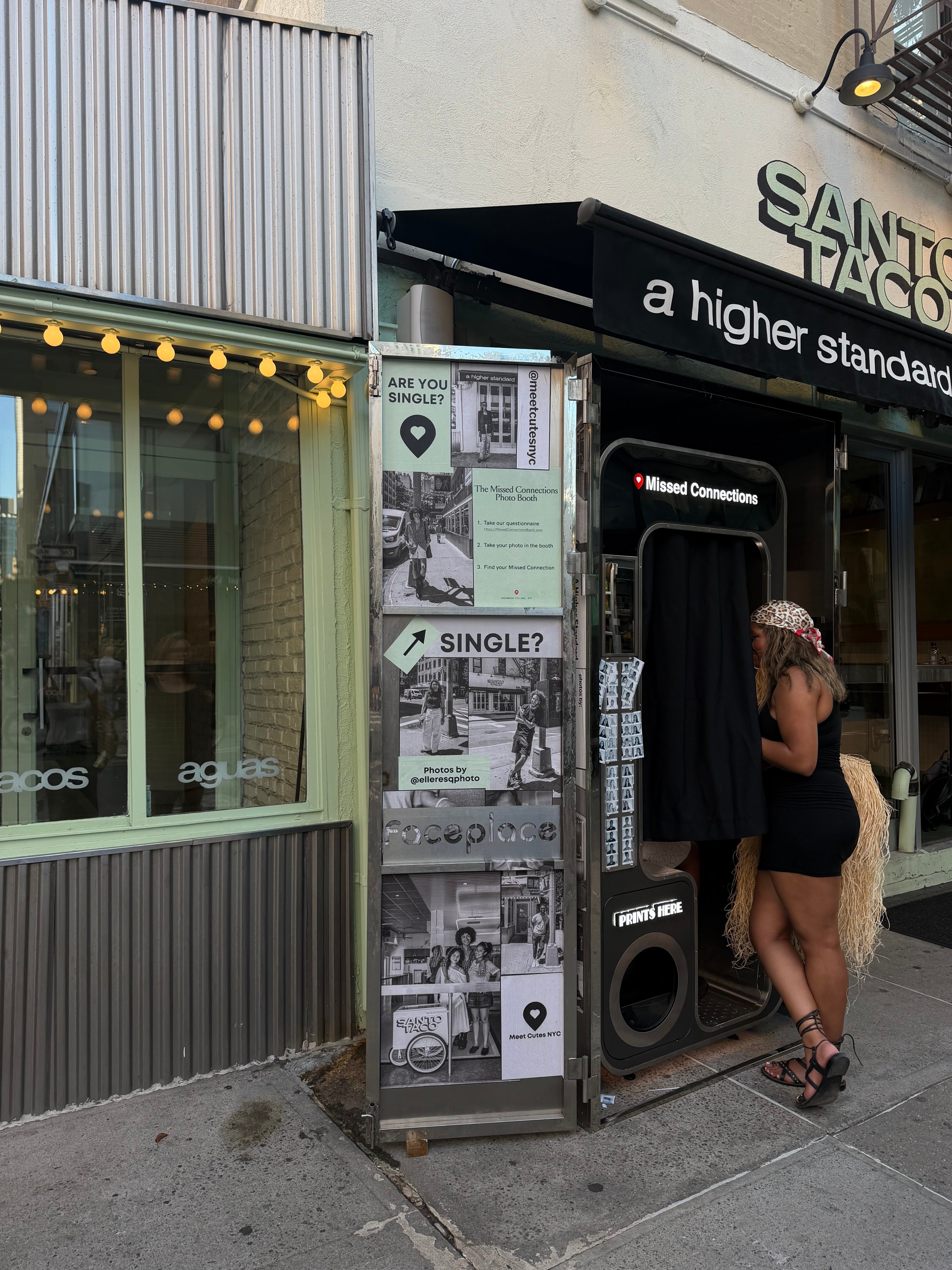
But I’m not convinced that this “Missed Connections” photobooth will help solve the sorry state of dating, either. It quickly becomes clear to me that this might be a thinly veiled marketing stunt. The inconvenience of having only the first name of your match to go off has already led some participants to post about it on social media, imploring strangers online to help them track down their connection, in an “internet…do your thing” style video. A handful of these posts already exist. I won’t be surprised if this trend goes viral next week.
It’s no surprise, then, that this booth is the brainchild of those who engineer some of the internet’s most viral moments. It is a collaboration between the matchmaking service Matchbox and @meetcutesnyc, the Instagram account with 3.3 million followers, which posts its ubiquitous and sentimental street videos capturing how couples first met.
Both companies have been tight-lipped about their mysterious new venture, specifically how they generate the results and what sort of criteria they use to match the singles.
When I reach out to the company, they say that the goal is to match people “who are compatible in the long run,” and that the questionnaire is centered on the “things that matter according to relationship science literature.” Liam McGregor, CEO of Matchbox, says via email: “There are plenty of moments in New York where you almost met someone important in your life. This lets you find the person you almost met.”
Days after my match, I start to grow uneasy about how many strangers are in possession of my photograph right now. Should I brace myself for a rogue Instagram DM or someone running up to me in the street because they recognize me? And then there’s the impracticality of trying to find your match, too. I even bring in my friend — who moonlights as an unlicensed private investigator for all matters of the heart — to hunt down my match, but the trail went completely cold.
There are other flaws, too. It soon becomes clear to me that the ratio of men to women taking part in this social experiment is completely unbalanced. Minutes after the printer churns out my match’s picture, another woman behind me gets the same one. We exchange awkward niceties about our shared match (“No, babe, you can have him!”) until we both conclude that the sample size of men participating must be slim.
Others I meet here seem similarly underwhelmed. Cassidy, a 22-year-old political science graduate, is skeptical about whether she can track down her match because they have a generic name. “I felt the questions didn’t ask enough about whether you care about a person’s religion when dating them, which I feel like is an important factor,” she says.
Rachel, a 23-year-old psychology major graduate, tried the photobooth because it felt more “tangible than dating apps.” But when her match emerges from the machine, she’s not exactly enamored by her results. “He’s not my type, but I’m sure he’s really nice,” she shrugs.
As I walked away, two photobooth strips in hand and somewhat defeated, I was left with more questions than I arrived with. Finding love is hard right now, but I draw the line at conducting a full forensic investigation to track down someone who I might be compatible with. To my match, I’m sure you’re a lovely guy, but this relationship has already run its course.