


Lighting your home goes beyond just flipping a switch – it’s about creating a space that feels inviting, stylish and comfortable, all while keeping your energy bills in check. With the right approach, you can make every corner glow beautifully without wasting electricity, by combining clever design, smart technology, and a few simple tricks.
What is the most efficient way to light a home?
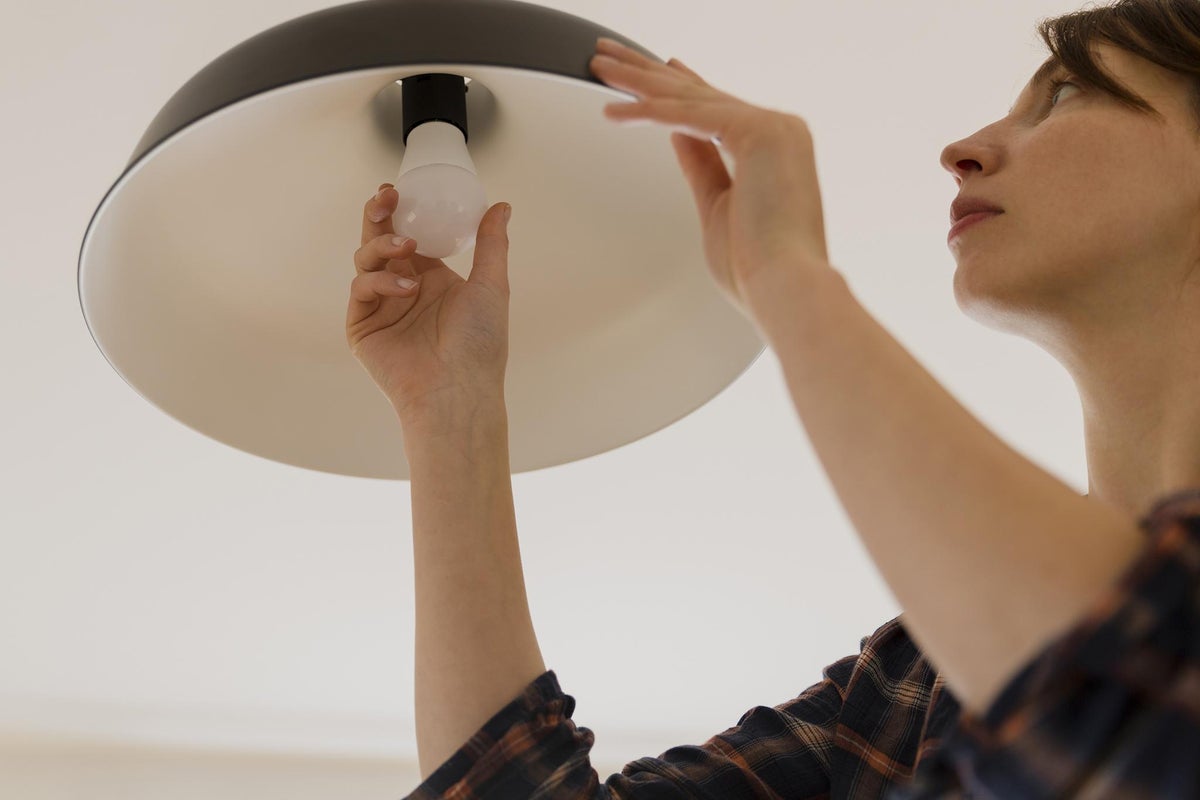
The most efficient way to light your home is by upgrading old incandescent bulbs to LED (light-emitting diode) lighting. LEDs are significantly more effective, using around 75-90 per cent less electricity and lasting 15-25 times longer. While most households have made the switch to LEDs in recent years, it’s worth checking for any lights you may have missed. The Energy Saving Trust estimates that replacing any remaining halogen ceiling spots with LED bulbs could save around £45 a year.
To save even more on your electricity bills, invest in smart LEDs. These allow you to have more control over your lights, often via a smartphone app, and offer functions such as dimmers and motion sensors. Look out for dusk-to-dawn LEDs with built-in light sensors that automatically turn lights on at sunset and off at sunrise.
Finally, rethink the colour of your bulbs. LEDs are measured in kelvins (K); choose lower-strength energy-saving bulbs in warmer colours (between 2,700K and 3,000K) for cosy living areas and keep cooler, brighter lights (between 4000K and 4500K) for kitchens/workspaces. You can even switch out your bulbs according to the seasons, opting for a cosier vibe in winter and fresher tones in spring and summer.
What to do if your house doesn’t get a lot of natural light?
If your home is naturally dark, there are plenty of ways to brighten it without turning on the lighting. Make the most of what daylight you do have by positioning mirrors opposite windows to bounce light back into the room, and opt for pale walls in reflective eggshell for the same effect. Swap bulky curtains for more streamlined blinds that block less light, and don’t overlook the outside either – trimming back hedges and trees that shade your windows can make a surprising difference indoors.
If your home has low ceilings, avoid pendant lighting. “They can bring the ceiling down and make the space feel cramped,” says Melissa Denham, interior design expert at Hammonds Furniture. And don’t forget to keep flooring light: “Painted or varnished floorboards will be most effective, although whitewashed wood and soft-coloured carpets can also work.”
In darker workspaces, daylight-mimicking bulbs – such as full-spectrum or 4000-5000K options – can help simulate natural light and lift mood, producing a crisp, clear white glow that’s ideal for focus. For a more structural fix, skylights can flood rooms with daylight, reducing the need for electric lighting altogether. If you have an internal room, consider investing in a solar tube (a tubular skylight that channels natural sunlight to the room through a reflective pipe).
What is a simple trick to cut your electricity bill?
Focus on ‘zoning’ your lighting, illuminating only the rooms – and areas within rooms – that are actually in use. In open-plan spaces, think about how you use the room at different times of day. Often, a single, well-placed task light, such as a table lamp beside an armchair, will provide all the illumination you need and will be cheaper to run than a larger overhead light.
If sockets are limited, rechargeable lights are a smart solution, allowing you to move light exactly where it’s needed. Look for adjustable lamps that can be angled or height-adjusted to avoid glare, and vary light levels throughout the room – on the floor, on shelves and on tables – to add depth, atmosphere and flexibility without increasing energy use.
Save on your electricity bills with Octopus solar and battery
GO TO WEBSITE
Advertisement

Save on your electricity bills with Octopus solar and battery
GO TO WEBSITE
Advertisement
What is the 5-7 light rule?
The 5-7 light rule (sometimes called the 5-7-9 rule) is an interior design principle that suggests a room should have at least five to seven different light sources rather than relying on one single ceiling light to create a warm and well-lit atmosphere.
Light sources generally fall into three categories: ambient (general, overhead lighting), task (brighter, focused lighting for work or reading) and accent lighting (used to highlight features or decor).
Julia Barnes, product director at online lighting destination ValueLights, recommends combining all three for the best effect. “Layered lighting helps achieve balance, warmth and depth, which mimics the softness of natural light. Start with an ambient light source, such as a pendant ceiling light or chandelier, to provide a gentle, overall glow. Then add layers with task lighting to create cosy pockets of illumination for reading or relaxing.”
In practice, a living room might combine an overhead light with a floor lamp, table lamp, and subtle accent lighting on shelves, while a bedroom could include a ceiling light, bedside lamps, and a floor lamp – all working together to create a calm, comfortable space.
Ally Dowsing-Reynolds, lighting expert at Dowsing and Reynolds, adds that layering lighting also prevents over-lighting, reducing electricity use. “It gives you a realistic overview of how much light is needed and where each light source should be placed to properly illuminate the space,” she says.
“People are craving spaces that are cosy, calm and warm, and lighting plays a huge role in that,” adds Dowsing-Reynolds. “We’re seeing modern, fluid shapes such as curves and circles become increasingly popular. Ideal for illuminating dark corners, side tables, and countertops, these smooth, sculptural fixtures softly brighten a space, diffusing light more evenly across a room and mimicking the effect of sunlight.”