

On a sunny afternoon in Valletta last year, a young man sat alone on a rooftop, headphones in, listening to a song he had just written. By the time the chorus arrived, he was crying. He took a photograph of himself and sent it to his mother. The message read: “I guess I have the song.”
The young man was Aidan, Malta’s representative in the Eurovision Song Contest 2026. The song was “Bella”. And that photograph, taken on a rooftop in Malta’s ancient walled capital, marked the end of a search that had consumed him for the better part of a decade.
Aidan is not, in the traditional sense, a Eurovision newcomer. He has been entering Malta’s national selection for years, with the tenacity of someone who can’t quite convince himself to stop. Since 2021, every single he has released has charted at number one or number two back home. This domestic success was never really in question. But Eurovision, the contest he has followed obsessively since childhood, kept slipping just out of reach.
He did not just follow it from a distance. He travelled to Sweden to attend Melodifestivalen, the country’s beloved national selection, not as an artist or an industry figure, but as a fan. He sat in the audience. He watched. He took notes, the way devoted fans do. “Eurovision was always the one thing I really wanted,” he says. “I really wanted to tell a story. I really wanted the highs and the lows in the song.”
To find that story, he wrote 35 songs. Not all were fully produced. But 35 distinct ideas were composed, developed, and subjected to what can only be described as a forensic selection process. Focus groups were convened: Eurovision journalists, casual viewers, professional musicians. A jury simulation was run. Feedback was gathered on jury appeal, emotional resonance, and how each song might sit within a live televised performance.
The song that survived was “Bella”. Not because it scored highest across every metric, but because it tested strongest where it mattered most – with the jury panels, whose votes can make or break a result. And because, when Aidan heard the first demo on that Valletta rooftop on a sunny afternoon, it made him cry before he had finished listening. “It was the uniqueness of it,” he says. “I was tearing up. I sent a photo to my mum. I said: I guess I have the song.”
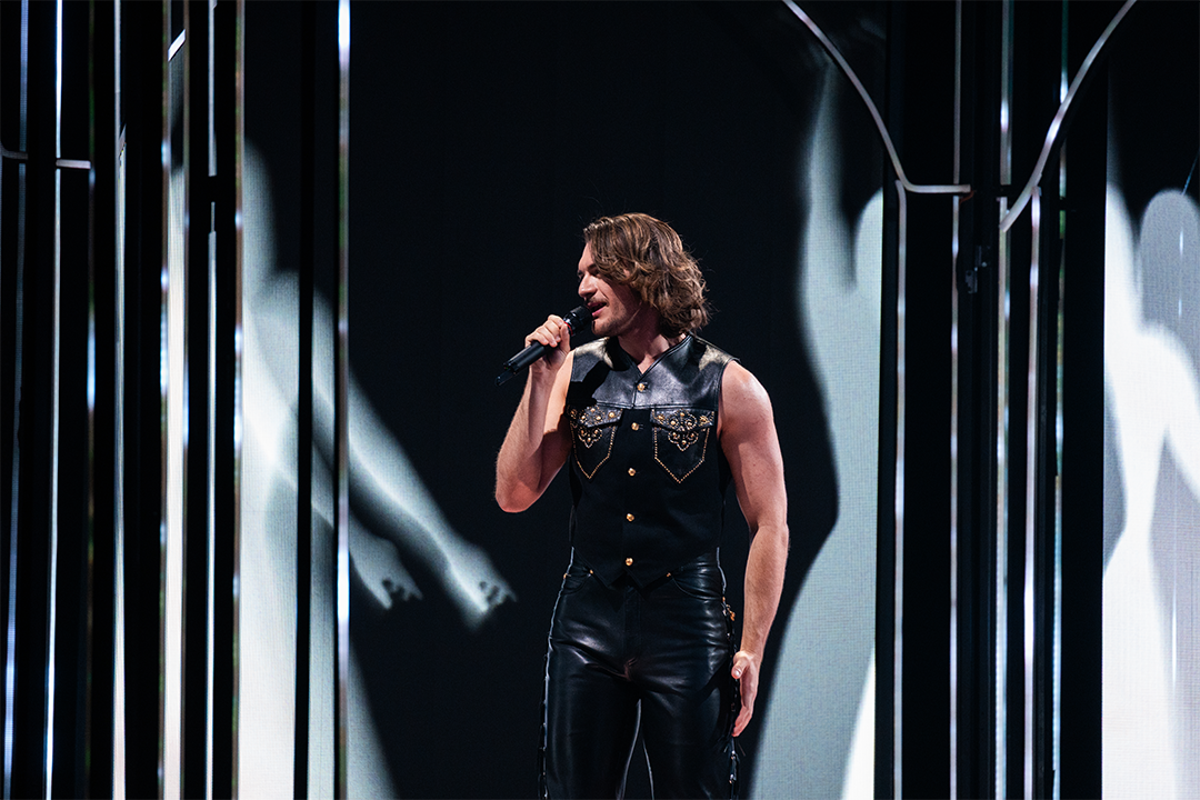
What awaits audiences in Vienna is not quite what they will expect. “Bella” opens quietly. It sounds, in its first moments, like a tender ballad, understated and classical in feel. That impression is, as those who have seen what Aidan is planning to do with it on stage will tell you, very much the point. “You arrive at the first notes,” his creative director, Dan Shipton says, “and you think: I know what we’re going to get. And by the end, you’re thinking: I was not expecting that at all. When the secrets are out, it is going to be a real shock for everyone.”
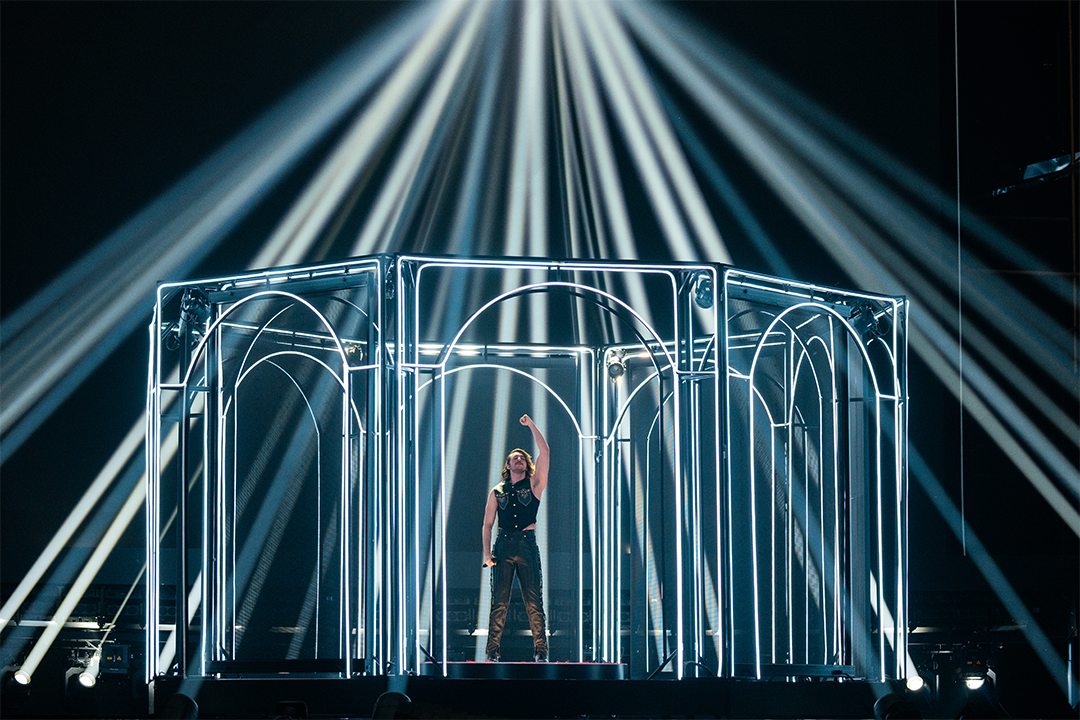
The staging is built on a deliberate rejection of the visual language that defines the modern Eurovision performance. There are no LED screens. No digital backdrops. Instead, Aidan will perform within a structure incorporating a piece of transparent display technology so new it was built from scratch specifically for this show. In fact, this is a piece of equipment that has never been used at Eurovision before.
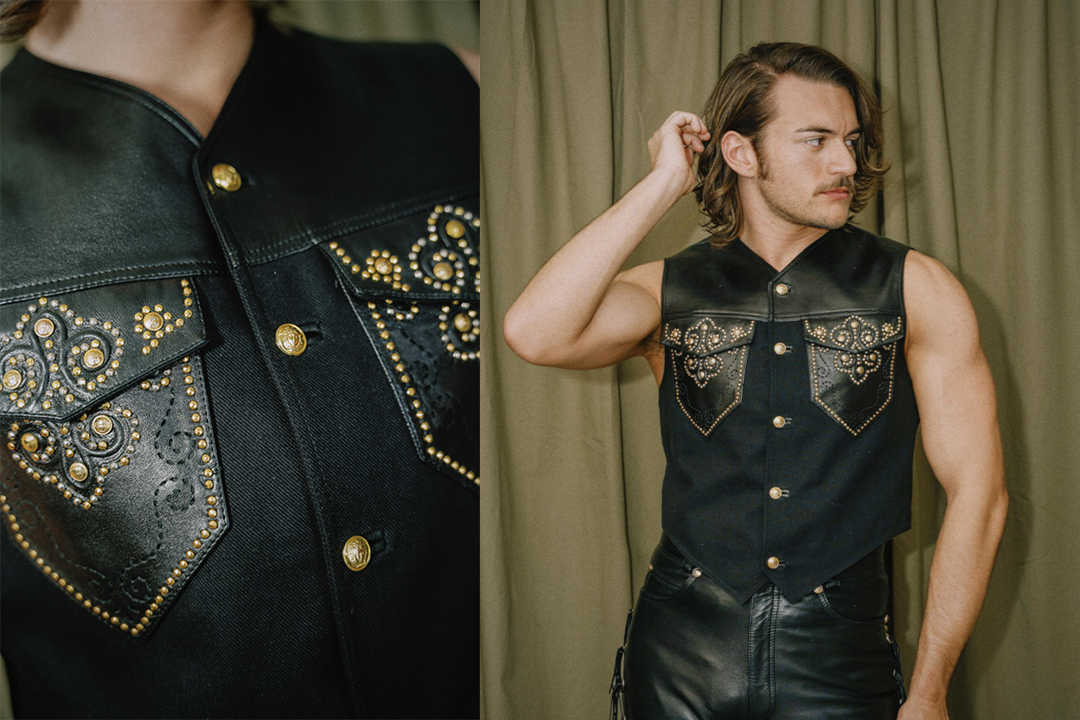
The performance opens with eight beams of light converging from above to trace the shape of the Maltese Cross. It closes with Aidan and the camera locked together at the centre of a spinning world, the entire set rotating around them as petals rise, a physical embodiment of the song’s central image: the memory of someone who cannot be let go. He will do all of this while wearing exclusive archival Versace.
Malta has competed in Eurovision since 1971. Although it has come agonisingly close – second place in 2005 and third in 1998 – the country has never won. These near misses have shaped a devoted (and slightly heartbroken) fan base of the island’s 500,000 people. Malta is one of the smallest nations in a contest that now spans 35 participating countries. The country has always put its all into the Eurovision Song Contest, without winning – yet.
Aidan carries something that cannot be manufactured or directed: the knowledge that winning matters more than almost anything. After spending years proving it, he is not entering Vienna naively. He will arrive prepared, in a way that very few artists in the contest’s history have been – with a performance designed to make people pay attention.
“Everyone has kind of slept on this a little bit,” his creative director shared, after the rehearsal footage was shown to a small group. “When the secrets are out, it is going to be a real shock for everyone.”
The semi-final is on 14 May. The grand final is on 16 May. Malta has been waiting a long time.