


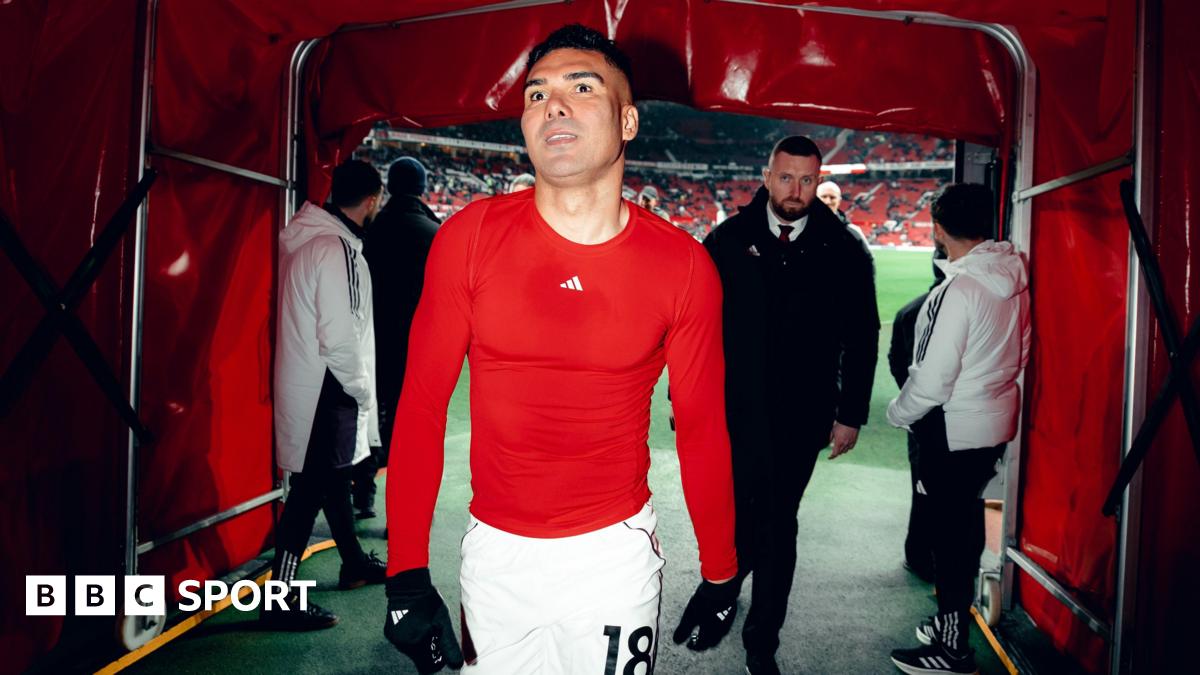
In addition to his goals, his general play on the ball looks far better this season.
Casemiro has a tendency to play direct passes often – which can be a good or bad trait depending on a team’s tactics.
With Amorim in charge, players were encouraged to execute certain passing routines that ended with the midfielders playing direct passes quickly to attackers running in behind.
That made games more end-to-end. But if the defenders didn’t step up as passes were played, it left the two midfielders with huge spaces to cover.
Pairing Casemiro with a strong runner in Bruno Fernandes helped mitigate some of these concerns but under Carrick, general play has been more measured.
The defensive midfield and attacking lines are closer together – with the team moving more collectively. With this more controlled approach in attack, Casemiro’s direct passing becomes a necessary risk rather than something that exposes the weaknesses of the team.
For Matheus Cunha’s goal against Fulham, the ball moved from the right side of the pitch to Casemiro in the centre. Casemiro turned his body and head to face towards the left, disguising his intentions – causing Fulham midfielder Alex Iwobi to shift that way.
This opened up space for Casemiro to play a through ball, resulting in Cunha’s goal.