

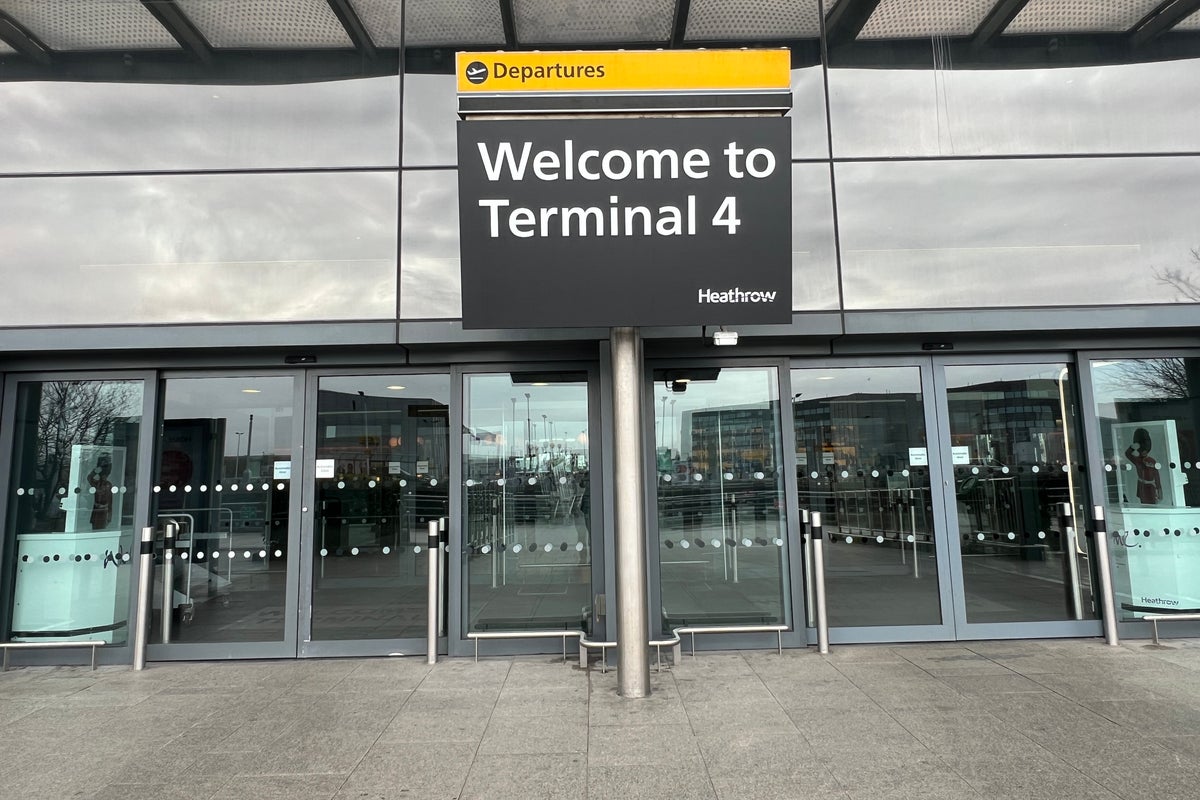
If a normal day is 100, how busy are you now? That is the question I put to a server in one of the catering outlets at London Heathrow airport’s Terminal 4.
“Right now? Ten.”
Surveying the ranks of empty check-in desks, in the middle of a Monday morning, that seemed plausible. However, closer analysis by The Independent indicates that the terminal has lost one in three of its passengers since the US-Israeli attack on Iran on 28 February.
Terminal 4 lies south of the southern runway, cut off from the more central Terminals 2, 3 and 5. With onward connections tricky, it has turned into more of a point-to-point terminal – with flights out to key Middle East hubs its main speciality.
To Doha, from 8.25am to 9.55pm, passengers can normally choose from seven Qatar Airways flights, up to and including a giant Airbus A380. Abu Dhabi? Etihad offers four daily nonstops, half of them using the “SuperJumbo”. Gulf Air of Bahrain and Kuwait Airways also fly wide-bodied aircraft twice daily between their hubs and Heathrow Terminal 4.
Israeli airline El Al is serving Tel Aviv from T4 only intermittently, with something of a skeleton schedule.
In total, the cancellations are affecting around 9,000 passengers arriving or departing per day. I calculate this represents one in three of the travellers who normally pass through T4, though Heathrow insists the fall is not so significant.
The departure screens show a yawning gap of 90 minutes in the middle of the day, during which there are no departures. At the other Heathrow terminals, such a lull in services would be unthinkable.


Terminal 4 opened in 1986 as a stop-gap facility during the interminable planning inquiry for the future Terminal 5. Its location is problematic: aircraft landing at or taking off from the northern runway must taxi across an active runway on arrival or departure.
Public transport has always been a problem. The Piccadilly line of the London Underground serves Terminal 4 on a branch loop. Once T5 opened, the Heathrow Express train was diverted to the new facility.
Recently, though, the Elizabeth line frequency has increased to four trains per hour to and from central London.
Air France and KLM serve their hubs in Paris Charles de Gaulle and Amsterdam Schiphol from T4. British Airways’ budget sibling, the Spanish low-cost airline Vueling, flies from the terminal to Barcelona, Santiago de Compostela, Bilbao and Paris Orly.
Were easyJet ever to launch flights to and from Heathrow, T4 would be its likely terminal of choice. It was designed with easy access to departure gates, facilitating a fast turnaround location. But Britain’s biggest budget airline is unlikely to move in until and unless a third runway is built.
Meanwhile, the cafés and duty-free shops at T4 are suffering – just as they did during the Covid pandemic, when Terminal 4 was completely closed for two years. A protracted Middle East conflict could conceivably have the same effect – though Heathrow says firmly that this is not an option.