In the Supreme Court term that began in October 2025, the justices delivered major decisions in cases ranging from voting rights to citizenship to presidential power. The Conversation’s Politics and Legal Affairs Editor, Naomi Schalit, spoke with Dickinson College President John Jones, a former federal judge, about the court’s session.
They focused on two recent decisions: birthright citizenship, which the justices affirmed, and a Mississippi state law that allows mail ballots postmarked by Election Day to be received up to five days later and still be counted, which national and state Republican parties challenged and lost.
Schalit: Two of the court’s conservatives, Chief Justice John Roberts and Amy Coney Barrett, joined the three liberals in saying that the Mississippi mail-in ballots law did not violate federal law and could stand. What do you make of this ruling?
Jones: The majority opinion, written by Justice Amy Coney Barrett, is really emblematic of an emerging pragmatic conservatism that she and the chief justice are showing, which is heartening to see, regardless of whether you agree with their judicial philosophy. Justice Barrett properly cast the question not as one of constitutional import but merely as an interpretation of Congress’ laws that mandate that federal elections be held on the same day. Notably those laws are silent on the issue of when ballots must be received, which has been left to individual states to regulate.
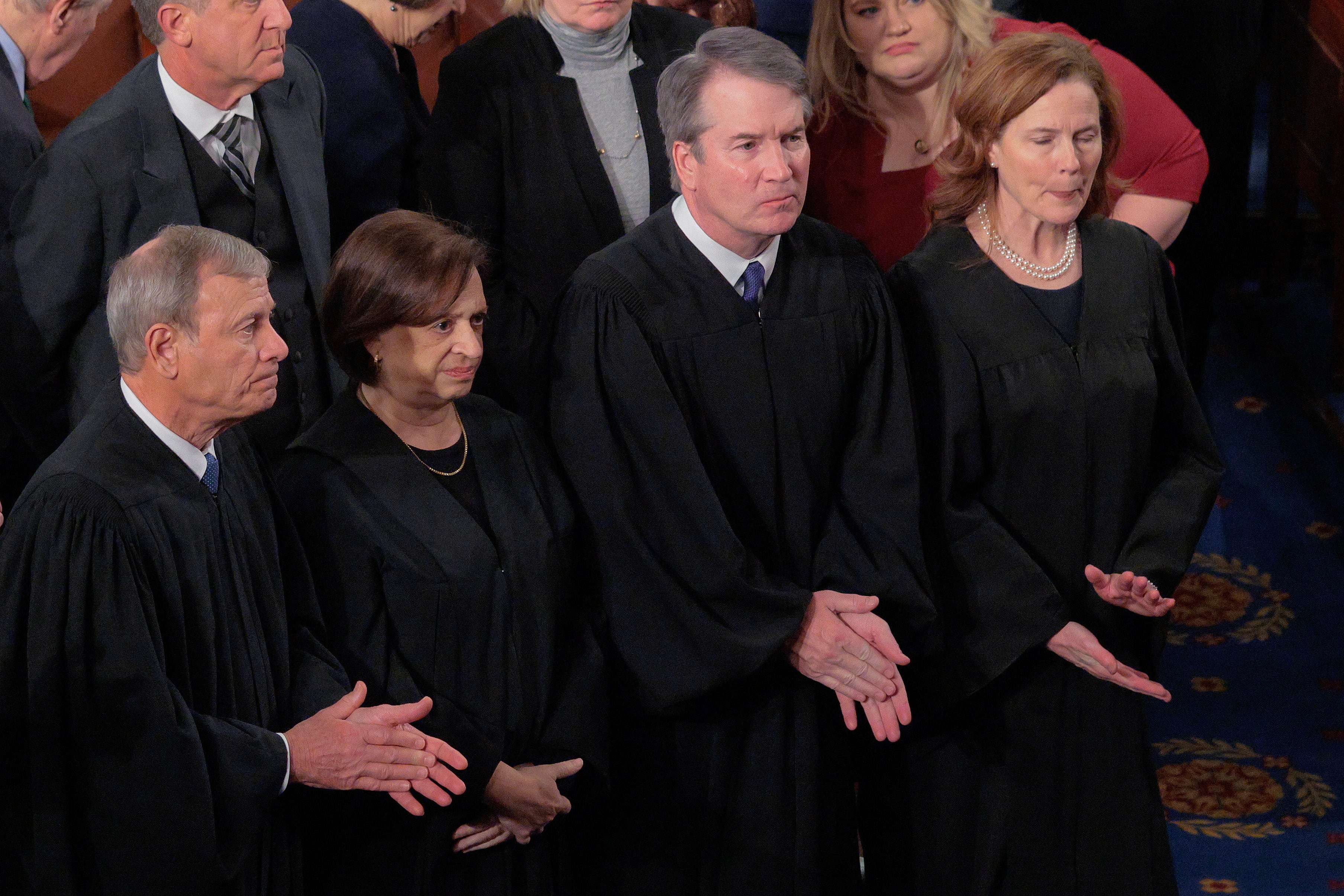
Justice Barrett actually sounded kind of sharp, almost scolding, in the opinion in her criticism of the assertions made by the plaintiffs and some of the justices in the minority. Is that tone typical?
I perceive an increase in what I would characterize as sort of judicial invective among the members of this court. I don’t love that, but sometimes you have to get your elbows up to make a strong point when you’re on an appellate court.
I suspect one of her problems was the sheer illogic of the dissent’s parade of possible horribles if you allow ballots to be counted after Election Day, which really flies in the face of the increasing adoption of mail-in voting. To have the dissenters hearken back to the 19th century and discourse about voting customs then was inapt, and the justice called them on it. She recognized that in the real world today, there are mechanisms that allow for the orderly counting of ballots after Election Day.
Justice Barrett wrote: “Notably plaintiffs admit that they cannot precisely tie this historical practice to the text of the election day statutes. That is a delicately put understatement.”
These types of suits, such as this one brought by the Republican National Committee, plainly intend to promote voter suppression. This traditionally helps Republican candidates. I don’t think the majority was blind to that purpose. Perhaps the justice’s visceral reaction was triggered by that attempted charade.
This lawsuit is really a smaller version of what the president is trying to do with the SAVE Act, which is to cut off mail-in voting, absentee voting and any counting after the election. This is based on a canard – that allowing ballots to be counted after Election Day necessarily triggers rampant fraud.
In effect, the dissenters are parroting what the current administration is saying in support of the SAVE Act, and we know that there is no empirical evidence to support those contentions. Adopting the Republican National Committee’s position would necessarily disenfranchise voters in the military and law-abiding citizens who are permitted to vote absentee or by mail and have their ballots postmarked at or prior to Election Day. That’s simply not consistent with how we view the franchise of voting in a democracy.
Birthright citizenship – the constitutional principle that almost anyone born in the U.S. gets citizenship – has broad support among Americans. The Supreme Court’s ruling strongly affirmed that right, Yet four justices did not vote to affirm birthright citizenship as a right ensured by the 14th Amendment, and some say that was alarming and points to a future of further challenges. What are your thoughts?
It ended up being a closer decision than I would have thought. But I don’t share the alarm. The only path for those who want to restrict birthright citizenship henceforth is a constitutional amendment, which is highly unlikely to pass. So I’m not unduly concerned by the margin. I think the majority, through the chief justice, spoke clearly and appropriately about the 14th Amendment.
The president has said in response to the ruling, “I’ll just get Congress to change things.”
He’s wrong.
That assumes that Congress can overwrite a constitutional right in the 14th Amendment that’s now clearly established by precedent. They cannot do so. The only way to change the court’s ruling is either to have a subsequent court reverse it or through the amendment process.
Good luck with either. For now, the door is closed.
As a former federal judge, what is it like to deal with such heavily politicized cases? Does it change how judges deal with them? Did you see methods of dealing with politically oriented cases at the court that looked different than how they might deal with cases that were not political in origin?
No, I don’t. In the end the court did its job, agree or not with the decisions.
They’re in a highly polarized environment, and so it’s easy for a jaded public to feel that everything they do is akin to the actions of politicians in black robes. I don’t adhere to that view, even though I may not agree with everything that the court has done.
One of the notions the court debunked is that it’s fully in the tank with the president, and that he just can run the table in these cases at will. That clearly was not the case, even though, of course, several of the opinions tilted in favor of the strong unitary executive theory. That doesn’t mean that I am in accord with everything the court held.
If you go back several years to the immunity case opinion by the chief justice – which gave ex-presidents absolute immunity for official actions they took while president – and then you look at, for example, this term’s Slaughter decision that allowed the president to fire an independent agency commissioner, both of those cases assume that the president is a rational actor. But there’s some inconsistency between those opinions and the Lisa Cook case, where the justices said the president couldn’t simply fire a member of the Federal Reserve Board of Governors.
Clearly, the Lisa Cook result seems in tension with the Slaughter holding. The Cook holding is built on a nod to history, tradition and independence of the Fed, but you could say that about a number of different agencies.
I think, clearly, what Justice Brett Kavanaugh and Chief Justice Roberts feared, and why the Lisa Cook case came down the way it did, unlike the other executive power cases, is that we have a president who just might wreak havoc on the financial system of the United States if he were given the unfettered power to pack the Fed.
So much for the assumption of the rationale actor! But to be sure, for your readers and viewers, those cases are facially hard to reconcile beyond the court engaging in pure pragmatism.
In the end, there remain some really stark philosophical divides on the court. When it convenes in October, we’re likely in for another wild ride.
Anything else you want to say about this session?
The decision in the Mississippi voting case was heartening to me because it truly recognizes the real world, and not the hyperbolic and unfounded speculation in which the dissenters engaged.
In addition, I loved Chief Justice Roberts’ majority opinion in the birthright citizenship case. He nailed it, and it’s one of those decisions that makes you prouder of the country and the traditions that we stand for, including the rule of law. As a former judge who enjoyed turning a phrase, I love great judicial poetry. The chief justice did a terrific job.