


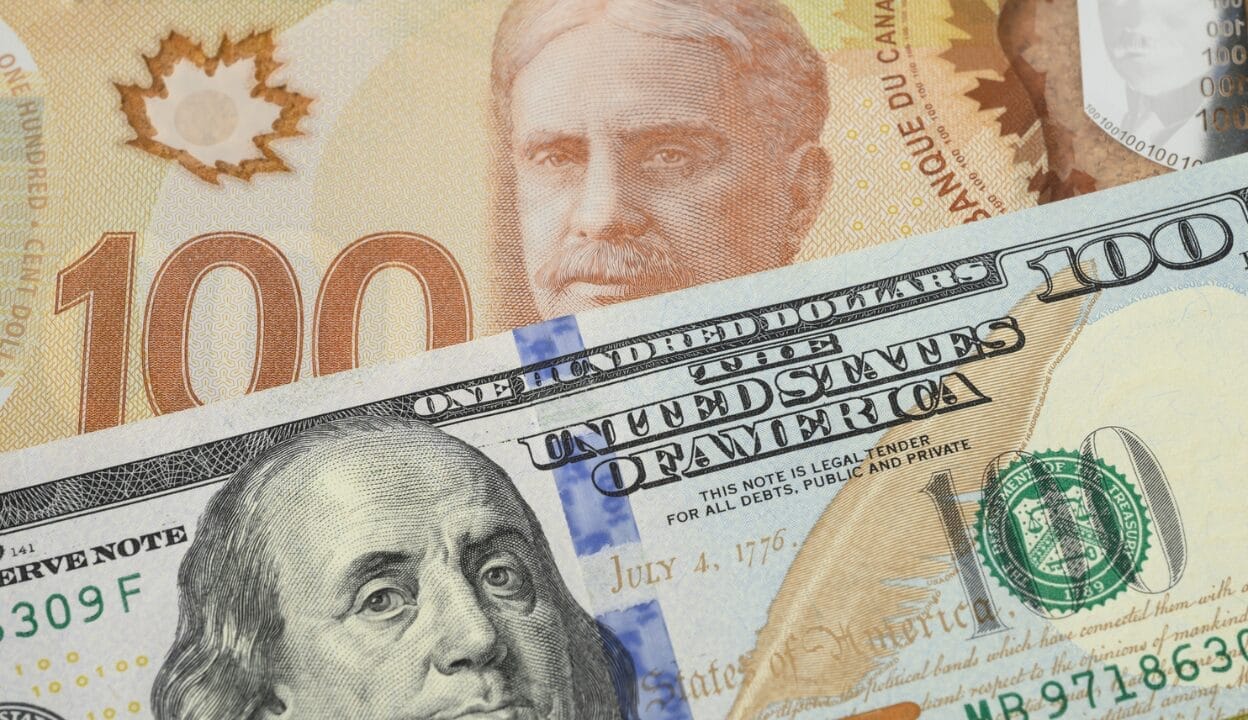
A weakening US dollar has eaten into the returns of Canada’s largest pension funds as annual reports revealed the currency shock forced a fundamental rethink from some investors around hedging practices.
The US dollar dropped 4.7 per cent against the Canadian dollar during the 2025 calendar year, with significant underlying exchange rate fluctuations caused by factors including Liberation Day tariff shocks and asset outflows from the US market. This has a complicated effect on Canadian pension portfolios, where the US dollar is usually the largest foreign currency exposure.
The C$145.2 billion OMERS saw C$1.7 billion in unrealised foreign currency losses for the 2025 calendar year, primarily due to depreciation in the US dollar, though partially offset by strengthening euros and sterling. Net US dollar-denominated assets represent 35 per cent or C$51 billion of the portfolio at the end of 2025, slightly up from 33 per cent in 2024.
In a substantial pivot, OMERS changed its currency management method from having a specific, policy-driven target hedge ratio before 2025 to a more flexible approach of managing with multiple objectives in mind. These include liquidity optimisation, portfolio diversification and risk-adjusted return improvements, according to its annual report. The hedging activities protected 70 basis points in return during the 2025 calendar year.
OMERS president and chief executive Blake Hutcheson warned in February this year that the fund won’t be alone in facing the challenge brought by a depreciating US dollar.
OTPP reported a 45 basis-point or C$1.2 billion foreign currency loss primarily due to a depreciating US dollar during the same period. The fund manages currency exposures at the total fund level and said its “proactive management” has significantly reduced the adverse US dollar impact.
Prominently, OTPP more than halved its net US dollar exposure from C$90.9 billion at the end of 2024 to C$41.3 billion at the end of 2025, and total net exposure across all foreign currency baskets also decreased from C$142.1 billion to C$101.2 billion.
The annual report did not elaborate on how the exposure is reduced, but chief investment officer of asset allocation Stephen McLennan said this does not mean the fund has significantly sold down US assets.
In fact, OTPP’s gross investments in the US increased from 33 per cent in 2024 to 38 per cent in 2025.
“As a large global investor with some degree of sophistication, we do have the ability to separate the actual investment decision to buy a US asset from the currency exposure so when we are thinking about the overall portfolio, we do try to layer in how currencies respond to broad asset buckets like equities, bonds and F/X,” he told industry blog Pension Pulse.
“Depending on those views and that outlook, we will adjust our hedge ratios accordingly… with the view [of] how are we generating a portfolio that’s going to give us the best risk-adjusted returns at the top of the house.”
An analysis of potential exchange rate movement from OTPP demonstrated the level of impact FX can have on portfolios.
If all other investment variables are held constant as at the end of last December, a 5 per cent increase/decrease in the value of the Canadian dollar against US dollar could cause OTPP’s portfolio value to decrease/increase by C$2.5 billion; against the euro, the value impact would be C$737 million; against the Swiss franc, the impact would be C$411 million, the fund outlined in its annual report.
Meanwhile, the C$517 billion La Caisse, which released its annual report last week, did not disclose whether foreign currencies contributed positively or negatively to the overall return in the 2025 calendar year, but highlighted a depreciating US dollar “adversely affected performance”. It was able to protect C$3.6 billion in fund value due to hedging.
Despite this, La Caisse is of the belief that developed countries’ currencies will have a neutral impact on performance over the long term while most emerging markets portfolios tend to depreciate. Between 2020 and 2025, the strength of the US dollar has added to La Caisse’s returns.
Its hedging approach to developed countries’ currencies consists of three parts: the strategic hedging, which sets the hedge level for each currency within each asset class based on the fund’s long-term view of where the currency should trade; the dynamic hedging, which takes advantage of periods where the Canadian dollar looks overvalued or undervalued compared to its equilibrium value; and active management decisions, which refers to discretionary hedges that can be implemented in specific market situations.
“Dynamic hedging should therefore be less frequent for a given currency, but the duration of the hedge, being unforeseeable, may vary widely and last for a few weeks to several years,” the fund said in its annual report.
La Caisse’s net US dollar exposures now stand at 22 per cent, the lowest level since 2019.
La Caisse returned 9.3 per cent in the 2025 calendar year, compared to 6.7 per cent from OTPP and 6 per cent from OMERS. Public equities was the primary performance driver across all funds while OTPP also highlighted a double-digit return from its gold allocation.
Note: 1 USD = 1.37 CAD as at May 11, 2026.
