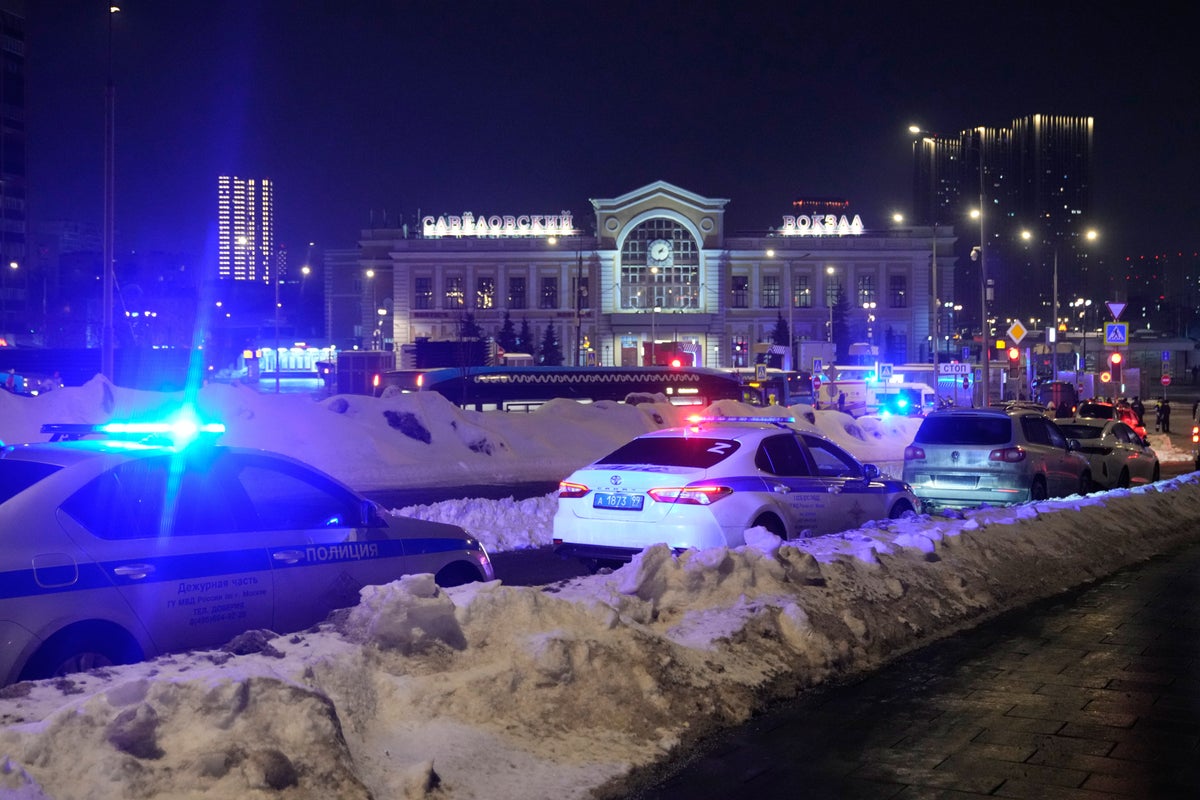
An unidentified attacker detonated an explosive device next to a police patrol vehicle in central Moscow early on Tuesday, killing himself and one officer, while injuring two others, officials have confirmed.
The incident occurred just after midnight near the Savyolovsky Train Station in the Russian capital’s downtown area, according to Moscow’s Interior Ministry branch. The assailant reportedly approached a traffic police car before detonating the device, resulting in the immediate death of an officer and hospitalisation for two colleagues.
Russia’s Investigative Committee has launched an inquiry into the attack. No details regarding the assailant’s identity, potential motives, or further specifics have been released.
The explosion took place on the fourth anniversary of President Vladimir Putin’s decision to deploy troops into Ukraine.
Western officials believe Vladimir Putin is no longer able to recruit Russian troops quickly enough to replace those dying on the battlefield in Ukraine.
However, armed forces minister Al Carns insisted that the depletion of Russia’s number of fighting men did not mean the UK could relax its commitment to raise defence spending.
The Government has announced Britain will provide new military, energy and humanitarian support to Ukraine, as Sir Keir Starmer is set to convene a coalition of the willing meeting alongside French President Emmanuel Macron.
Between 30,000 and 35,000 Russian soldiers are recruited each month, according to western officials.
But the number of those killed over the past three months is believed to have been higher than those who joined up.

This means that for the first time in the four years of war, for a sustained period, Moscow’s battlefield numbers are falling. Russia invaded Ukraine on February 24 2022.
Mr Carns described this as a “casualty uptick which is disproportionate in scale”.
Western officials believe this will have a significant impact on the Kremlin’s ability to “generate offensive power” for a spring or summer offensive, meaning that any Russian forward march would be sluggish.
It also raises the prospect of “coercive” mobilisation within Russia, such as conscription, rather than relying on the promise of large financial rewards to recruit soldiers.
Drone attacks continue to be the driving force behind the casualty rate on the battlefield, and officials believe that ground-based drones – so-called unmanned ground vehicles (UGVs) – will become ever more present over the coming year.
However, Mr Carns said individual soldiers remain “essential” for capturing and holding ground once drone attacks are over.
Britain has promised to spend 3.5% of national income on defence by 2035, which it made in line with a pledge by Nato members last year.
As the full-scale war in Ukraine enters its fifth year, the Government has announced a new package of support aimed at bolstering Kyiv’s war effort.
This includes a £20 million package to help repair and protect the nation’s power grid – often a target of Russian strikes – as well as £5.7 million assistance for Ukrainians whose towns and villages are on the front line of the war.
Ukrainian military medics are also being mentored by British surgeons, nurses and physiotherapists in battlefield surgery.
Foreign Secretary Yvette Cooper will spend Tuesday in Kyiv, where she will call out “Russification” tactics being used by Moscow in occupied Ukrainian territories.
People in the territories are being forced to adopt Russian passports, are prohibited from speaking the Ukrainian language and are arrested on arbitrary charges for expressing pro-Ukraine sentiments, according to the Foreign Office.
Russia’s bombardment of Ukraine continued over the weekend, with a barrage of missiles and drones killing one person in Kyiv and striking the country’s energy grid.
Ukrainian officials have meanwhile said that the next round of talks aimed at ending the war could come as early as the end of this week.