
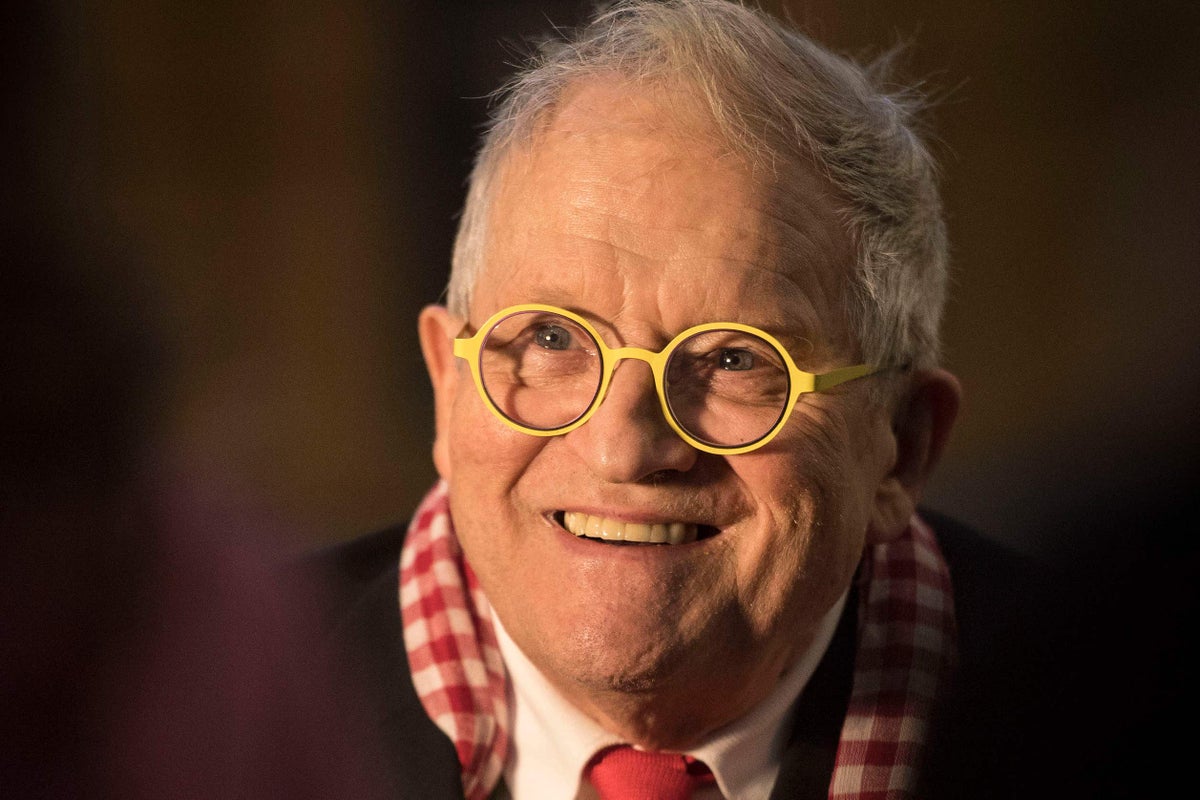
David Hockney, the bespectacled and besuited British artist whose work spanned the turquoise swimming pools of Los Angeles to the emerald hills of his native Yorkshire, has died aged 88.
He passed away peacefully at home on 11 June 2026, one month short of his 89th birthday, his representatives said in a statement.
Born in Bradford, Yorkshire, in 1937, Hockney was the fourth of five children by creative, politically radical parents: a devout Methodist, vegetarian mother, Laura, and father Kenneth, an accountant who was a conscientious objector during the Second World War.
He spent childhood summers near the coast arranging sheaves of corn into stooks, in fields that would become the subject of some of his most famous works. From a young age, he knew that he wanted to be an artist. Academically gifted, he failed his exams deliberately so he wouldn’t have to drop art and transferred to the Bradford School of Art, working from nine in the morning until nine at night.
While attending the Royal College of Art in London, where his fellow students included Patrick Caulfield and RB Kitaj, Hockney exhibited and sold work at important shows. He sold out his debut solo exhibition – David Hockney: Pictures with People In – at John Kasmin’s gallery in 1963, when he was 25. By this point, however, Hockney had already grown disillusioned with London, in its first throes of the Swinging Sixties, and set off for LA. “I never thought London was that swinging when I did come back,” he told The Guardian in 2010. “It was for a few people, but in LA it was for the many, which I preferred. In LA in 1964 there were enormous gay bars. There wasn’t anything like that in London, or even in New York.”
Hockney came out as gay aged 23 – seven years before Britain decriminalised homosexual acts – and explored themes of gay love in works such as “Domestic Scene, Los Angeles” (1961), and in the pink and blue-hued “We Two Boys Together Clinging” (1963), the latter named after the Walt Whitman poem about two rebellious lovers. He once described his early paintings as “homosexual propaganda”; moving to California allowed him to more freely explore themes of desire and intimacy among men. In June this year, he appeared near the top of The Independent’s annual Pride List, celebrating the LGBT+ people making change happen.

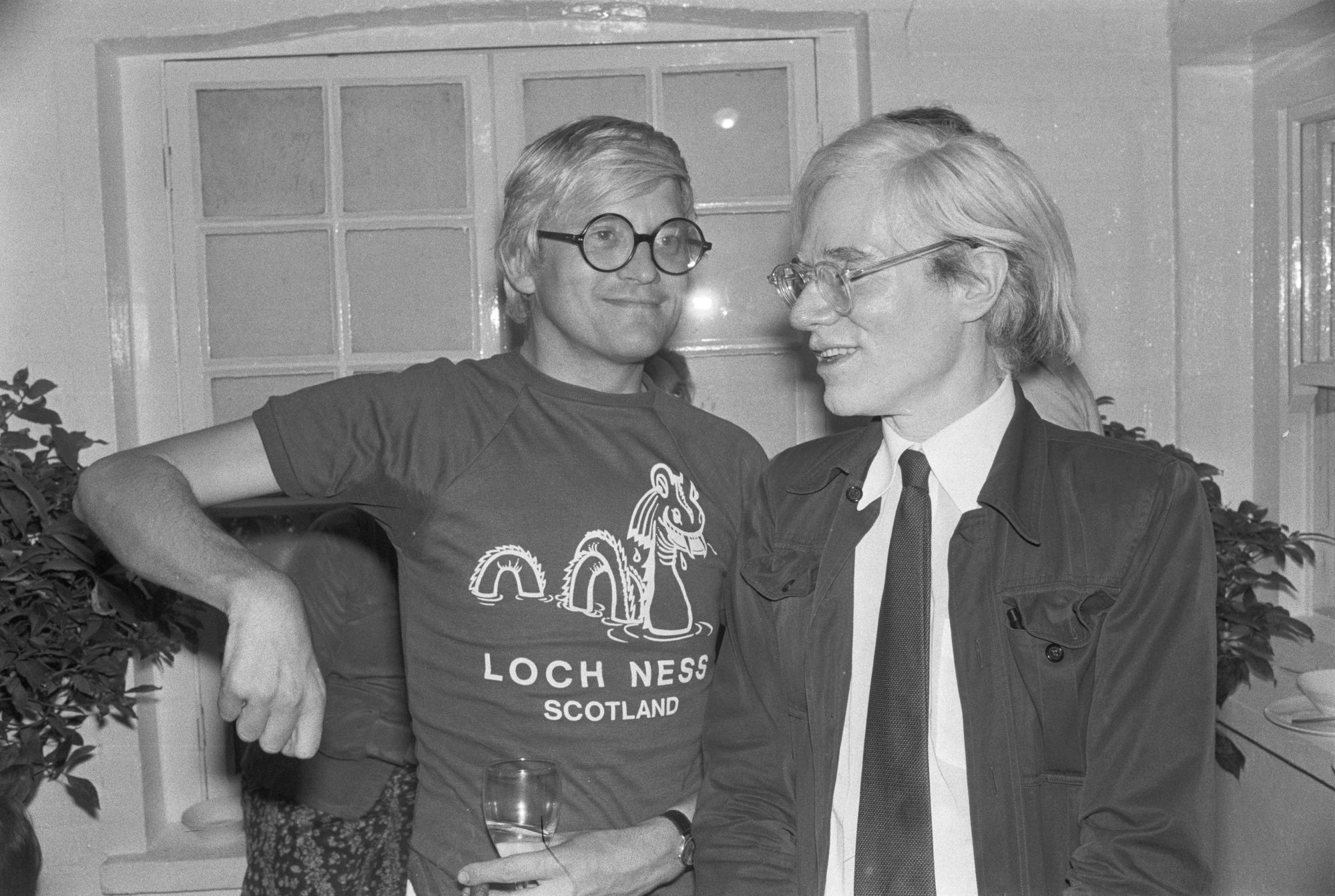
It was in Los Angeles that he met the writer Christopher Isherwood and his partner, artist Don Bachardy, along with other influential friends such as screenwriter and director Jim Bridges, and art dealer Nicholas Wilder, the latter whom the Los Angeles Times noted in its obituary possessed “an ability to find gifted artists and home in on their best works”. Hockney depicted Wilder in his 1966 painting, “Portrait of Nick Wilder”, and also included a drawing of him in his 1976 collection of lithographs, titled Friends.
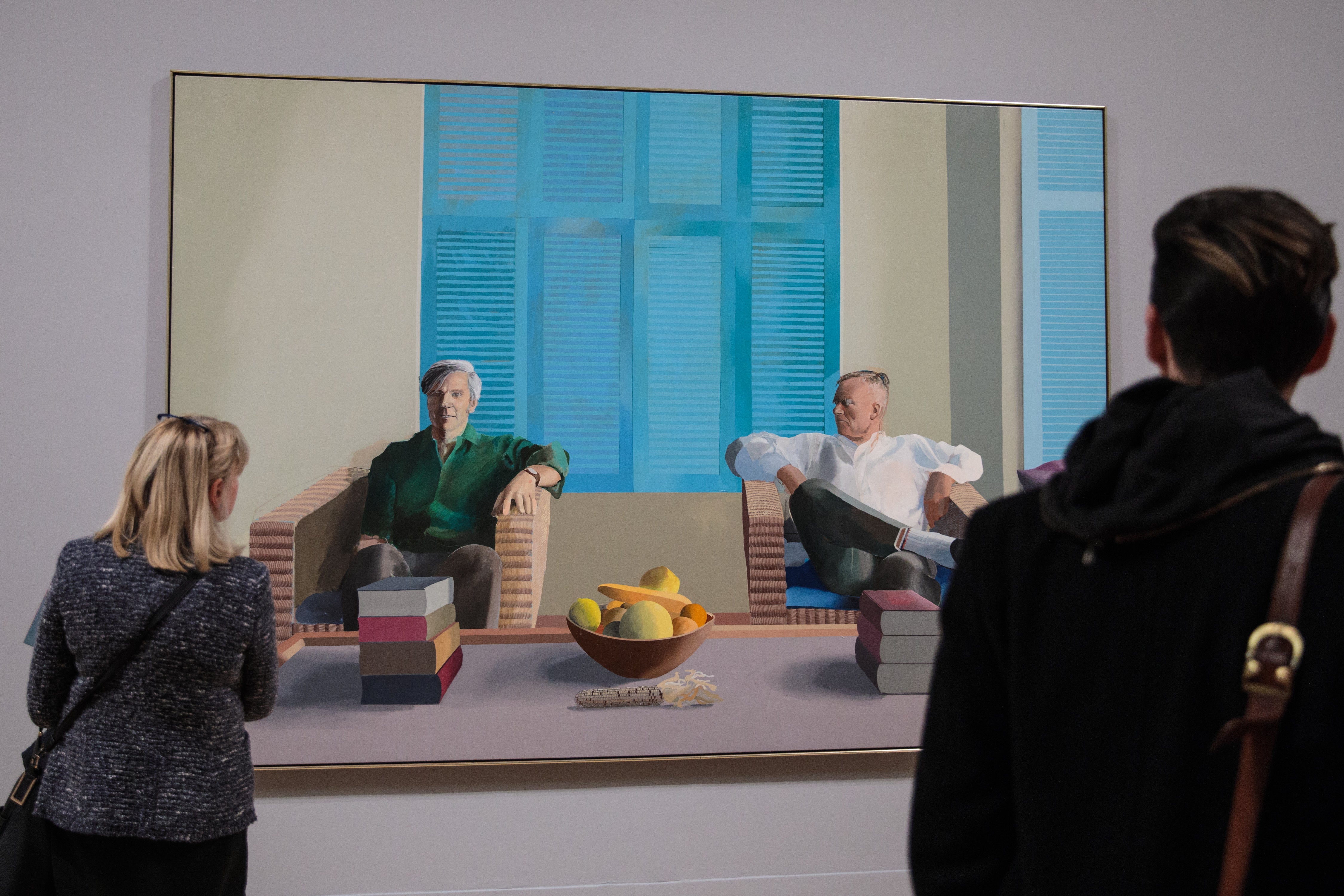
Isherwood and Bachardy, meanwhile, would become the subject of the first of Hockney’s ambitiously scaled double portrait series, 1968’s “Christopher Isherwood and Don Bachardy”. A literal picture of domesticity, it was at the time a daring depiction of a gay couple living together openly, completed shortly after the decriminalisation of homosexual acts in England and Wales, and just before the 1969 Stonewall Riots in New York’s Greenwich Village. “[Hockney] took up gay subject matter before anyone else,” remarked novelist Edmund White, “and the amazing thing is that he got away with it.”

Through the late Sixties and early Seventies, Hockney became the foremost chronicler of LA’s dazzling brightness: the azure swimming pools, the blazing sun in endless blue skies, the lithe, tanned bodies reclining on white sunbeds. In particular, he was fascinated by the movement of water: “The idea of painting moving water in a very slow and careful manner was (and still is) very appealing to me,” he said. “It is a formal problem to represent water, to describe water, because it can be anything – it can be any colour, it’s movable, it has no set visual description.”

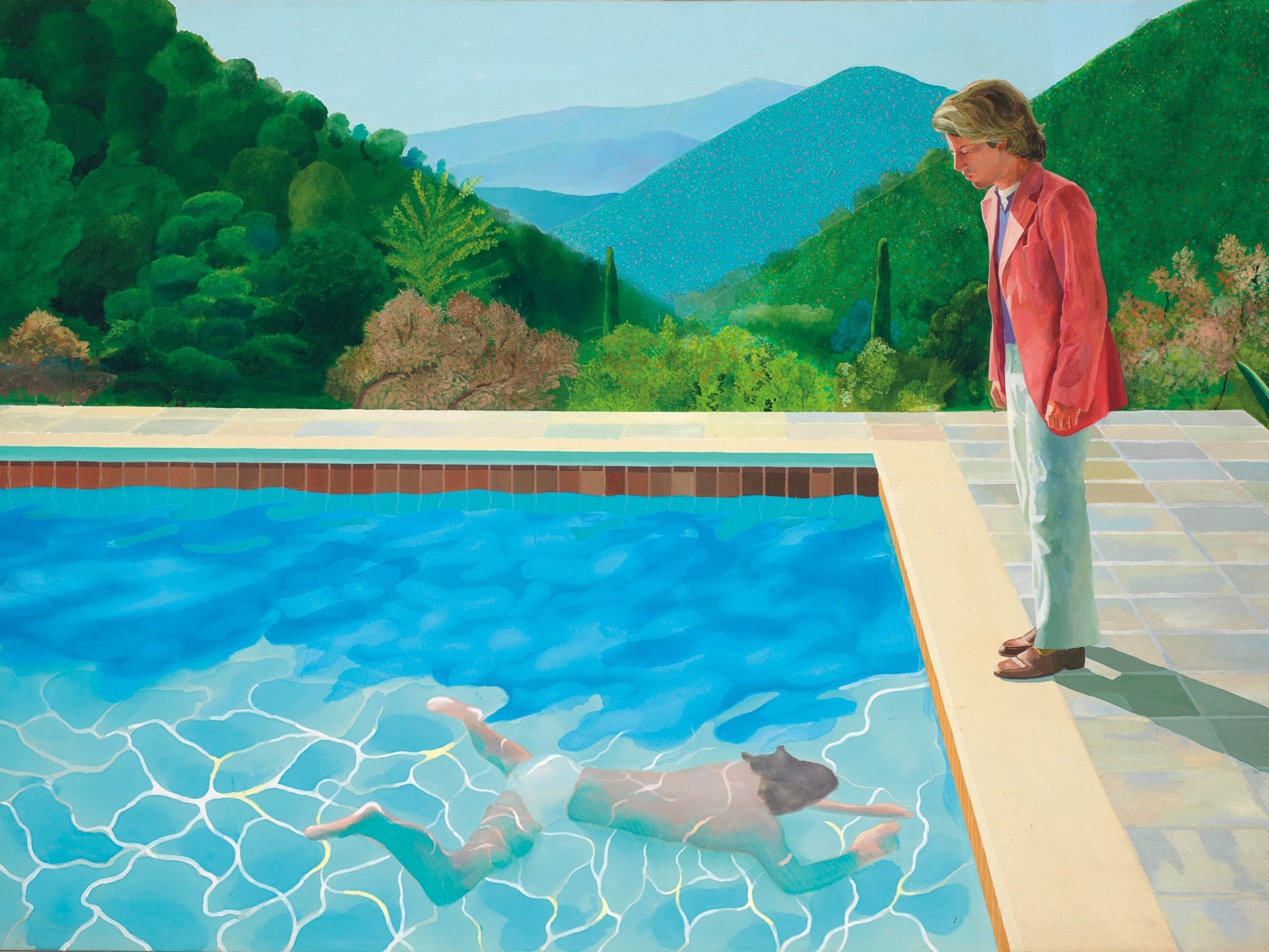
Swimming was depicted by Hockney as more of a state of mind than an act of physical exertion, and the bright blue pools served as the settings for some of his most important subjects. In one of the 20th century’s most recognised works, “Portrait of an Artist (Pool with Two Figures)”, he painted his former lover and muse, Peter Schlesinger, staring down at a swimmer under the water. In 2018, it became one of the most expensive works by a living artist ever sold at auction, going for $90.3m.
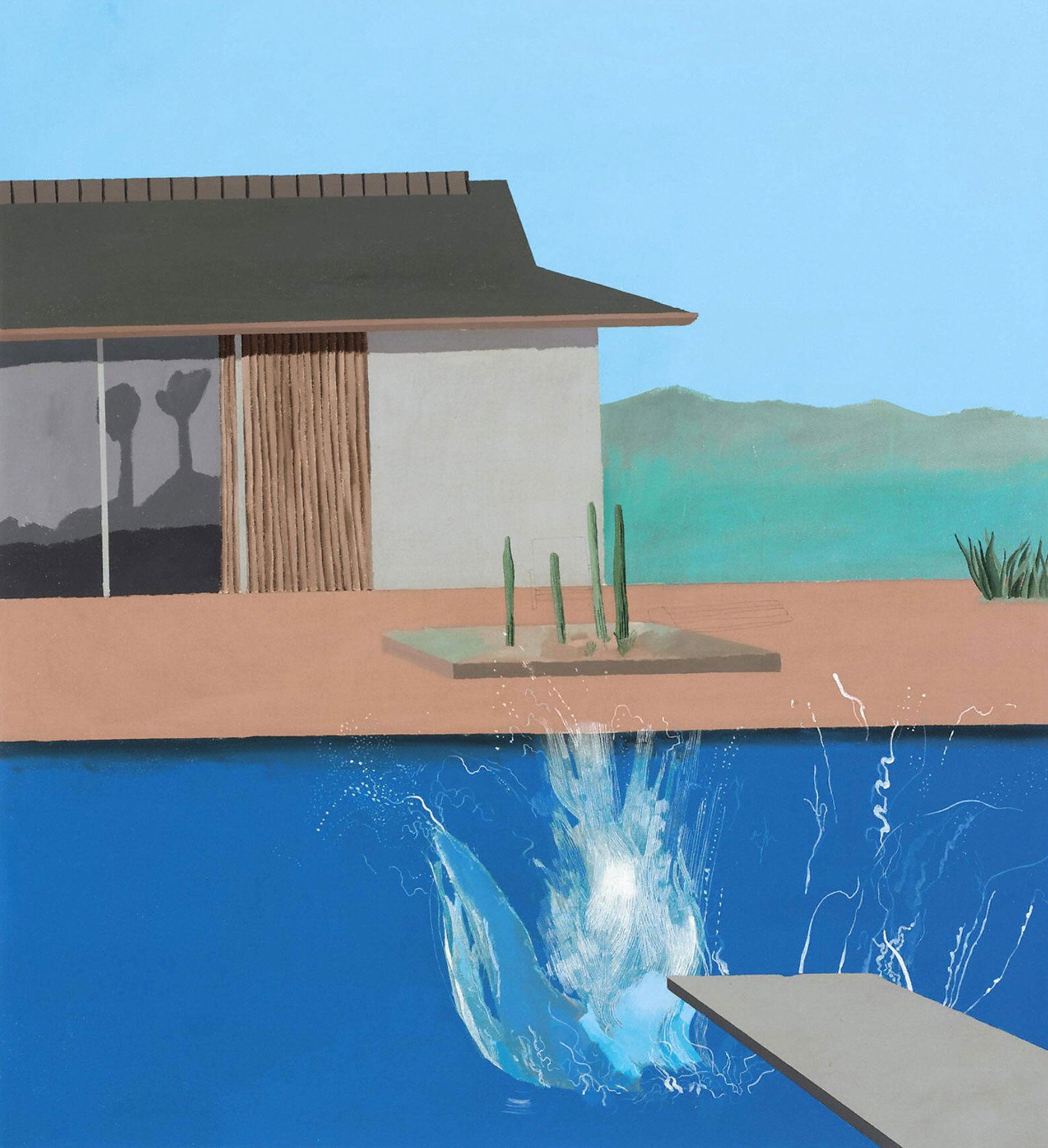
His famous “Splash” trilogy, too, demonstrated the artist’s ability to capture a singular moment in time. The Splash, one of his most famous works, sold for more than £23.1m at auction in London in 2020. Depicting the moment a diver hits the water in an LA swimming pool, it was sold to an anonymous buyer at Sotheby’s and is part of Hockney’s trio of works, alongside A Little Splash – which is housed in a private collection and has never appeared on the public market – and A Bigger Splash, currently on display at London’s Tate Britain as part of its permanent collection.

Hockney experimented with different mediums through his career, including drawing, printmaking, watercolours, and photography. He often returned to Yorkshire to visit his mother, who died in 1999, and began painting the landscapes that had surrounded him in childhood. In 2015, he sold his house in Bridlington and moved to Normandy, where he was inspired by the changing seasons, in particular the arrival of spring. He lived with his boyfriend and collaborator of many years, musician and photographer Jean-Pierre Gonçalves de Lima.
He was astonishingly prolific, arguably growing more so in his later years as his interest in technology led to groundbreaking exhibitions such as 2023’s Bigger & Closer (not smaller & further away), a collaboration with the National Theatre’s former executive director Nick Starr. A 4D cinematic immersion experience, the landmark work projected his paintings, photographs, opera sets, drawings and collages on four 11-metre-high walls at the Lightroom gallery in London.
In a 2023 interview with The Independent, Hockney cited his move to Normandy as the creative catalyst that gave him a “new lease of life”. He was unperturbed by the prospect of his death: “I don’t know what will happen,” he said. “It could be what I have described: an adventure.” This was how he viewed his life, too: “I don’t do regret,” he declared. “I do NOW. All artists do.”

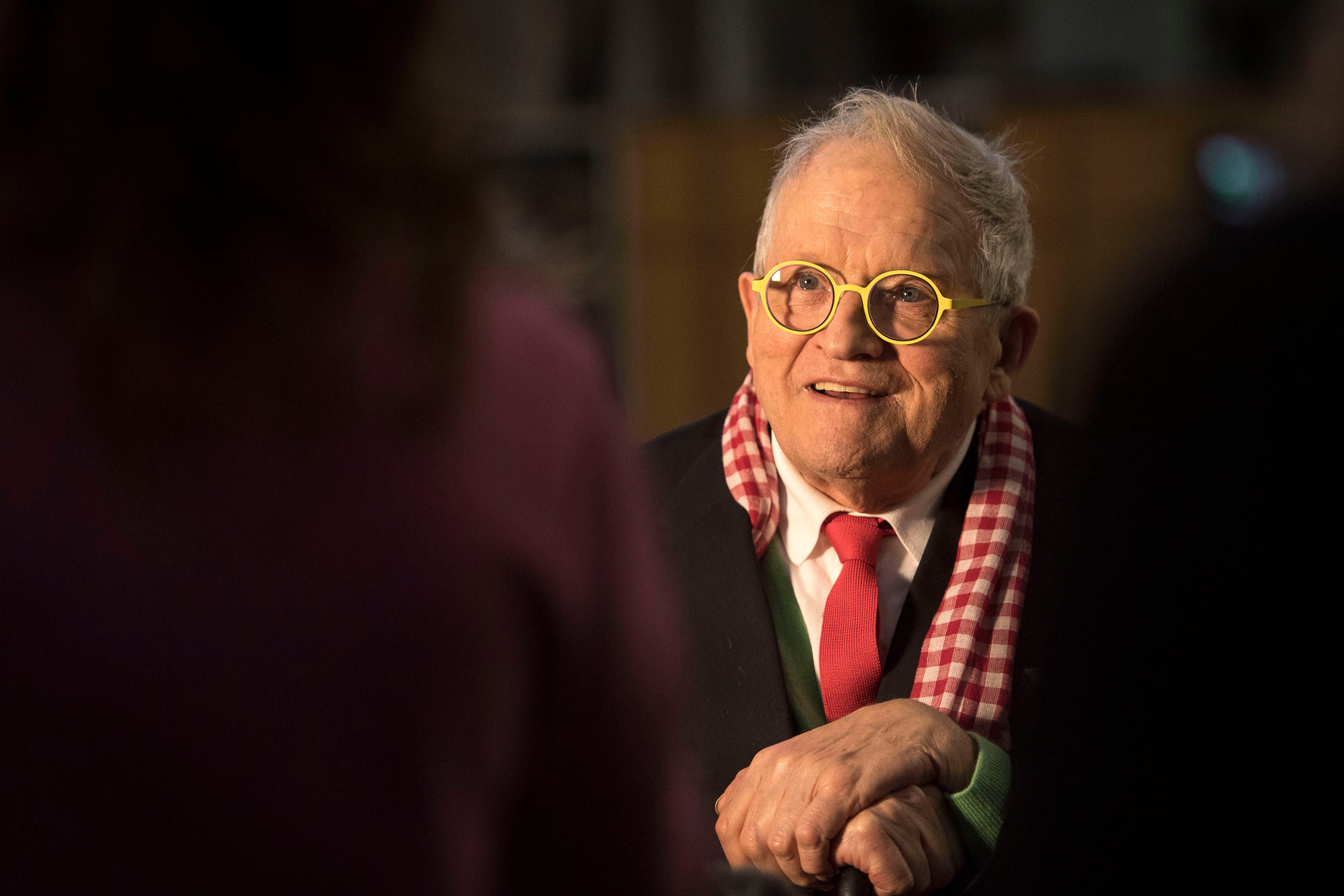
He was one of the most decorated artists of his generation, yet often spurned honours and prizes, telling the Bradford Telegraph and Argus in 2003 that he viewed them as “a bit suspect”. He once turned down a request to paint a portrait of the late Queen Elizabeth II, as he was too busy painting landscapes, and rejected a knighthood in 1990. In 2012, he was appointed to the Order of Merit – known as Britain’s “most exclusive club” – celebrating its 24 members who have achieved distinction in the arts, learning, science and public service.
Hockney continued to work right up until his death, always finding new sources of inspiration. For his “Drawing from Life” exhibition at the National Portrait Gallery in 2023, he offered paintings of a besuited Clive Davis, legendary record executive, and one of pop star Harry Styles in a gaudy yellow knit. In April he opened his third show in as many years at Paris’s Fondation Louis Vuitton, to critical acclaim. The show was named “David Hockney 25”, and spanned works from the past quarter-century. The Independent’s Mark Hudson claimed “this could be the most monumental David Hockney Show any of us will see”, adding that it was “imbued with the same sense of freedom and play that defines the British artist’s earliest works”.
“He is the Picasso of our times, and when I say that, people laugh at me, as Picasso was the archetypal artist of the 20th century. But David Hockney is also an incredibly popular artist whose work changes how we see things,” curator Sir Norman Rosenthal told The Independent last year ahead of Hockney’s Paris exhibition. “When there is a Picasso show at the Tate, there are queues around the block; the same with David. Both really looked, and showed what they saw, and brought joy.”
He is survived by his long-time partner and companion Jean-Pierre Gonçalves de Lima, his great-nephew Richard, who acted as studio assistant in his last years, his brothers Philip and John, and numerous nieces, nephews, great-nieces and great-nephews.
Details of memorials will follow in due course.