

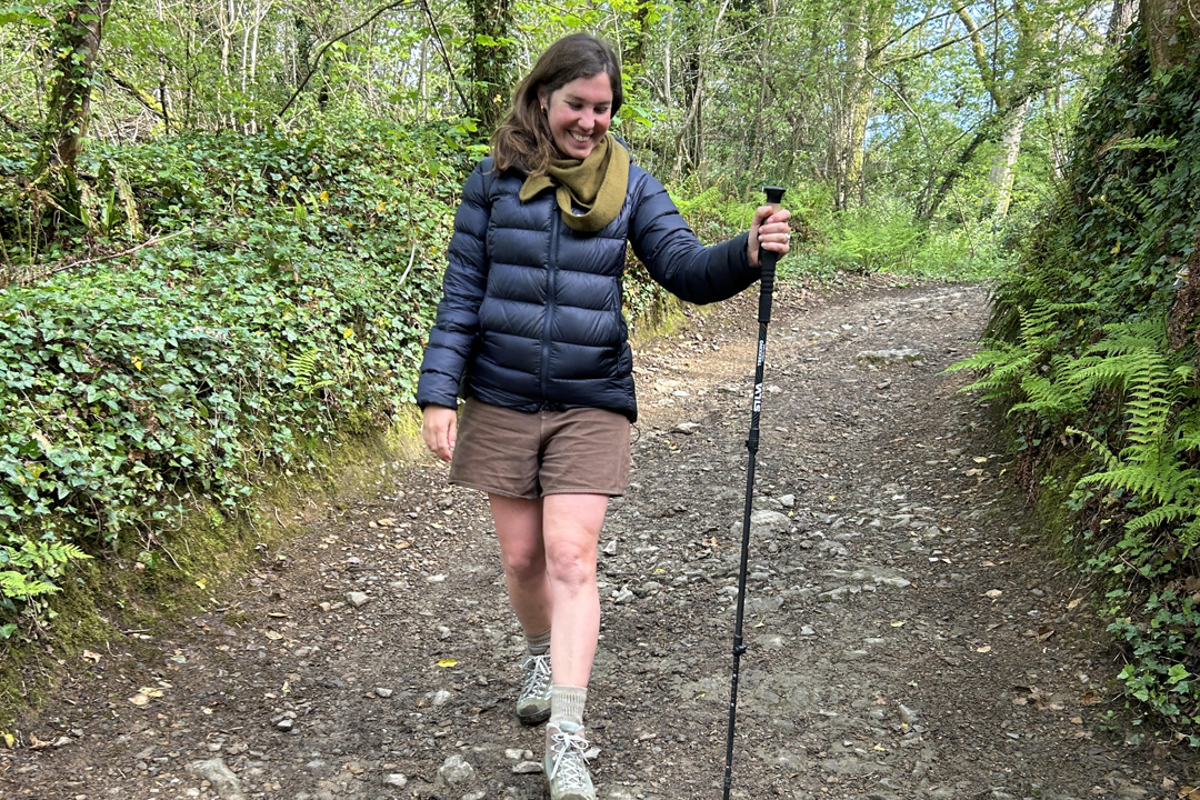
Your questions on walking poles answered
What are the best walking poles?
For a decent all-rounder, I love the Treklite carbon walking poles. Their carbon fibre build feels durable and the clip locks are straightforward to adjust mid-walk. They are a touch on the lengthy side when packed down, though. If that’s a concern for you, pick the Trespass forus walking poles instead, which pack down to just 43cm, or treat yourself to the premium Helinox ridgeline LBB120, which pack down to 51cm.
If you want the lightweight feel but would prefer aluminium, check out the Vango kesugi walking poles, which weigh 10g less per pole than the Treklite best buy.
How I tested walking poles
I tested each walking pole out on the trails, across different types of terrain. During my tests, I assessed the poles against the following criteria.
- Comfort: I looked at grip materials. Cork is great at wicking sweat and avoiding blisters, but foam is more immediately comfortable. I also paid attention to the wrist wrap and how the grip felt in hand.
- Ease of use and adjustability: This matters because many walkers either change their pole length throughout the walk (shorter uphill, longer for downhill) or use the poles on and off throughout the route. If it’s a faff to set up and adjust, the likelihood of you using the pole decreases. So I looked at the locking mechanism, how simple and secure it was and how much customisation it provided.
- Weight and portability: A heavy pole quickly feels cumbersome, and a long pair of poles is no good if you’re planning to pop them in your pack, so I took these practicalities into consideration, too.
- Stability: How well the poles performed across a variety of terrains was another important consideration.
- Build quality. Both aluminum and carbon fibre have their pros and cons (as detailed below), and these were noted across different types of terrain during testing.
What is the best material for walking poles?
Aluminium poles are typically the more affordable option and are known for their durability, with the ability to bend under heavy stress instead of snapping. Carbon fibre poles, meanwhile, are usually much lighter, better at dampening vibrations and offer a stiffer feel, although they can be more vulnerable to cracking under extreme pressure.
If you regularly tackle rocky or demanding trails, aluminium poles may be the better choice for their toughness. However, if you’re covering long distances and want to keep weight to a minimum, carbon fibre poles are worth considering.
It’s also worth paying attention to the grips. Look for materials such as cork or foam rather than plastic, as these provide a more comfortable hold, while helping to wick away sweat on warmer walks.
How to use walking poles
Typically used as a pair – with one in each hand – walking poles should work in rhythm with your steps. The key is to swing each one in sync with the opposite foot, giving you extra support and stability as you make your way along uneven ground.
You should be able to hold your elbow at a 90-degree angle when holding the pole by its hand grip, so either make sure you choose a fixed pole that’s the right length for your height or buy a fully adjustable pole. I prefer adjustable options – as well as getting a custom height, you can adjust the length on downhill stretches, which need a longer pole than uphill treks.
Why you can trust IndyBest reviews
The Independent‘s reviews are written by our experts, following real-world use. Cornwall-based writer Abby Driver has written extensively about health and fitness and, for IndyBest, has previously tried, tested and reviewed the best walking boots for women. Here, she has shared her honest verdict on walking poles after thorough hands-on testing.
I roadtripped the Scottish highlands and this is the only bag I took with me
.png?trim=0,0,0,0&width=1200&height=800&crop=1200:800 "Hasbro takes another shot at introducing Play-Doh for adults – UK Times")