

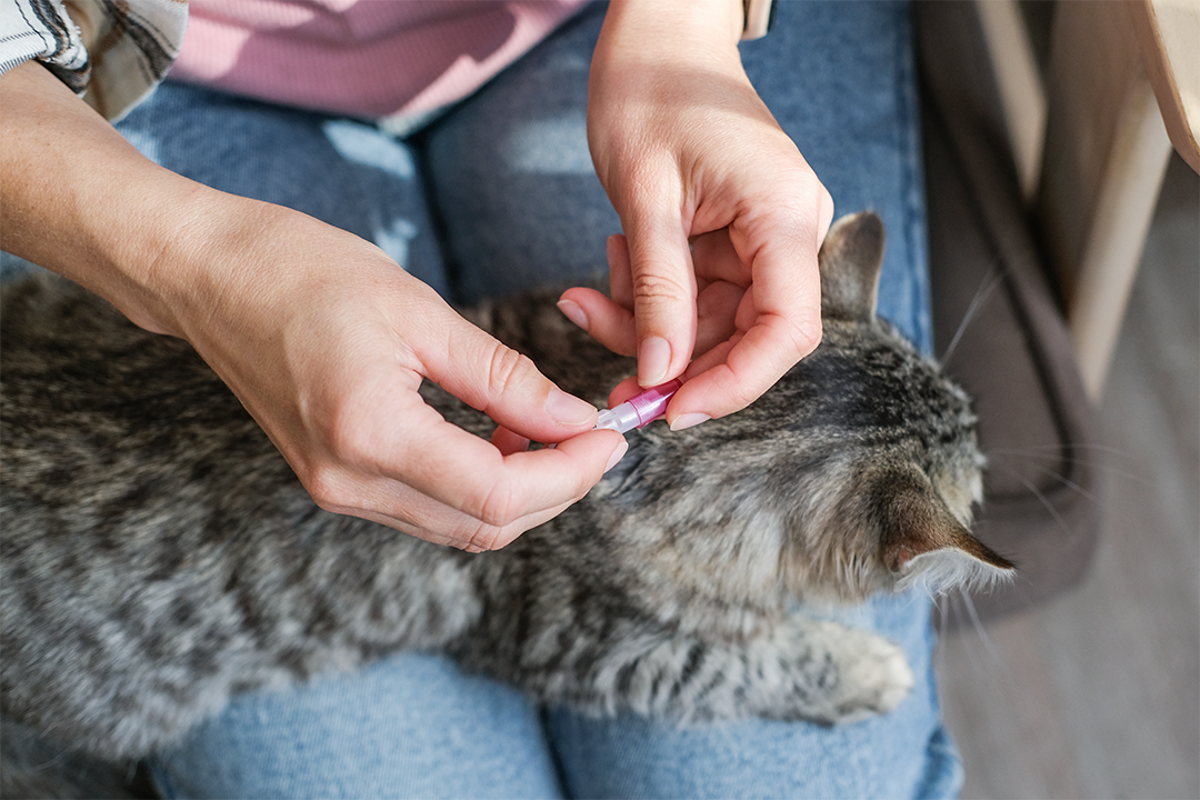
Fleas are a real nuisance and cause your cat discomfort. They’re persistent, but with the right approach and products, they can be dealt with effectively. To find out exactly how to combat the problem, we asked vets about everything from how often to treat cat fleas, to what products to use.
When it comes to treating for fleas, there’s something people often miss. There’s a misconception that fleas “spend most of their time on the animal”, when in fact they’re mostly in the home environment, says Will Chandler, owner of Brockwell Vets. With this in mind, if you’re dealing with a flea problem, he recommends that you do “regular and rigorous vacuum cleaning”. On top of this, you should consider a household flea spray, which prevents flea larvae from maturing into adults.
When treating the home, you want to make sure you cover “in and around bedding, under sofas, in dark corners”, and “usually in close proximity to where the cat usually likes to stay”, he says. Always read the instructions with these sprays. Caroline Reay, Blue Cross chief veterinary surgeon, notes that, when using sprays, you should pay “particular attention to how long you have to wait before your pet can re-enter the room”. And for a complete home treatment, she suggests you “wash bedding on a high temperature to kill flea eggs” and “treat all dogs, cats and rabbits in the household”.
Read more: 11 best cat foods, reviewed by pet owners
What are the best flea treatments for cats?
There are spot-ons or topical solutions (these are administered to the skin and absorbed into the body), oral treatments (tablets), flea collars or shampoos. The one you choose should depend on your cat. As Reay explains: “It can be difficult to give some cats tablets, although they can be given in food, whereas some cats hate having the spot-on put on.”
As for recommendations, Chandler’s top choice is Advantage spot-on (£5.25, Petsathome.com). “You want a product that will persist to some degree on the coat [of your cat], or one that will diffuse into the fat of the skin”, he explains, so “many of the collars with a fabric liner, flea powder and shampoos are not, in my opinion, an effective means to control fleas.”
Similarly, “over the counter tablets can be a great way to kill fleas quickly but they only kill the fleas actually on the animal at the time”, while you want to “manage the fleas in the environment or waiting to mature”, too.
When using flea products, never use dog products on cats, and always “weigh your pet and use a product that’s appropriate for their weight”, says Reay.
Advantage spot-on cat flea treatment
This spot-on treatment kills fleas and prevents larvae development. Said to prevent further flea infestation for up to three to four weeks, it is expected to kill fleas within one day after you have treated your cat. If you are repeating the treatment, this is to be done monthly. One treatment is suitable for cats weighing less than 4kg, with another available for cats more than 4kg.
Most over the counter spot-ons contain imidacloprid, which is the active ingredient in Advantage, or fipronil. Chandler says these ingredients are “going to be effective in many cases”. However, there tends to be less resistance to imidacloprid. “In my particular area, there is a lot of resistance to fipronil”, he says, “in the same way that bacteria become resistant to an antibiotic”. Imidacloprid can also be found in cat flea collars, such as Seresto’s cat flea and tick collar (£35.29, Amazon.co.uk), which Chandler says “would help with ongoing infections”.
With the potential for resistance to flea treatments, Chandler suggests seeing a vet if over-the-counter flea treatments haven’t worked. If you can see black dots (flea poo) “three to four weeks after applying a treatment”, it means fleas are “living long enough to feed and poo”, a sign that the treatment has not been effective.
Environmental contamination from spot-on treatments is worth considering too. Imidacloprid and fipronil have been detected in wastewater and the environment, where they impact biodiversity. In light of this, treating for fleas “only when we need, and with the right product, is going to be appropriate in the long term”, Chandler says. “I myself am biased to some of the oral prescription tablets, where environmental contamination is thought to be minimised.”
Prescription vs over-the-counter
Prescription treatments from the vet are “not always better” , says Chandler. The active ingredient in Advantage (£5.25, Petsathome.com) is identical to that in Advocate, which is on prescription, he explains. There’s no difference in potency either.
However, prescription products are good for treating other issues at the same time. “Many of the over-the-counter options are only active against fleas and sometimes ticks, whereas many [prescription only] products from the vet treat mange mites, many intestinal worms and sometimes lungworm, too” Reay explains.
With this said, it’s worth keeping in mind that some prescription options are particularly reliable. Prescription-only flea spot-on treatments and tablets containing isoxazolines are “generally very effective”, says Chandler, who is “yet to see resistance or an ineffective treatment with” it.
How often should you treat your cat for fleas?
Chandler recommends treating indoor cats in the warmer months, ” generally April to October”, as a preventive measure, because flea eggs need warmth to mature into larvae. If a cat was “under-treated during the mid to late summer, you may find that you see fleas in your home start to become active in the early winter when your central heating turns on.” However, cats in areas where there’s a higher flea population “might need more frequent administration”, he caveats, when monthly treatments “may be more appropriate”.
Read more: Best dog leads 2026, tried and tested with a golden retriever
While you don’t always need to, Chandler suggests the mid-to-late summer for treating indoor cats preventatively, . You “shouldn’t be needing to treat [an indoor cat] during the winter if you treat them effectively in the summer”, he says.
How do you know if your cat has fleas?
According to Battersea’s veterinary team, “increased scratching, especially around the neck and base of the tail”, is one of the most obvious signs. “You might also notice some bald patches or small scabs from all their itching and overgrooming”. However, some cats “won’t show much irritation at all, while others with flea allergies can be incredibly uncomfortable”.
With this in mind: “The real giveaway is flea dirt – tiny black specks in your cats’ fur. If you brush these onto damp cotton wool and they turn reddish-brown, its flea dirt. You’ll often find it where your cat sleeps too so keep an eye out. The life cycle of a flea can be as short as 12 days so an infestation can develop quickly.”

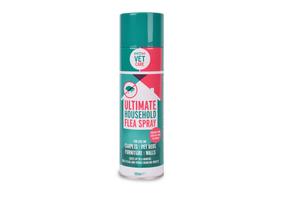
PDSA vet care ultimate household flea spray
If you’re looking for a household flea spray, the PDSA’s works to prevent the development and growth of flea eggs and flea larvae, and should be effective for up to six months.
We were able to put it to the test in a home with a mild flea problem, following the instructions that said to hold the spray 30cm away from the area and spraying walls up to 1m high. We also made sure to leave the area closed for two hours and then ventilated it for at least half an hour.
It was easy to hold the sprayer nozzle down, while the spray comes out continuously as a fine mist. It did run out after covering a large downstairs area, which could be down to overzealous spraying, but buying a couple of cans for larger homes would be wise. It does have a bit of a heady, chemical smell in use and when it’s settled, but it’s not so potent that it’s unbearable.
Read more: 10 best cat carriers, tried and tested by pet owners