Artemis II crew describe life inside Orion
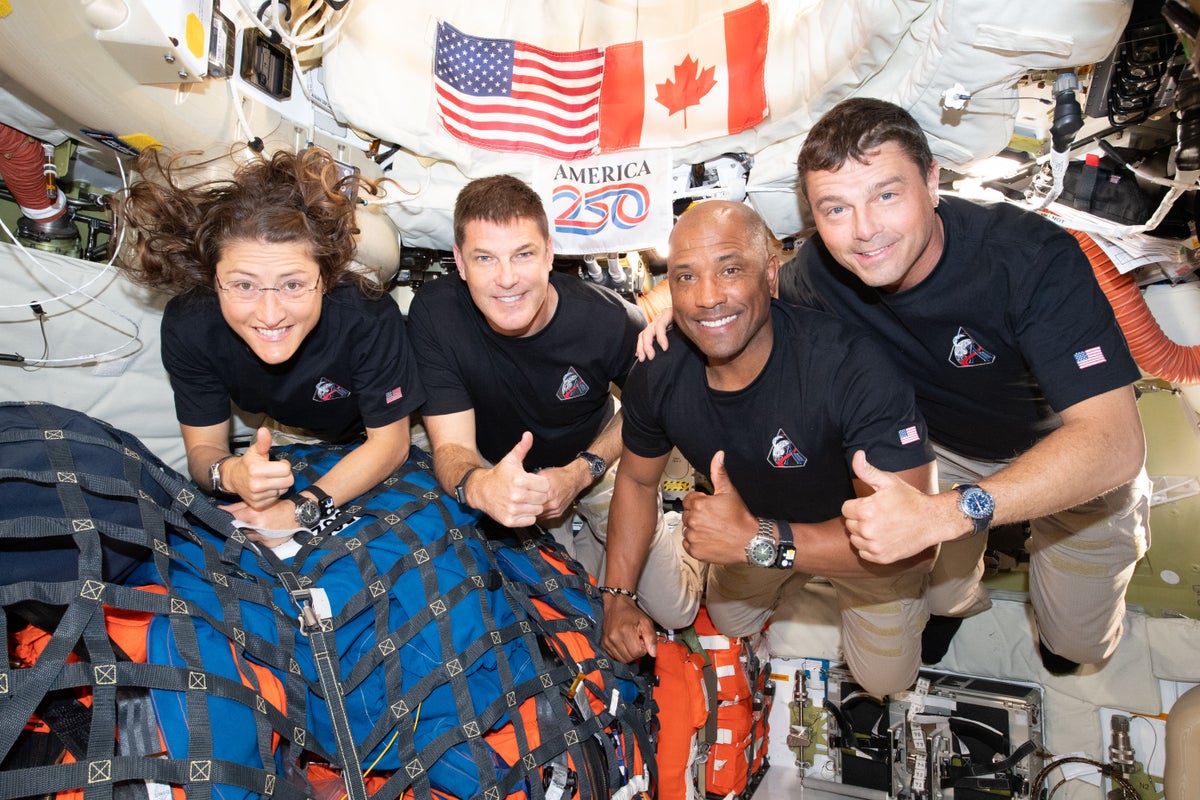
The Artemis II mission crew say that living inside the Orion spacecraft in microgravity makes the capsule feel bigger than it actually is.
Nasa astronaut Christina Koch added that it was still a tight space where crew members were constantly bumping into each other.
“We have loved living in Orion, and in fact, we’ve all said that sometimes you can forget where you really are because.. we’re in this small space that just gives us everything we need,” Koch said.
“Yes, it is bigger in microgravity, and yes, we are bumping into each other 100 per cent of the time.. A phrase that you often hear in the cabin is, ‘don’t move your foot.. I’m just going to reach for something right under it’, or, you know, ‘can I get there?’ And my goal is to get over there.
“And we’re constantly moving around, whether it’s to complete a task, to just eat, you know, to look out the window, to take a picture, everything we do in here is a four-person activity.
“But it’s also really fun.”
Maroosha Muzaffar9 April 2026 05:40
Artemis II crew describe rare moment they saw the eclipse from the far side of the Moon
The Artemis II crew that saw the eclipse near the far side of the Moon described the rare moment during their broadcast today and said that it was the most surprising and powerful moment of the mission.
The astronauts said that even though they had trained for it and seen simulations, the real experience was far more breathtaking than expected.

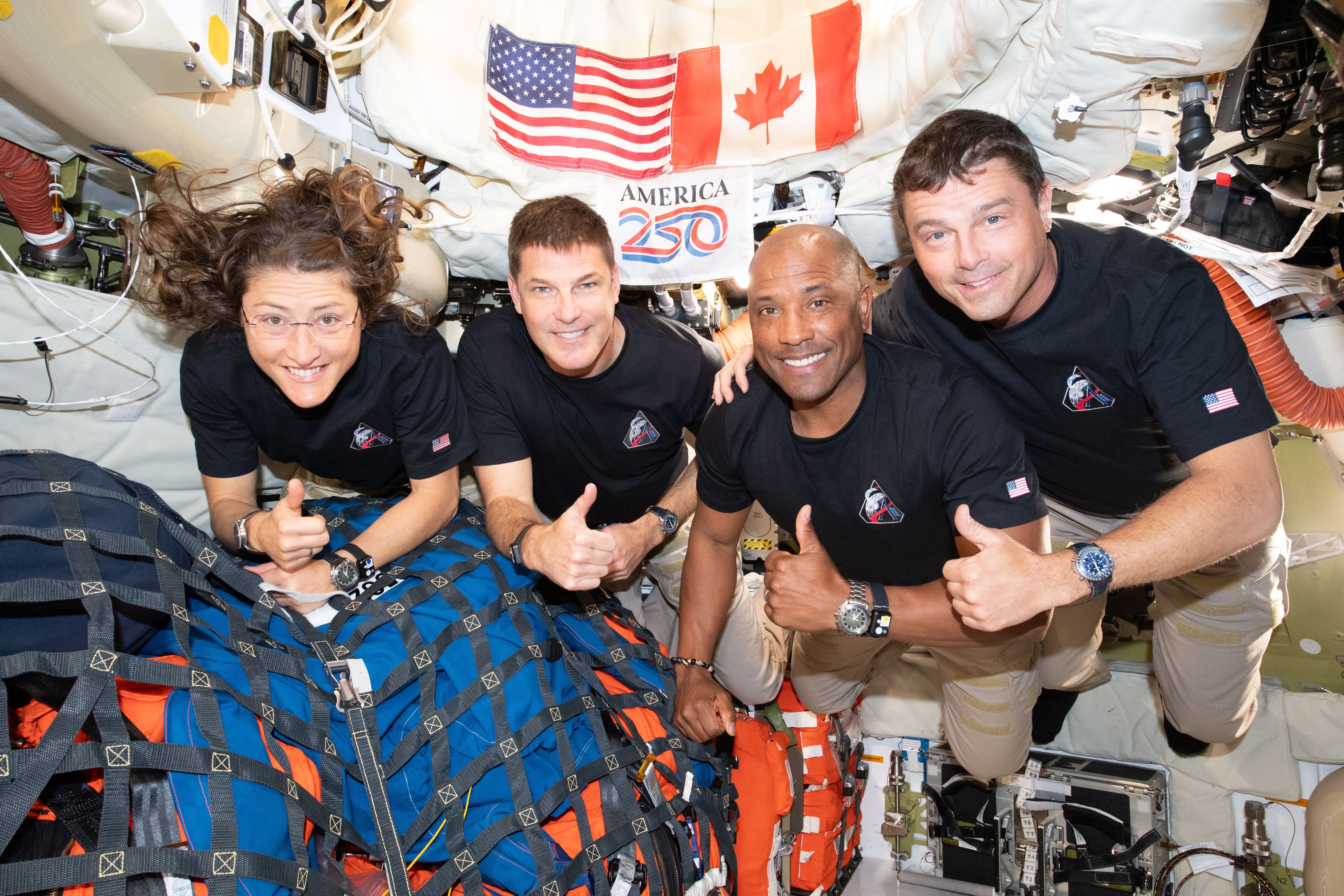
“The thing that we saw that really surprised me the most is we trained to view the eclipse from the far side of the moon, or after going beyond the far side of the moon. We saw great simulations made by our lunar science team, but when that actually happened, it just blew us all away.
“I mean, you heard the reaction real time, but it was the fact that we trained for it. I don’t want to say unhappy about, but launching on April 1 meant the far side wasn’t as limited as we were hoping.”
“That thing seemed to be a consolation, and it was one of the greatest gifts of that part of the mission.”
Maroosha Muzaffar9 April 2026 05:00
Nasa crew say they see Artemis II mission as a ‘relay race’
The Artemis II crew said during their broadcast that they see their mission as part of a relay race and that they’re not just focused on their own success, but on improving everything for the next team.
“Part of our ethos as a crew, and our values from the very beginning, were that this is a relay race. In fact, we have batons that we bought to symbolise physically that we plan to hand them to the next crew, and every single thing that we do is with them in mind.”

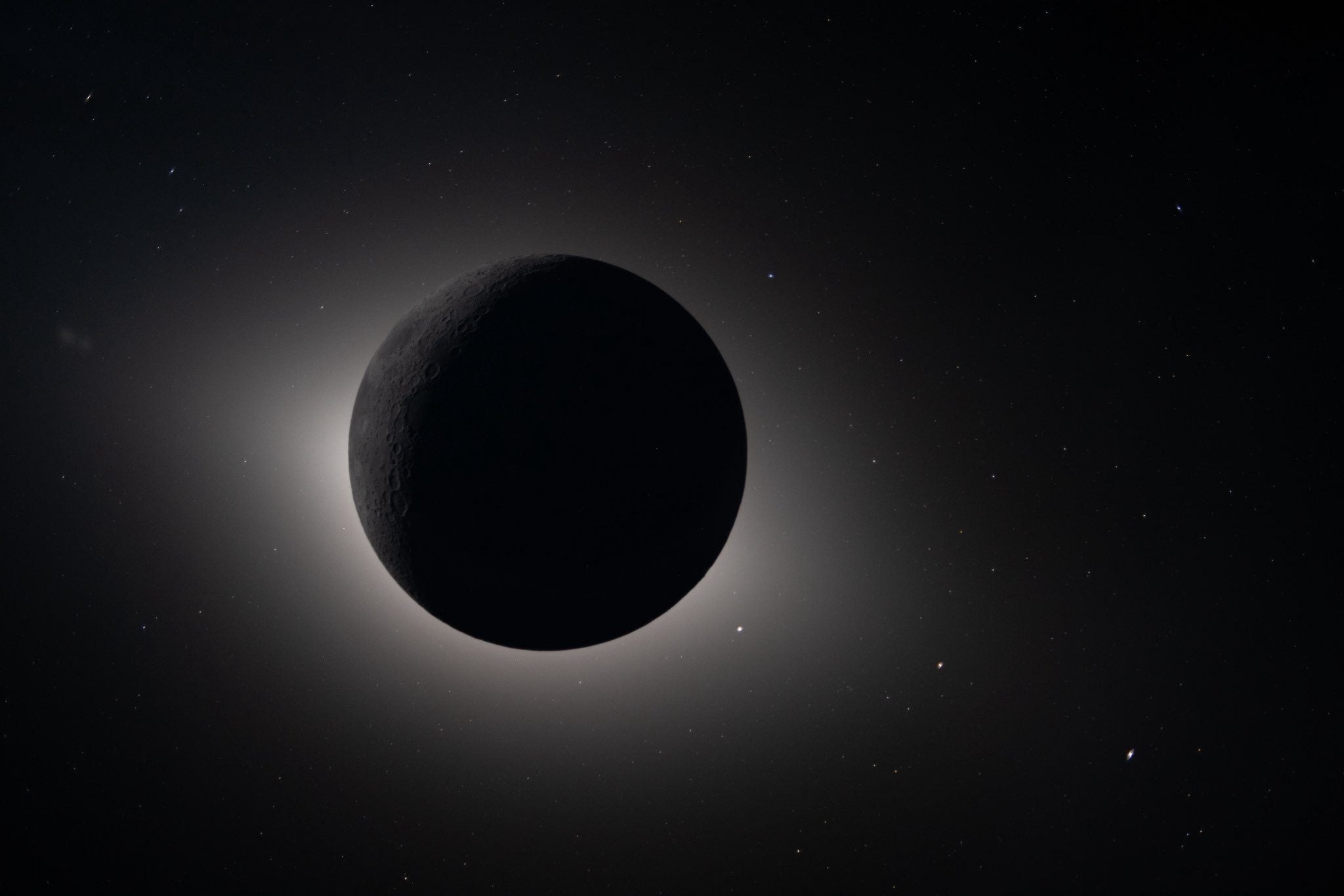
Nasa astronaut Christina Koch, said: “Oftentimes, it’s actually easier in human spaceflight, especially on a first mission, to accept some of the things that aren’t working quite right, or the operational workarounds. We have actually been diligent to try to fix everything.
“We’re always thinking from the perspective of: what is the next crew going to think about this? How will this help them to succeed?”
She added: “In the last three years, we’ve really just worked to make sure that they are set up for success. That’s all of the teams, not just the crew, but the flight control teams, the mission engineering rooms, the launch teams – everyone.”
Maroosha Muzaffar9 April 2026 04:16
Nasa highlights ‘Rise’, the mission mascot
Today, ‘Rise’, the little mascot of the mission, is taking over Nasa’s social media accounts.
You can read more about the mascot here.
(There’s not all that much going on in the mission today – the astronauts are just making their way home ahead of re-entry in a couple of days.)
Andrew Griffin8 April 2026 15:19
Wake up with the Artemis crew
Every morning, the astronauts on board the Artemis II mission are woken up by a new song, chosen and played by Nasa. Now the space agency has shared the playlist of songs that it has picked for them, so you can wake up to them too.
Andrew Griffin8 April 2026 14:40
Not just moons
The astronauts on board the Artemis II mission are also getting a stunning, in some ways unprecedented view of the rest of our galaxy too. Nasa has shared one of the photos they took of just that.
Andrew Griffin8 April 2026 13:29
Science continues as astronauts prepare for most dangerous part of the mission
The spacecraft has been pointed towards Earth, and the ship that will pick up the astronauts after they splash down in the ocean is on its way – but still the work to do science in space continues.
Today, for instance, they will be testing an “orthostatic intolerance garment”. That’s a special piece of clothing that is designed to help ensure astronauts keep their blood pressure and circulation as they come back into Earth’s gravity.
Andrew Griffin8 April 2026 09:49
Nasa says first return correction burn complete as Orion begins journey back to Earth
Nasa said the Orion spacecraft carried out its first thruster burn overnight to correct its path back to Earth.
“At 8.03pm EDT, the Orion spacecraft, named Integrity, ignited its thrusters for 15 seconds, producing a change in velocity of 1.6 feet-per-second and guiding the Artemis II crew toward Earth,” the agency said.
After the historic mission, the spacecraft is now returning to Earth and will make a splashdown in the Pacific on Friday.
Maroosha Muzaffar8 April 2026 08:40
Nasa explains why human observations are still needed in time of satellites and probes
The Artemis II crew observed 30 lunar targets during their flyby, including parts of the Moon never witnessed before by human eyes.
Nasa says “human eyes and brains are highly sensitive to subtle changes in colour, texture, and other surface characteristics”.
The agency added: “Having astronaut eyes observe the lunar surface directly, in combination with the context of all the advances that scientists have made about the Moon over the last several decades, may uncover new discoveries and a more nuanced appreciation for the features on the surface of the Moon.”
Details on the Moon observed by the crew include the massive 3.8-billion-year-old Orientale basin. Spanning nearly 600 miles, the crater – dubbed the “Grand Canyon” of the Moon – it was seen in full for the first time by astronauts.
Mission commander Reid Wiseman described its annular ring: “The annular ring, which I think everybody describes as a pair of lips or a kiss on the far side of the moon, from here is very circular in nature.”
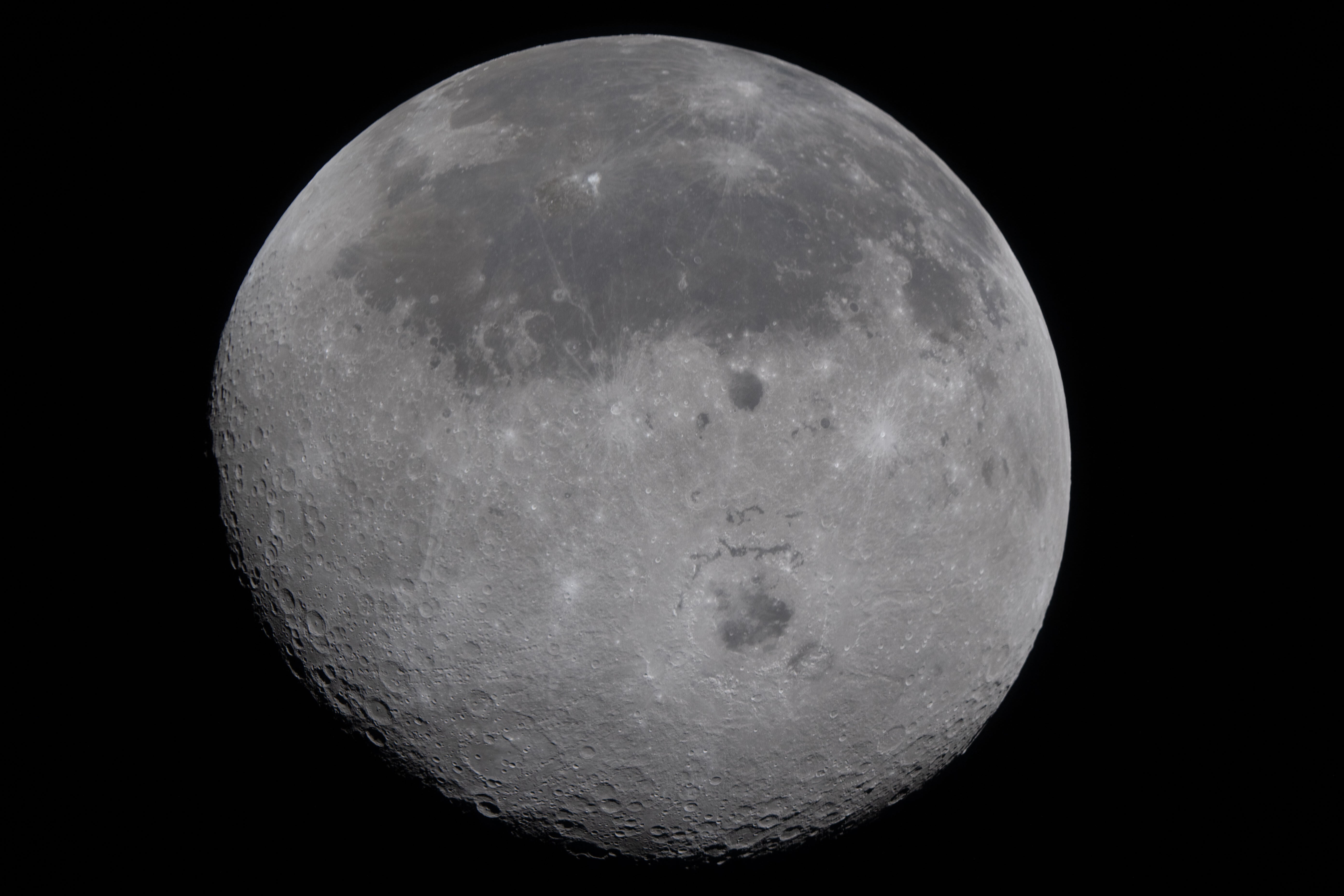
He added: “The northern part of it is wider, darker. The southern part is much lighter. It is very neat-looking … far more circular than I remember it looking in our training.”
During their flyby, the astronauts also suggested names for two additional craters. They named one after their spacecraft, “Integrity”, and the second “Carroll”, in honour of Wiseman’s late wife, Carroll Taylor Wiseman.
Maroosha Muzaffar8 April 2026 08:00
Nutella goes viral after jar floats in zero gravity during Artemis II livestream
The beloved chocolate spread brand has gained immense attention not just on this planet but also in space after the tub casually came on the Artemis II’s livestream, making a star appearance.
The jar moved across the spacecraft’s kitchen during NASA’s historic lunar mission.
The video garnered a lot of attention, with viewers claiming no marketing team could ever replicate this kind of ad placement.


Nutella goes viral after jar floats in zero gravity during Artemis II livestream
In a bizarre moment on the Artemis II livestream, a Nutella tub was seen floating in zero gravity across the cabin. The beloved chocolate spread brand has gained immense attention not just on this planet but also in space after the tub casually came on the Artemis II’s livestream, making a star appearance. The jar moved across the spacecraft’s kitchen during NASA’s historic lunar mission. The video garnered a lot of attention, with viewers claiming no marketing team could ever replicate this kind of ad placement.
Maroosha Muzaffar8 April 2026 07:20