.jpg?width=1200&height=800&crop=1200:800 "Earning around 0,000 will just qualify you as ‘lower-middle class’ in these 12 states, report says – UK Times")


Scientists have developed new methods to recreate perfumes used during the ancient Egyptian mummification process, an advance that could lead to multisensory museum experiences in the future.
Developments in archaeology have led to advanced methods for studying ancient DNA, proteins and other molecules, revealing insights into past diets, diseases and ritual practices.
In recent times, researchers have developed improved tools to study a category of molecules called volatile organic compounds (VOCs), which have the potential to reveal secrets of ancient fragrances.
Recreating ancient VOCs can provide unprecedented insight into perfumery, medicine, ritual, and daily life of the past, scientists from the Max Planck Institute in Germany say.
“Biomolecular data provide essential clues but the perfumer must translate chemical information into a complete and coherent olfactory experience that evokes the complexity of the original material rather than just its individual components,” archaeochemist Barbara Huber from the University of Tübingen said.
“This research represents a significant shift in how scientific results can be shared beyond academic publications,” Dr Huber, author of a new study published in Frontiers in Environmental Archaeology, added.

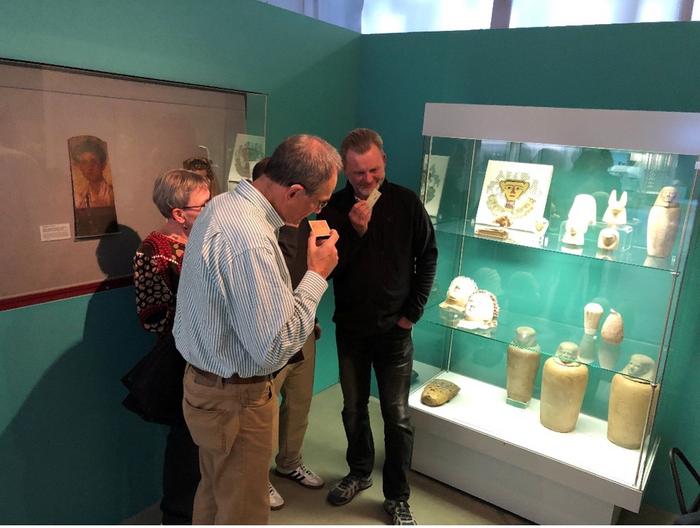
The study describes two new museum artefacts – “scented cards” and “fixed scent stations” – along with Egyptian mummy displays, opening a new dimension to understanding the ancient preservation process.
Scented cards are now provided to visitors during The Scent of the Afterlife tours at the Museum August Kestner in Hanover, Germany.
The scents came from a set of four Egyptian canopic jars belonging to Lady Senetnay, a high-ranking noblewoman who lived around 1450BC.
To recreate the fragrances, scientists developed multiple formulations, each with 20 ingredients, following interdisciplinary discussions among a perfumer, archaeochemist, archaeologist, and an olfactory heritage consultant.
“Since the materials identified in the chemical analysis of the original balm dated to antiquity, modern olfactory equivalents had to be identified that were both safe for public use and faithful to the biomolecular results,” the researchers explained.
“This scent development process raises the importance of recognising that today’s raw materials differ from those of the past and that interdisciplinary cooperation is required to capture the ancient past as accurately as possible.”

The scented cards, prepared by applying aromatic substances to paper or other diffusive objects, are available for visitors to hold, examine, and sniff at their own pace.
“Scent provides a new approach to mummification,,” museum curators Christian E Loeben and Ulrike Dubiel said, “moving away from the scare factor and horror movie clichés towards an appreciation of the motivations behind the actions and the desired results.”
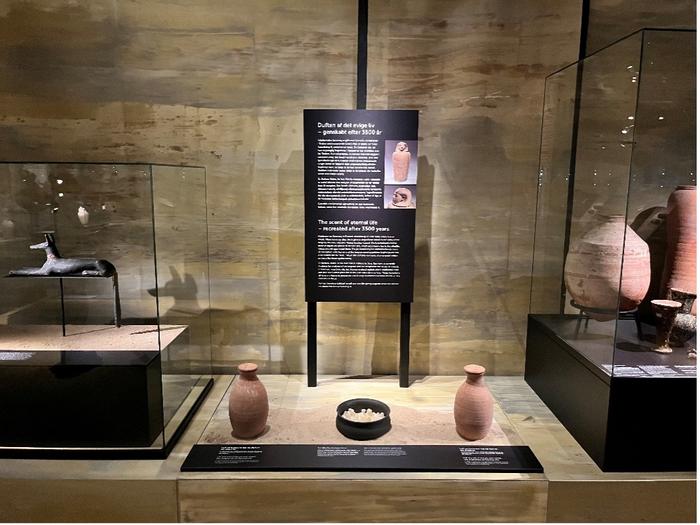
A scent station has also been installed at the Ancient Egypt – Obsessed with Life exhibition at the Moesgaard Museum in Aarhus, Denmark.
“The scent station transformed how visitors understood embalming. Smell added an emotional and sensory depth that text labels alone could never provide,” said curator Steffen Terp Laursen.
“We hope to offer museums compelling new tools for bringing visitors closer to past environments and practices via sensory interpretation and engagement,” said Sofia Collette Ehrich, another study author.