


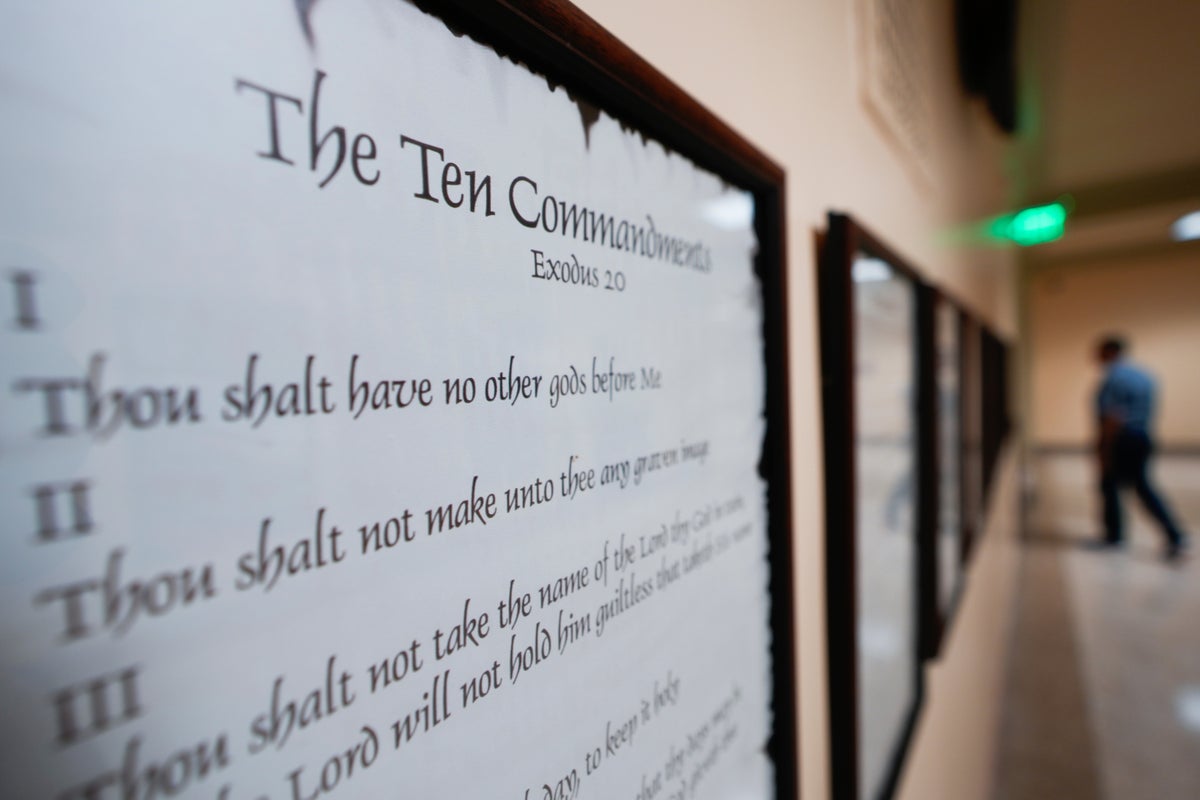
The Tennessee Senate on Thursday passed a bill requiring public schools to display copies of the Ten Commandments in a “prominent” place alongside historical documents such as the Constitution and Declaration of Independence.
Critics said the bill inappropriately mixes church and state.
“Our children need to be learning about reading, writing, arithmetic, science, tech to get them ready to be a world-class generation of kids who can push this country forward, not be indoctrinated to what the Bible says here and there,” Sen. London Lamar, a Memphis-area Democrat, said during floor debate. “That is the responsibility of the church, their parents, their families and whatever private entities they want to engage with in order to receive the teachings of Jesus Christ.”
Democratic Sen. Jeff Yarbro, of Nashville, said legislators should spend more time trying to follow the commandments themselves and warned the bill, which passed 27 to 6, would prompt costly legal battles.
“It’s inevitable that taxpayers will end up paying for litigation,” he said at a press conference.

“Our Constitution’s promise of church-state separation means that families – not politicians – get to decide if, when and how children engage with religion,” Rachel Laser, CEO of the advocacy group Americans United for Separation of Church and State, told The Independent in a statement. “Ten Commandments displays in public schools are clearly unconstitutional and a violation of families’ religious freedom.”
The group is urging Tennessee Gov. Bill Lee to reject the legislation.
Backers of the bill say the Ten Commandments are an important part of the ethics and principles that went into the nation’s founding.
“We are not forcing religion on anybody,” bill sponsor Sen. Mark Pody said on the floor. “We are saying in the founding of this nation, the Ten Commandments was one of the founding documents.”
The law, SB 303, now needs to be reconciled with a House version that passed earlier this month. The Senate bill makes showing the commandments mandatory, while under the House bill it is optional.
The House Education Committee is set to take up the bill on March 24.
Tennessee joins a growing group of Republican-led states seeking to require the Ten Commandments in schools.
In 2024, Louisiana became the first state to pass such a law. The bill prompted immediate challenges, though in February a federal appeals court overruled a lower decision blocking the law, finding that the challenge was premature because posters of the Ten Commandments hadn’t gone up in classrooms yet.


This week, a federal court struck down a similar Arkansas law.
“Nothing could possibly justify hanging the Ten Commandments—with or without historical context — in a calculus, chemistry, French, or woodworking class, to name a few,” Judge Timothy L. Brooks wrote in his ruling.
The state has vowed to appeal.
A federal appeals court has heard arguments over a Ten Commandments law in Texas but hasn’t issued a decision.
The patchwork of rulings could eventually yield a Supreme Court fight, a major test of how the conservative-leaning high court would rule on religious liberty as Republicans across the country push to increase the influence of Christianity in public schools.
Tennessee itself is an example of the trend.
The same day the state senate passed its Ten Commandments bill, lawmakers in the upper house cleared the “Charlie Kirk American Heritage Act,” in honor of the slain conservative and evangelical activist.
The bill allows public schools to teach about the “positive impacts of religion” in history classes, though it is not a requirement.