


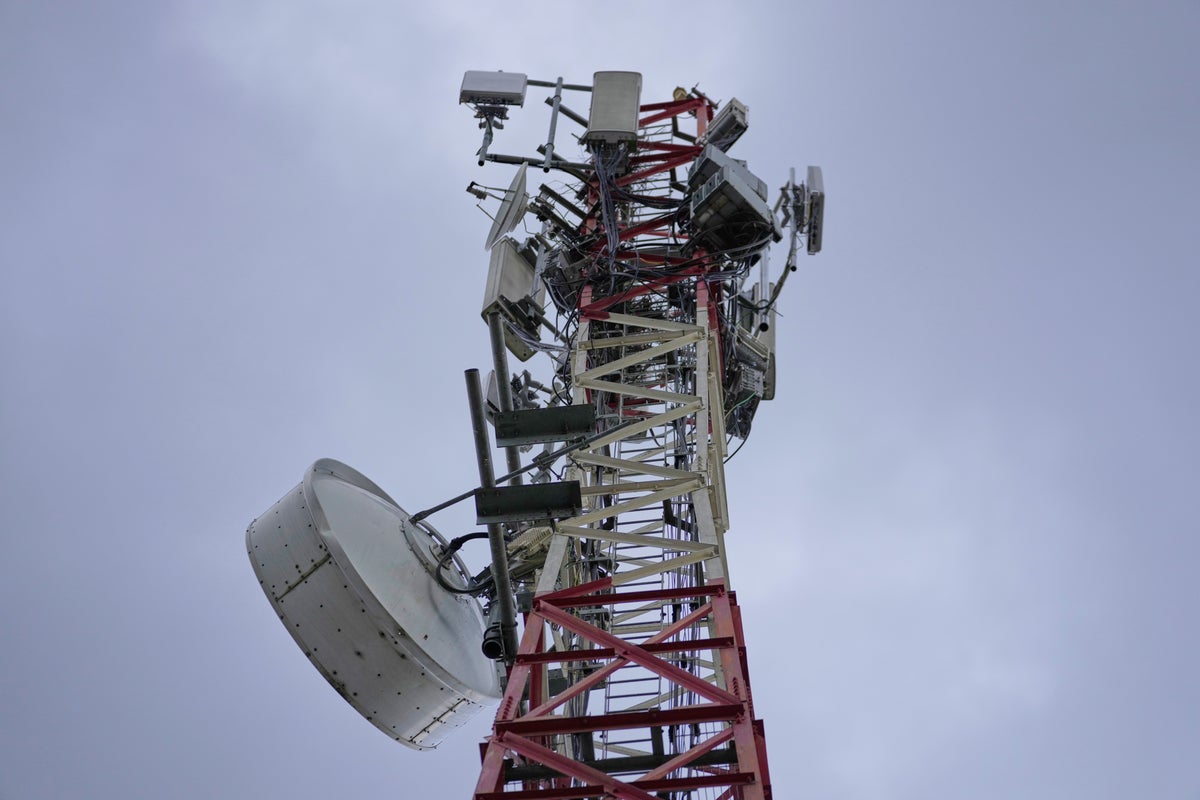
Rising diesel prices linked to the Iran war are adding urgency to a shift already underway across Africa to move cellphone towers off fossil fuels and onto solar power.
Diesel, which powers the majority of Africa’s roughly 500,000 telecommunications towers, has become more expensive and sometimes harder to secure in recent weeks as global fuel markets tightened following the conflict. Several African countries that rely heavily on imported fuel have reported price spikes and supply disruptions, prompting governments and companies to reassess energy strategies.
The transition to cleaner power for the towers that provide cellphone service predates the latest price shocks, driven by cost pressures and climate goals. But the war in the Middle East has accelerated the push.
“Diesel has always been a major cost, but recent global events have made it even more volatile,” said Lande Abudu, senior energy specialist for Africa at GSMA, a global industry organization representing mobile operators. “That strengthens the case for solar and hybrid solutions.”
Across the continent, mobile network operators are increasingly adopting hybrid systems that combine solar panels, battery storage and limited diesel backup. Some are aiming for fully solar-powered sites over time, particularly in rural and off-grid areas where extending electricity grids is costly.
Cellphone towers in Africa have traditionally been powered by diesel generators, often large industrial units that require operators to manually refuel them. In contrast, solar-powered towers rely on sunlight, using solar panels to generate electricity and battery systems to store energy for continuous operation.
Globally, most telecommunication towers in developed markets such as the United States and India are connected to the electricity grid, with diesel generators used mainly as backup during outages. In parts of Southeast Asia, including Indonesia, operators have also relied heavily on diesel but are now pursuing similar transitions to renewable energy.
Last month, American-owned Atlas Tower Kenya said it was investing $52.5 million to construct 300 new, solar-powered telecommunication towers to serve major operators, including Safaricom, Airtel and Telkom Kenya. The firm currently has 82% of its 500 towers solar powered.
“It’s a significant shift, but there’s still a long way to go,” said Abudu.
Financial arguments for solar-powered towers
The economics are becoming increasingly compelling. Energy accounts for up to 60% of operating costs for telecom towers in off-grid areas. Diesel, once the default solution, has become more expensive and harder to manage, with challenges ranging from transport logistics to theft and maintenance.
Vodacom Africa said its energy costs rose 5% to $300 million in 2025 from the prior year, citing higher electricity tariffs and fuel prices. The company operates in Egypt, South Africa, Congo, Mozambique, Tanzania and Lesotho, and owns subsidiaries in Kenya and Ethiopia through Safaricom. Safaricom last year raised $153.6 million in green bonds to help it transition its towers to solar power.
In countries like Nigeria, cost pressures have shifted sharply. The removal of fuel subsidies in 2023 triggered a surge in diesel prices, rising by as much as 200% within a year, and operators now spend $400 million annually to keep towers running. Recent global price increases tied to the Iran conflict have added further pressure.
Companies are responding by accelerating clean energy deployments. Firms such as iSAT Africa are rolling out solar-powered towers backed by new financing models, while major operators including Orange, Vodacom, MTN Group and Airtel Africa are expanding solar and hybrid systems across their networks.
“By replacing diesel-powered telecom towers with fully solar-powered infrastructure, we expect to reduce the carbon emissions associated with mobile network operations,” said iSAT Africa CEO Rakesh Kukreja in March, announcing new funding for clean energy tower projects.
Early results show significant savings. MTN operations in South Sudan have cut fuel spending by about 30% after adopting solar power, while Airtel Africa, working with ENGIE Energy Access, has reduced diesel use by more than half at sites in Zambia and Congo.
Vodacom Africa said in its 2025 sustainability report that connecting towers to national grids and rolling out more solar and battery were key parts of its strategy to replace diesel generators.
Improving network reliability
The benefits go beyond cost. Solar-powered towers are less vulnerable to fuel shortages and generator failures, improving reliability in underserved areas. In parts of northern Nigeria and Congo, cellular outages linked to fuel shortages predating the war have caused disruptions to services ranging from mobile money transactions to emergency communications.
Replacing diesel generators with solar energy could help close Africa’s connectivity gap, where about 65% of people who could benefit from mobile internet remain unconnected, according to the GSMA.
“Renewable energy systems enable faster and more cost-effective expansion into underserved areas,” Abudu said.
In rural Kenya, residents in some off-grid communities say solar-powered towers have improved service stability, enabling more consistent access to mobile banking, education and health information.
“Before this telecommunication mast was installed, we struggled to process mobile money payment or even call for help during medical emergencies,” said Martin Imwatok, a teacher in northern Kenya. “When these towers go off, business and life stop.”
Africa’s reliance on diesel is more pronounced due to weaker grid infrastructure, making the shift both more challenging and potentially more transformative. However, regulators say the transition could deliver broader benefits. In Nigeria, the telecom regulator has encouraged operators to integrate towers into solar minigrids that can also supply nearby communities.
“These telecom towers can act as anchor clients for solar minigrids, supplying electricity not only to the towers but also to nearby homes, businesses and public services,” said Aminu Maida, head of the Nigerian Communications Commission.
As fuel prices remain uncertain amid global tensions, industry experts say the case for cleaner energy will only grow stronger.
“This is no longer just about climate,” Abudu said. “It’s about resilience, cost and keeping Africa connected.”
___
The Associated Press’ climate and environmental coverage receives financial support from multiple private foundations. AP is solely responsible for all content. Find AP’s standards for working with philanthropies, a list of supporters and funded coverage areas at AP.org.