

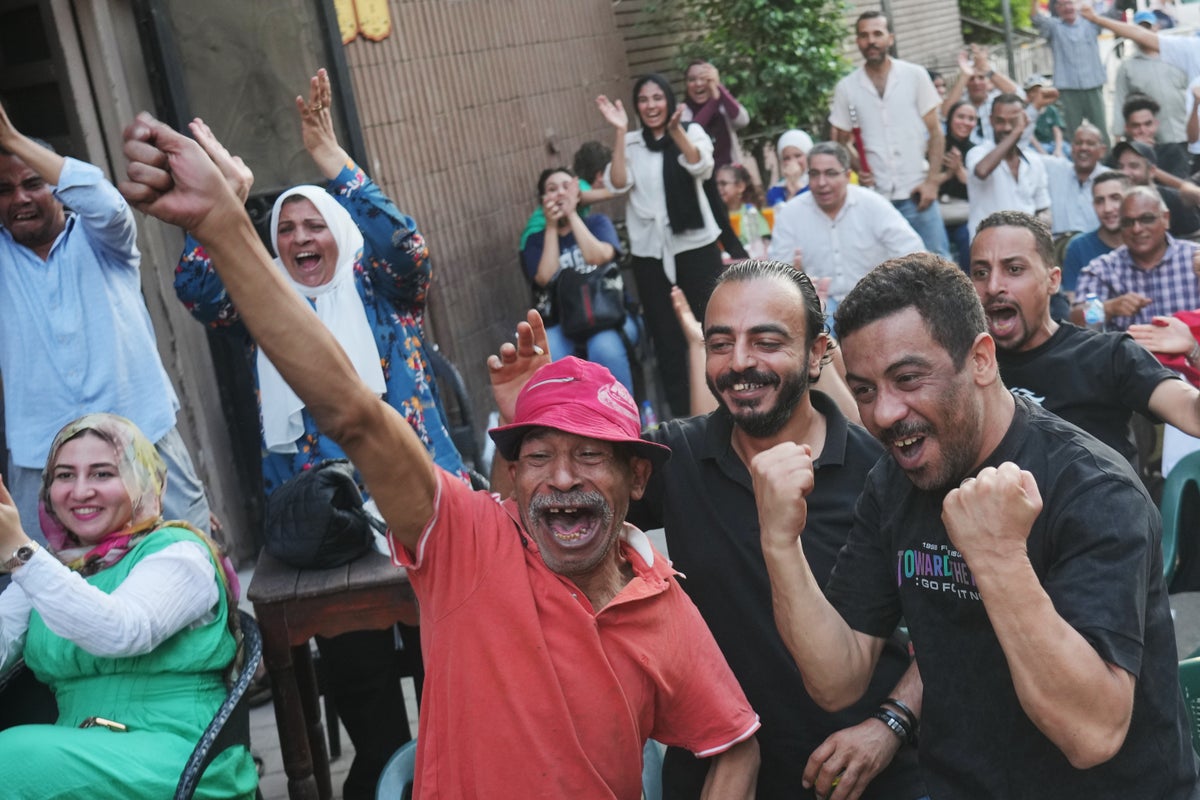
The small coffee house in Cairo was turned Tuesday into a tiny stadium.
Several hundred people, mostly men and boys as young as 7, gathered around wall-mounted screens ahead of the kickoff whistle.
The scene played out across the soccer-mad nation as Egypt faced the defending World Cup champion in the round-of-16 fixture in Atlanta.
It was a historic day for millions of Egyptians even after their national team’s adventure reached its end with Tuesday’s 2-3 loss to Argentina.
“It’s a brutal scenario,” Ahmed Saadany, a teacher, reflected after the game. “The journey shouldn’t have ended that way.”
With their own star Mohamed Salah, Egypt reached the round of 16 by beating Australia 4-2 on penalty kicks after a 1-1 draw in the round of 32 on Friday.
The Pharaohs advanced to the knockout stages — their first ever — after securing the second place in the Group G, behind Belgium.
Preparations for the game started well ahead of the kickoff at 7 p.m. local time. Rows of plastic and wooden chairs faced wall-mounted TV screens as fans flocked into hundreds of thousands of coffee houses and fan-zones across Egypt.
In squares and main thoroughfares, vendors were seen selling Egyptian flags, whistles and fan paraphernalia in preparation for the game.
Throughout the day, Egyptian flags were seen fluttering over vehicles and balconies, with debates on television and in public spaces, like coffee houses and markets, centering for days around the national team’s performance and its anticipated game against Argentina.
“Overall, the performance was excellent,” said Hassan Shehata, taking his seat in a packed coffee house in Cairo ahead of Tuesday’s game. “We’re developing. We play and compete.”
It’s Egypt’s fourth World Cup during which the most populous Arab country with seven Africa Cup of Nations trophies proved hard to beat.
The 2026 finals saw Egypt’s best-ever performance. The Pharaohs broke their curse of never having won a World Cup game with their 3-1 victory over New Zealand, advancing to the knockout stage for the first time.
“It was a dream,” said Rami Saeed, a 23-year-old university student. “(Coach) Hossam Hassan and his team have beaten our expectations.”
In a packed coffee house in Giza, many were seen wrapping themselves with or waving the Egyptian flag, chanting “Masr, Masr, Masr!” — the Arabic name for Egypt, while others beat drums.
The coffee house was rocked when Egypt scored and when the Pharaohs’ goalkeeper saved Messi’s penalty kick. A dead silence covered the place when Argentina scored their goals.
The fans were disappointed by Tuesday’s loss but pointed with pride at the team’s historic performance.
“It’s injustice,” Haitham Raafat, a 13-year-old boy, burst into tears after the final whistle. “The referee wasn’t fair.”
President Abdel-Fattah el-Sissi lauded the team’s “unprecedented accomplishment in the history of Egyptian football.”
“Thank you to the heroes of the national football team,” he wrote in a social media post. “We are proud of you, and your achievement.”
Shaban Youssef, a 45-year-old mechanical engineer, said he is also proud of the team, saying: “They held our heads high, especially Hossam Hassan’s support of the Palestinian people.”
Hassan, Egypt’s head coach, used the World Cup platform to show support for the Palestinian people in an impassioned monologue at a pregame news conference.
Asked about his emotions when he draped a Palestinian flag around himself after Egypt’s victory over Australia in the last round, Hassan gave a more than four-minute answer amid applause by the assembled media.
“If there is anyone in the world who does not feel for the Palestinian people, then they are not human — whether they are Arab, European, or American,” he said.
Hassan’s comments were lauded by many Egyptians, who took to social media to express their support for both the coach and the Palestinians.
“Whatever the result,” prominent novelist Ezzat el-Kamhawi wrote in a Facebook post ahead of Tuesday’s game. “Our team plays tonight, and the championship is already in their pocket, thanks to Hossam Hassan’s goal against Zionism.”
During Egypt’s World Cup games, hundreds of war-weary Palestinians packed around TV screens in makeshift shelters across the war-torn Gaza Strip to cheer on the Pharaohs. They gathered between their shelters, chanting, clapping and waving Egyptian flags, with Egyptian patriotic songs playing in the background.
“It’s a duty to support Egypt,” Soliman Salem, a Palestinian young man, said in a phone interview from his shelter in Gaza after Tuesday’s game. “We’re very sad, but proud of the Egyptians.”
Abdel-Rahman Baroud, another Gaza resident, said they hoped that Egypt would qualify to the next round, but “luck wasn’t on their side in the second half.”
“We all return home, disappointed,” he said.

.jpg?trim=0,0,0,0&width=1200&height=800&crop=1200:800 "Bernie Sanders urges Graham Platner to quit Maine Senate race after sex assault allegation – UK Times")