

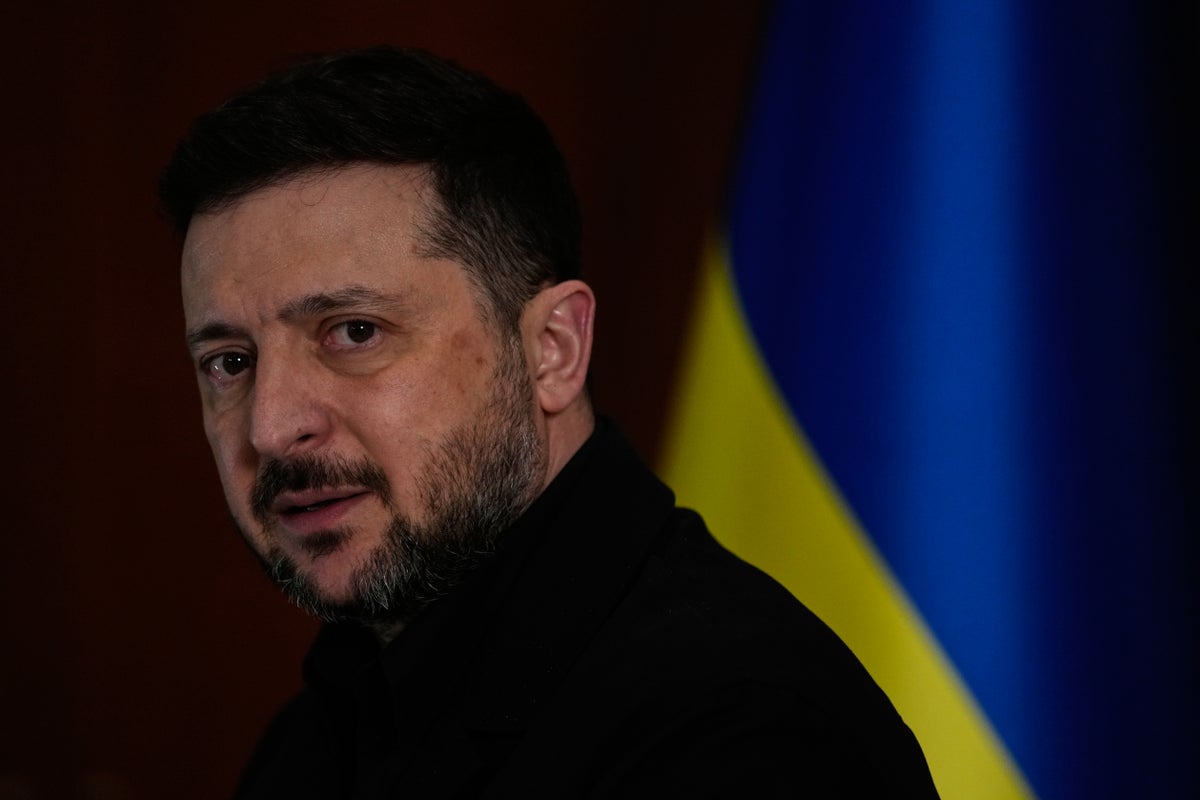
Ukrainian President Volodymyr Zelensky expressed concern that a prolonged U.S.-Israeli war on Iran could further erode America’s support for Ukraine as Washington’s global priorities shift and Kyiv braces for reduced deliveries of critically needed Patriot air defense missiles.
Ukraine desperately needs more U.S.-made Patriot air defense systems to help it counter Russia’s daily barrages, Zelensky said, speaking to The Associated Press in an exclusive interview late Saturday in Istanbul.
Russia’s relentless pounding of urban areas behind the front line following its full-scale invasion of Ukraine more than four years ago has killed thousands of civilians. It has also targeted Ukraine’s energy supply to disrupt industrial production of Ukraine’s newly developed drones and missiles, while also denying civilians heat and running water in winter.
“We have to recognize that we are not the priority for today,” Zelensky said. “That’s why I am afraid a long (Iran) war will give us less support.”
A loss of focus on Ukraine
The latest U.S.-brokered talks between envoys from Moscow and Kyiv ended in February with no sign of a breakthrough. Zelensky, who has accused Russia of “trying to drag out negotiations” while it presses on with its invasion, said Ukraine remains in contact with U.S. negotiators about a potential deal to end the war and has continued to press for stronger security guarantees.
But, he said, even those discussions reflect a broader loss of focus from Ukraine.
His most immediate concern, Zelensky said, are the Patriots — essential for intercepting Russian ballistic missiles — as Ukraine still lacks an effective alternative.
These U.S. systems were never delivered in sufficient quantities to begin with, Zelensky said, and if the Iran war doesn’t end soon, “the package — which is not very big for us — I think will be smaller and smaller day by day.”
“That’s why, of course, we are afraid,” he said.
Interlinked wars
Zelensky had been counting on European partners to help make the Patriot purchases despite tight supply and limited U.S. production capacity.
But the Iran war, now in its sixth week, has sent shock waves through the global economy and pulled in much of the wider Middle East region, further straining these already limited resources, diverting stockpiles and leaving Ukrainian cities more exposed to ballistic strikes.
For Kyiv, a key objective is to weaken Moscow’s economy and make the war prohibitively costly. Surging oil prices driven by Iran’s closure of the Strait of Hormuz are undermining that strategy by boosting the Kremlin’s oil revenues and strengthening Moscow’s capacity to sustain its war effort.
In his interview with the AP, Zelensky said Russia draws economic benefits from the Mideast war, citing the limited easing of American sanctions on Russian oil.
“Russia gets additional money because of this, so yes, they have benefits,” he said.
A renewed diplomatic push
To keep Ukraine on the international agenda, Zelensky has offered to share Ukraine’s hard-earned battlefield expertise with the United States and allies to develop effective countermeasures against Iranian attacks.
Ukraine has met Russia’s evolving use of Iranian-made Shahed drones with growing sophistication, technological ingenuity and low cost.
Moscow significantly modified the original Shahed-136, rebranded as the Geran-2, enhancing its ability to evade air defenses and be mass produced. Ukraine responded with quick innovation of its own, including low-cost interceptor drones designed to track and destroy incoming drones.
Zelensky said Ukraine is ready to share with Gulf Arab countries targeted by Iran its experience and technology, including interceptor drones and sea drones, which Ukraine produces — more than are used up — with funding from Americans and its European partners.
In return, these countries could help Ukraine “with anti-ballistic missiles,” Zelensky said.
In late March, as the Iran war escalated, Zelensky visited Gulf Arab states to promote Ukraine’s singular experience in countering Iranian-made Shahed drones, leading to new defense cooperation agreements.
Zelensky has also positioned Ukraine as a potential partner in safeguarding global trade routes, offering assistance in reopening the Strait of Hormuz by sharing Ukraine’s experiences securing maritime corridors in the Black Sea.
Zelensky was in Istanbul for talks with President Recep Tayyip Erdogan, a day after the Turkish leader spoke with Russian President Vladimir Putin.
Zelensky said they discussed peace talks and a possible meeting of leaders in Istanbul. He also said there could be new defense deals signed between the two countries soon.
Russia steps up its spring offensive
Each year as the weather improves, Russia moves its grinding war of attrition up a notch. However, it has been unable to capture Ukrainian cities and has made only incremental gains across rural areas. Russia occupies about 20% of Ukraine, including the Crimean Peninsula, which Russia seized in 2014.
On the roughly 1,250-kilometer (750-mile) front line stretching across eastern and southern parts of Ukraine, short-handed Ukrainian defenders are getting ready for a new offensive by Russia’s larger army.
The commander-in-chief of Ukraine’s armed forces, Gen. Oleksandr Syrskyi, said Russian troops have in recent days made simultaneous attempts to break through defense lines in several strategic areas.
One thing Zelensky says he has insisted on and will continue to do so — a territorial compromise and giving up land will not be on Ukraine’s agenda.