



I’m writing this from Los Angeles, on a complimentary press pass, at a conference where the minimum ticket costs $25,000 and, as of a few weeks ago, an individual wanting to attend as a private buyer would have paid as much as $150,000. That context matters for everything that follows.
This is my tenth Milken Global Conference and the first since the pandemic. While the event retains the extraordinary intellectual and financial firepower that has always been its signature, something has shifted. The absences are as instructive as what’s on the program.
Start with China. The primary China session this year drew around 35 people. I remember, a decade ago, a ballroom of 1,500 or 2,000 people electrified by the China opportunity. That collapse in interest is not a footnote; it’s a verdict on how dramatically the Western investment conversation – or at least that in the US – has reoriented itself. And yet, China is not less consequential.
Nor, for that matter, are the dozens of other large and increasingly powerful economies across Asia that received almost no attention whatsoever across three days of programming.
As for the seemingly omnipresent Trump administration, it barely scored a mention. Whether that silence is tactical, diplomatic or simply a feature of the Beverly Hills bubble is hard to say. But for an event billed as a gathering of global leaders grappling with consequential issues, the conspicuous avoidance of the most consequential political development in recent American history was striking.
Climate and ESG? Almost nowhere. Raphael Arndt, CEO of Australia’s sovereign wealth fund, the Future Fund, participated in what appeared to be the only substantive session touching on climate. That’s a single session, at a conference with more than 120 sponsors, across four days.
What you get instead is a festival of private capital. Of the roughly 5,000 attendees, my rough count puts as much as 70 per cent in the funds management, private equity or venture capital space — all here chasing a fairly thin layer of actual investment allocators.
The philanthropy is real, but even here, as with most things in America, the commercial ingredient is never far from the surface. Michael Milken — who went to jail for his role in the 1980s junk bond scandal, emerged a billionaire, and built this institution over more than two decades — has assembled a Rolodex that may be unrivalled anywhere. The calibre of speakers he can convene is genuinely extraordinary. But the event increasingly resembles a very expensive, very intellectually stimulating trade show.
AI uncertainty
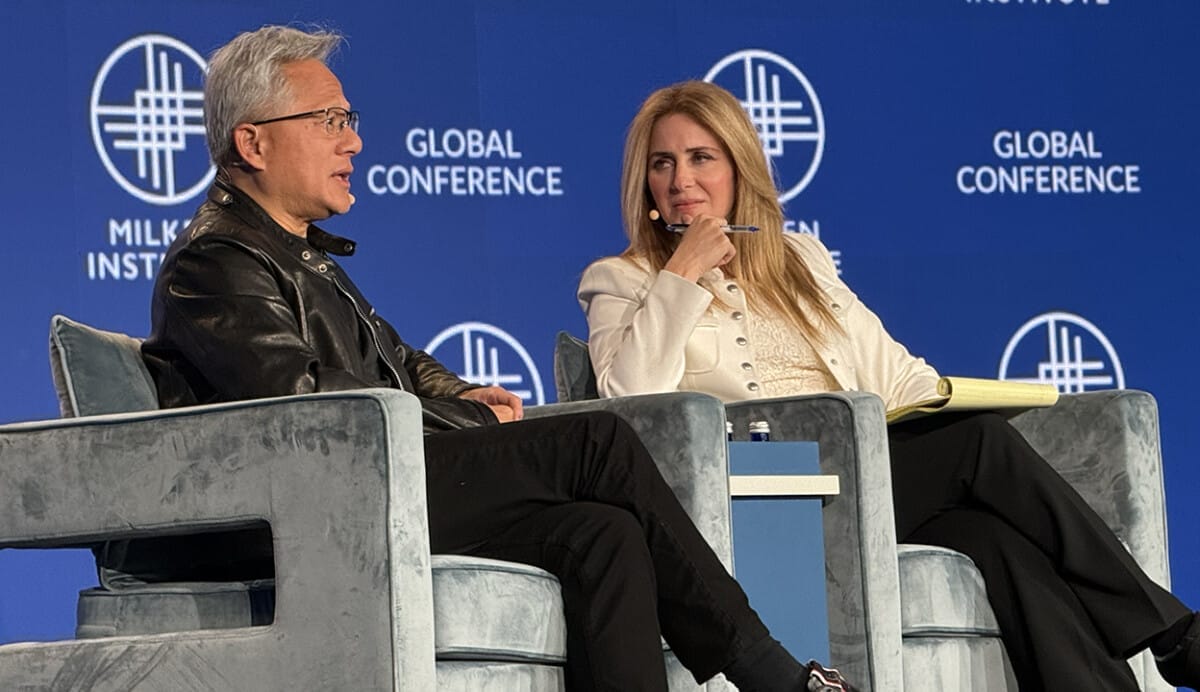
The most affecting session I attended was with Jensen Huang, founder of Nvidia, who is the eighth-richest person in the world by Forbes’s reckoning, worth around $180 billion. He spoke for about 45 minutes with an admirable generosity and candour that most chief executives would find uncomfortable.
His comments on AI ethics and the shared responsibility of the tech sector to maintain guardrails were pointed and sincere. In a program that sometimes felt disconnected from consequence, his remarks landed differently.
On AI more broadly: nobody knows where it’s going. That’s my honest takeaway. The gold rush energy is everywhere. The certainty is not.
There’s a broader observation underneath all of this. America is flying, and it’s hard to dispute the numbers. The Magnificent Seven dominate the market narrative as they dominate the market itself. In my view, the investment community here carries an inflated confidence in what this country is producing and will continue to produce. That confidence is not groundless — the depth and dynamism of US technology and capital markets are real.
But the Trump administration has introduced genuine questions about rule of law, ethical governance and the reliability of the US as a business partner in the ways that investors historically took for granted. That uncertainty registered on the sidelines of Milken, rarely in its main rooms.
There are moments of real intellectual nourishment here. But the signal-to-noise ratio has shifted, and the things that matter most to the world beyond Beverly Hills — the fracturing geopolitical order, the countries that will shape the next century, the ethical dimensions of AI, the catastrophic underrepresentation of the world’s largest emerging capital pools — felt like subtext rather than subject.
Milken is worth attending once. Whether it warrants an eleventh visit, I’m still deciding.
Colin Tate is the founder of Conexus Financial, publisher of Top1000funds.com. He is currently on long service leave.
