

Vienna’s famed coffeehouses, while embracing the Eurovision Song Contest, have also become a microcosm of the tensions surrounding Israel’s inclusion in the sequin-drenched pop music competition.
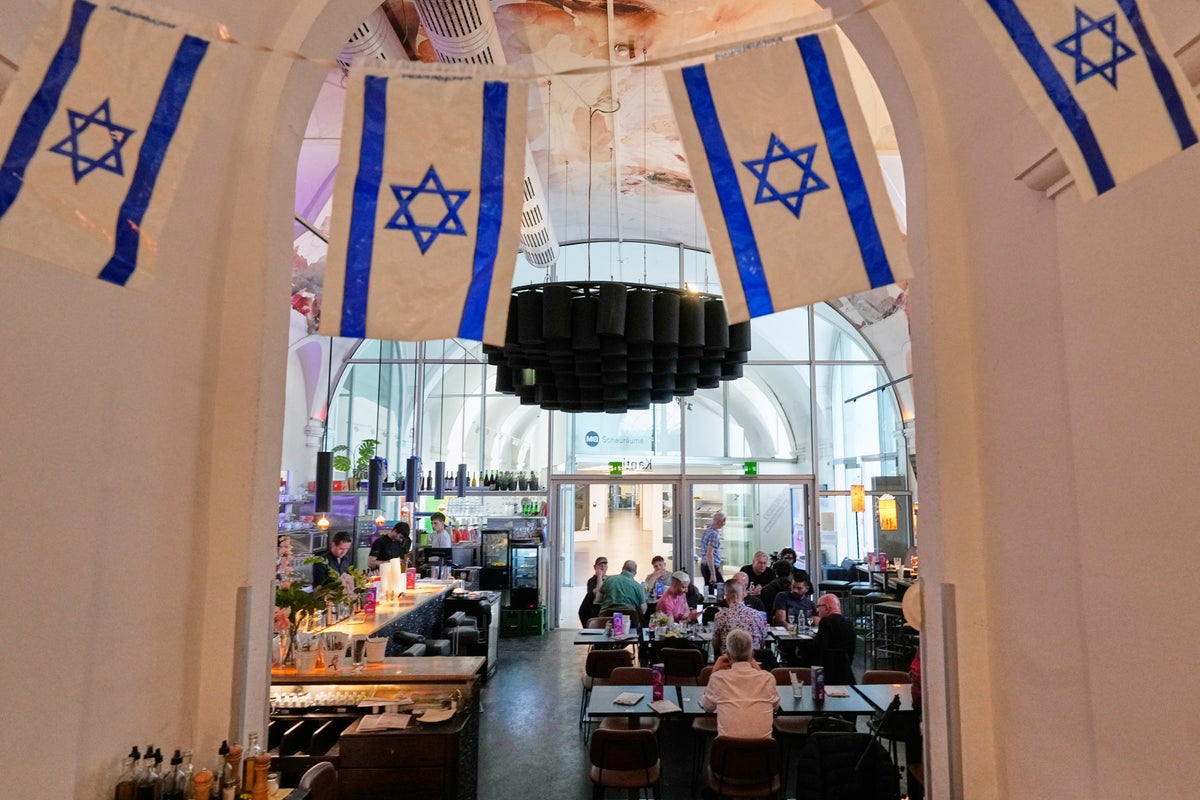
Initially, Israel was conspicuously absent from the list of “Eurofan Cafes” – Vienna coffee shops offering food and music from competing countries. MQ Kantine, a modern café in the city’s arty museums quarter, stepped in. It now features falafel, bagels with lox, and kosher wine, with small Israeli flags hanging from the ceiling – and a police officer outside its door.
Security is notably tight across Vienna during the international music contest, whose “United by Music” slogan rings somewhat hollow this year. Five countries are boycotting due to Israel’s participation. Pro-Palestinian activists plan a protest concert – one of several Eurovision alternatives across Europe – and an anti-Israel march before Saturday’s grand final.
At MQ Kantine, volunteers monitor for potential trouble. However, Daniel Kapp, a PR consultant and pro-Israel campaigner, noted that the mood has so far been supportive.
“It’s beautiful,” he said, as people drank coffee and beer on the café terrace in the spring sunshine, though he noted that the police officer on duty showed that all is “not entirely normal.”
“My feeling is that Austria to a certain degree has learned from its history,” Kapp said, referring to the deadly antisemitism under the Nazis before and during World War II. “Which is why the support for Israel is a lot more normal than it is in other countries.”
Israel has competed in Eurovision for more than 50 years, and won four times. But its participation has been contested since it launched a war in Gaza after 1,200 people were killed in a Hamas-led cross-border attack on Oct. 7, 2023. More than 73,000 Palestinians have been killed since the war began, according to the territory’s Health Ministry, which operates under the Hamas-run government and whose detailed records are viewed as generally reliable by the international community.
Israel’s government has repeatedly defended its campaign as a response to the Oct. 7 attack. But a number of experts, including those commissioned by a United Nations body, have said that Israel’s offensive in Gaza amounts to genocide. Israel, home to many Holocaust survivors and their relatives, has vigorously denied the claim.
The latest Israel-Hezbollah war in Lebanon and the U.S.-Israeli war on Iran have driven tensions still higher.
The 2024 Eurovision contest in Malmo, Sweden, and last year’s event in Basel, Switzerland, saw pro-Palestinian protests that called for Israel to be expelled. Five countries — Iceland, Ireland, the Netherlands, Slovenia and Spain — pulled out of the 2026 contest after organizers allowed Israel to compete.
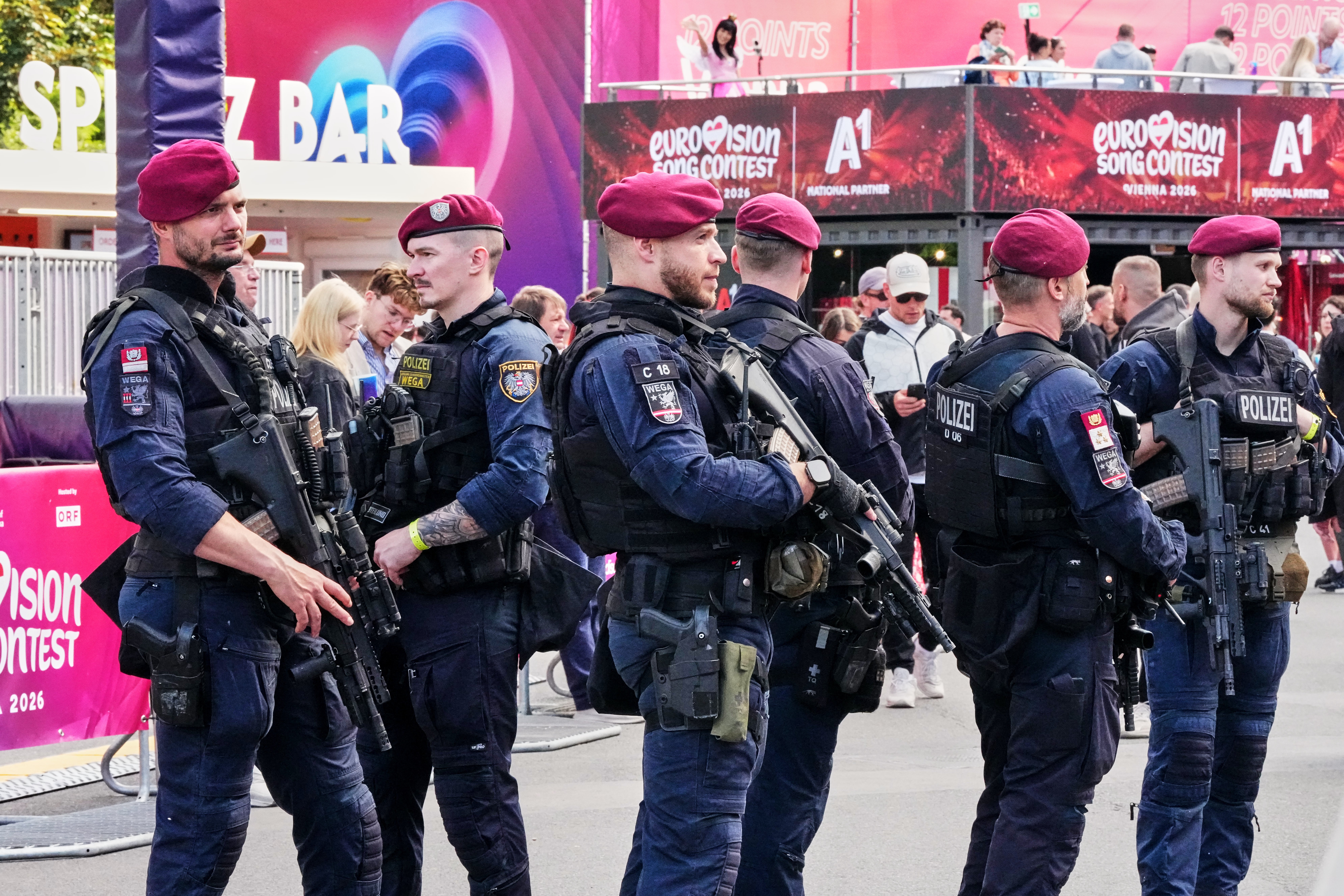
The tensions have produced a Eurovision of two halves. An upbeat party atmosphere prevails inside the Wiener Stadthalle arena and in the separate Eurovision Village fan zone. But getting in means passing through a ring of steel, with searches, scanners and a ban on all bags inside the arena. Armed police are a very visible presence on the streets.
Awareness of risk from terror plots is high in the city after a 21-year-old Austrian man accused of pledging allegiance to the Islamic State group pleaded guilty to plotting to attack a Taylor Swift concert in Vienna in 2024.
Israeli singer Noam Bettan told Israeli media that, like last year’s Israeli competitor Yuval Raphael, he practiced performing while being booed. There were scattered shouts amid the cheers when he performed in the first Eurovision semifinal on Tuesday. He secured a spot in Saturday’s final by being one of the top 10 finishers in voting by viewers and national juries.
Organizers said four people were removed from the 10,000-strong audience for disruptive behavior.
Austrian Eurovision fan Ivo Herzl, who attended the semifinal, said “the vibe was incredibly positive.” He is showing support for Israel by making and selling Mazel Lov T-shirts — a play on “mazel tov,” a Hebrew and Yiddish phrase of congratulations.
“Vienna has always been a city of tolerance,” Herzl said. “It’s the city of music and we’ll always do everything possible for everyone to enjoy a musical event.”
Some Israeli fans said they were reassured by the tight security. Oz Yona, attending his first Eurovision, said he had experienced “no hate” and felt Austria took antisemitism seriously.
He came with friends to cheer for Israel, though he was not optimistic about Bettan’s chances — for musical rather than political reasons.
“I don’t think he will win,” Yona said. “Finland is better this year. Greece is better this year. We have a good song, but not a winning song.”
Birgitta Peterson and Kristina Nilsson, who wear matching pink bomber jackets and call themselves The Swedish Ladies, love to explore new cities and meet up each year with their “Eurovision family” of fellow fans. They plan to wave Israeli flags at Saturday’s final, after Swedish contestant Felicia said earlier this year that she didn’t think Israel should be in the contest.
They say tensions over Israel have divided a fan community long known for its friendliness and embrace of diversity.
“The wounds are very deep at the moment,” Nilsson said.
“This event should really be about ‘united by music’ and happiness,” she added. “That’s what Eurovision is all about.”