
More than a month into the U.S.-Israeli air campaign against Iran that has upended the global economy and sent fuel prices soaring, a new poll from CNN and SSRS finds just one third of Americans approve of the ongoing military action.
The 34 percent of respondents who said they approved at least somewhat of President Donald Trump’s war represents a seven-point decline from a similar poll taken just after the start of the bombing campaign on February 28.
At the same time, a supermajority of 66 percent of Americans disapprove of the war, with 43 percent of those reporting that they strongly disapprove.
Worse yet for the president, more than three quarters of respondents — a whopping 77 percent — said they would oppose the Pentagon’s request for $200 billion to fund further military action against Iran, while 68 percent said they were opposed to the idea of sending ground troops into Iran.
The negative polling result for Trump’s latest military action comes just hours before he is set to deliver an address to the nation at which he is understood to be planning to essentially declare victory while savaging members of NATO for not heeding his post-facto demand for assistance in combatting Iranian efforts to bottle up maritime traffic in the Strait of Hormuz, the key waterway through which about a fifth of the world’s energy supply must pass before heading to global markets.
Since Trump announced the start of the unprovoked war in a social media video posted in the wee hours of a Saturday morning four weeks ago, his approval rating has fallen to levels that are lower than what was recorded during the shambolic final days of his first term after he fomented a riot at the U.S. Capitol in a last-ditch attempt to overturn his 2020 election loss to Joe Biden.
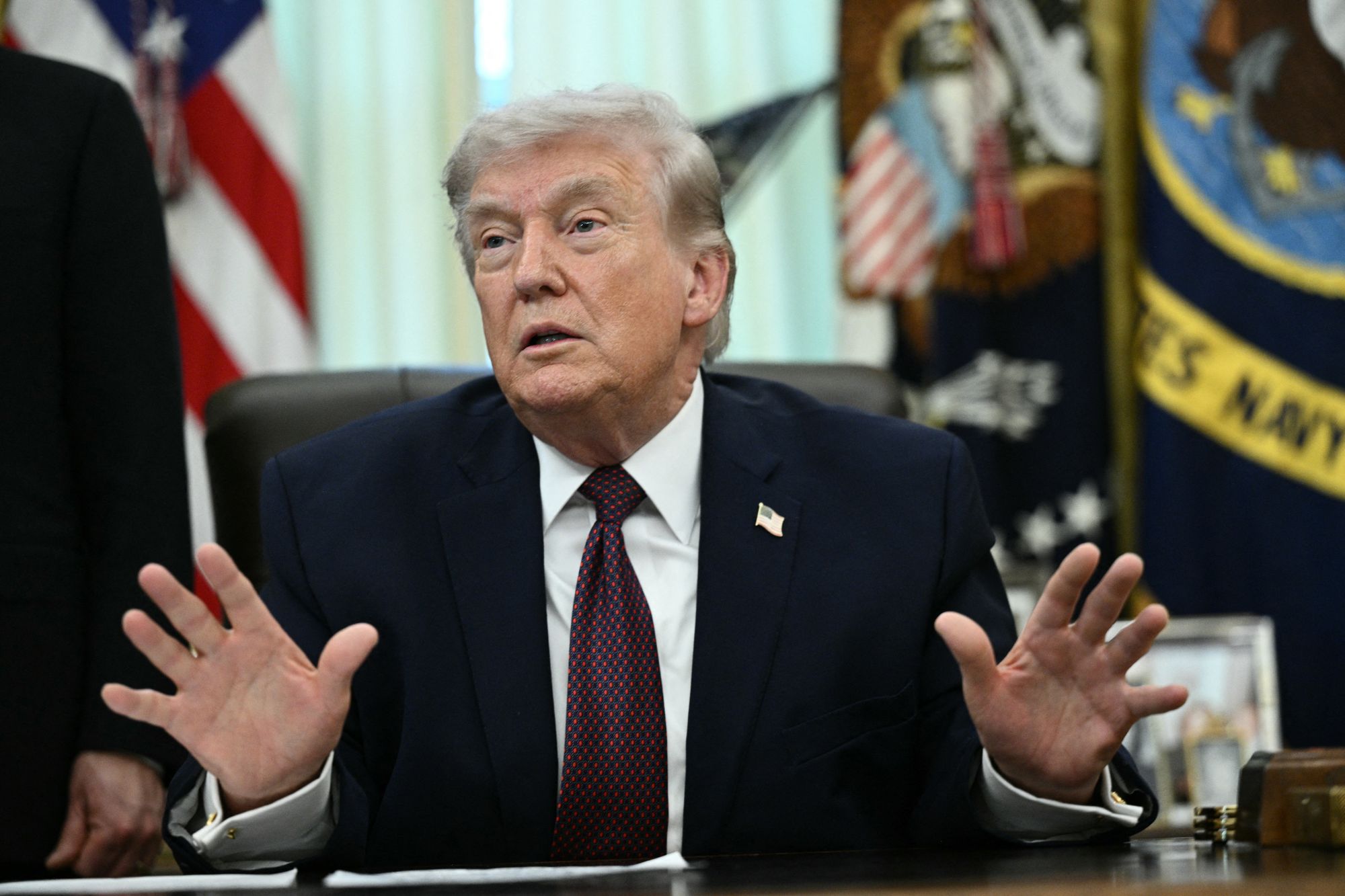
The CNN poll found his overall approval rating at 35 percent, with just 36 percent approving of his conduct of foreign policy as president.
Just 33 percent of Americans said they approve of his handling of the Iran war, the same number who said they approve of his performance as commander-in-chief of the U.S. armed forces.
Since the start of the bombing campaign at the end of February, Trump and his aides have offered shifting justifications for the war effort and have continued to insist on pushing forward even as Iran’s largely successful blockade of the Strait of Hormuz has caused gasoline prices in the U.S. to rise by more than a dollar per gallon on average across the country.
Earlier on Wednesday, Trump took to social media to claim he’d rejected a new request for a ceasefire from Iran’s president and, in the same breath, threaten to bomb the country “back to the Stone Ages” if Tehran does not allow ships to resume passing freely through the strait.
Writing on Truth Social, Trump said “Iran’s New Regime President” — who he described as “much less Radicalized and far more intelligent than his predecessors” — had asked for a “ceasefire” from the U.S.
“We will consider when Hormuz Strait is open, free, and clear. Until then, we are blasting Iran into oblivion or, as they say, back to the Stone Ages,” he added.
Separately, he lashed out at America’s NATO allies in a pair of interviews in which he once again floated the idea of pulling the U.S. out of the 32- member bloc.
According to a source familiar with his thinking, Trump’s pique at NATO stems from the way global financial markets have been roiled by the month-old air war in large part due to Iran’s effective control over the Strait of Hormuz.
Although Trump promised that American naval vessels would escort ships through the key waterway early on in the conflict, he never delivered on that promise and has instead repeatedly badgered America’s European allies to contribute naval support for an operation to reopen the strait to maritime traffic.
While multiple American allies, including the U.K. and France, have expressed interest in a multinational force to guarantee freedom of navigation, European leaders — including British Prime Minister Sir Keir Starmer — have stressed that no such operations could begin until after the U.S. and Israel end their war.
In response, Trump has repeatedly blasted NATO members for not joining in the war effort even though he made no attempt to rally international support before commencing the airstrikes.
He has attacked the 32-member alliance as a “paper tiger” and claimed the failure of NATO members to obey his demands shows the alliance to be one-sided even though the only time it has invoked the North Atlantic Treaty’s mutual defense provision was to defend the United States after the September 11, 2001 terror attacks on New York and Washington.
On Wednesday, Trump told The Telegraph that taking the US out of the alliance was now “beyond reconsideration”.
He also said he’d use his remarks on Wednesday evening to express “disgust” with the alliance and said he was “absolutely” considering whether to withdraw from NATO despite clear U.S. law banning the president from doing so without approval from Congress.
In separate comments to Reuters, he claimed the US has “some more targets left” before the war can end and claimed Iran “won’t have a nuclear weapon because they are incapable of that now.”
“And then I’ll leave, and I’ll take everybody with me, and if we have to we’ll come back to do spot hits,” he said.
He added that he “does not care about nuclear material” and that the US would be out of Iran “pretty quickly” signaling that the country would be wrapping up its military operations in the region soon, contrary to reports of a ground invasion.