

HBO Max, a new streaming service from the channel behind The Sopranos, Sex and the City and Game of Thrones, launches in the UK this week, almost six years after it first appeared stateside. In those six years, much has changed: war in Europe, Keir Starmer in Downing Street, Brooklyn Beckham ceasing diplomatic relations with his parents. And quietly, barely known on these shores, HBO has been putting out exclusive content, such as its medical drama The Pitt, which swept last year’s Emmys and has been heralded as one of the great post-pandemic series. Now, as its second season concludes in America, the show finally arrives here in Britain.
Each season of The Pitt follows a single day in the life of the emergency department of a hospital in Pittsburgh, Pennsylvania. The emergency room is led by Michael Rabinovitch, known to all as Dr Robby (Noah Wyle), and features a cast of misfits. Among them are wry charge nurse Dana (Katherine LaNasa), smarmy resident Langdon (Patrick Ball), cocky intern Santos (Isa Briones), and brittle medical student Javadi (Shabana Azeez). Unfolding in frenetic real time, like Kiefer Sutherland thriller 24, The Pitt explores some of America’s hot-button issues: sex trafficking, online misogyny, racial inequality in healthcare, neurodivergence and more. As the hours pass, an anxiety emerges. Is this day just a snapshot of life in an overcrowded, under-funded hospital? Or are we witnessing an extraordinary 24 hours at the bloody face of American medicine? After a mass shooting event concluded the show’s first season, its second chapter picks up in apparent peace. “Who else is going to get this place through the Fourth of July weekend,” Dana observes, with a twinkle, as Robby rocks up on a motorcycle.
Nothing, however, is straightforward down in the Pitt. Robby is about to take a sabbatical to bike across the country (“zoom therapy,” he quips to a psychiatrist), meaning that his stickler replacement, Dr Al-Hashimi (Sepideh Moafi), is shadowing him and trying to implement a new tech-savvy regime. “Her gut?” Al-Hashimi queries, after Robby tells a younger doctor to follow her gastric instincts. “Yeah,” he replies, “it’s this thing that AI will never have.” But even as this tension between the old and the new – the outgoing and the incoming – persists, the ER is flooded with patients presenting a range of issues. A woman who’s superglued her eye shut, an alcoholic with a tooth abscess, a student who’s been tasered by campus security, a bloodied parkour runner, an abandoned baby – the list goes on. So too does the day, ticking towards a bigger calamity. After all, Robby’s final shift was never going to be easy.
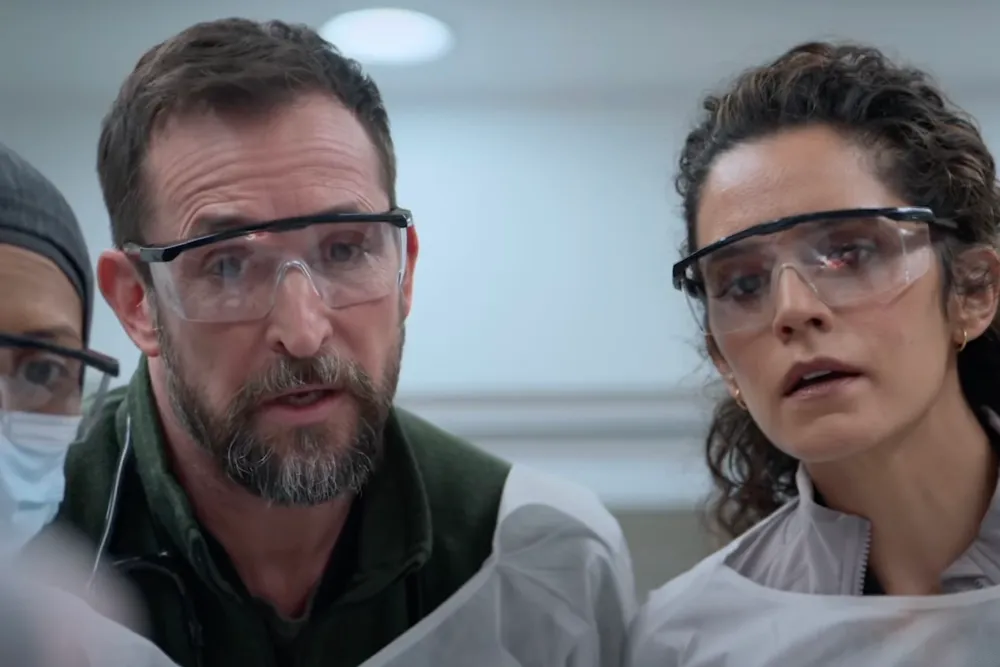
Created by R Scott Gemmill, a writer on Michael Crichton’s long-running drama ER, The Pitt has been praised for its unflinching realism and kinetic directing. It is paced like The Bear or Boiling Point on a hospital ward, with the camera and characters jumping between stations like a sous chef prepping their mise en place. As for the realism, the medical community can sometimes overstate this (my mother, an oncologist, used to claim that Green Wing was the most accurate show, despite camels being ridden in corridors), and The Pitt doesn’t demur from a little medical mystery or graphic sensationalism. “Never saw that in nursing school, am I right?” Dana remarks to a new hire, after writhing maggots spill out of a homeless man’s cast (in the first season, it was rats). Far from muting the impact, it offers a helpful dose of fun to a show that could, otherwise, prove unrelentingly grim.
But let me be honest: The Pitt is good, not great. It has thrived at a transitional time for prestige TV, with shows like Succession and Better Call Saul ending and the slow-release schedule of prospective heirs like Severance and The Last of Us denting their impact. Noah Wyle is hugely likeable in a role that might’ve been a cliched “doesn’t play by the rules” maverick, while LaNasa brings a tenderness to her part, the standout among the supporting cast. There are moments that are heartbreaking, there are moments that are shocking, and there are moments that are amusing – it all feels designed, in the mould of its great medical drama forebears like ER, to hit its beats. Interesting political commentaries about insurance and ICE agents work better than other threads that address social issues. A Jewish patient thanking her Muslim nurse for their community support after the 2018 Pittsburgh synagogue shootings feels cheesy, and some of the dialogue (“Black women tend to go under-diagnosed with eating disorders”) feels more like a public service announcement than a drama.
But what The Pitt does really well is work under its self-imposed restraints. The world never feels small, the characters never less than fully fleshed out. In an environment of such elevated stakes, hysteria and hyperbole can easily set in. The Pitt isn’t shy of drama and while it occasionally lapses into convenient contrivances, it largely remains grounded. Life and death, day to day.