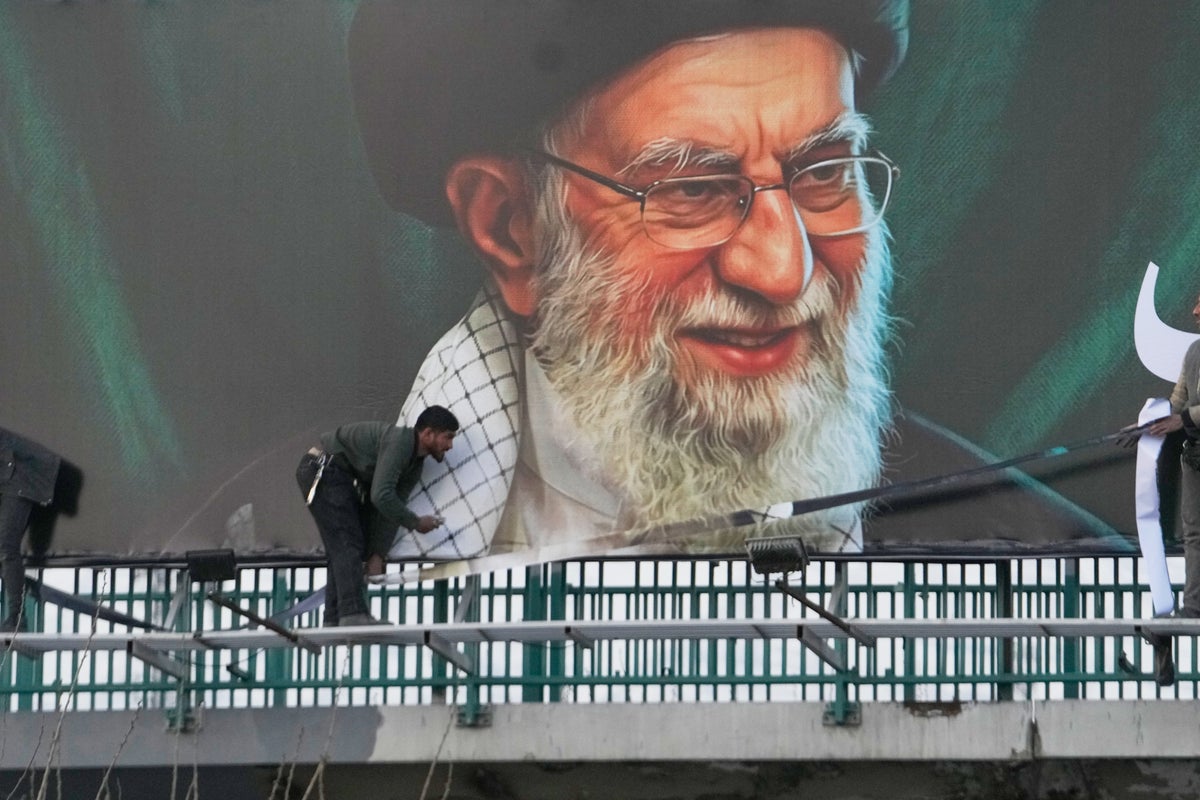
The latest US-Israeli bombings in Iran differ from last year’s because one of the stated aims this time is regime change.
Engaged in the mass murder of civilians at home and fomenting violence abroad, the current Iranian regime has few friends internationally.
Many would be glad to see Iran undergo a far-reaching program of political reform. For many in the Iranian diaspora, regime change imposed from outside is better than none.
But the historical record of imposed regime change, particularly as undertaken by the United States, is patchy at best.
Things rarely go to plan, and the long-term consequences are often disastrous.
Afghanistan and Iraq
Some immediate examples spring to mind.
Still fresh in the public mind would be the shocking scenes of desperate Afghans trying to leave Kabul in 2021 as the United States conceded it could not permanently defeat the Taliban.
This admission came after two decades, thousands of deaths of US and allied troops and tens of thousands of Afghan deaths.
Many would also remember then-US President George W. Bush’s disastrous speech in May 2003 about America’s regime change efforts in Iraq, begun in March that year. Here, Bush addressed the press while standing in front of a huge banner that said “Mission Accomplished”; the implication was regime change had been achieved in just a few months.
In fact, what followed was another decade of US fighting to try to stabilise Iraq, with actions arguably not wound up until 2018 or even beyond.

Once again this came at a huge cost to civilian lives, with The Lancet estimating as early as 2004 that around 100,000 “excess deaths” had occurred as a result of the US attempt to effect regime change there.
Thereafter, Iraq was continuously wracked by violence and civil war. Notably, ISIS took advantage of its weakened state to establish its “caliphate” on Iraqi territory, leading to yet another wave of US intervention.
But US attempts to impose regime change have a much longer and equally unsuccessful history, as well.
From the Bay of Pigs to Iran
The phrase “Bay of Pigs” has become a synonym for the inability to overthrow a government.
Aimed at overthrowing Fidel Castro in Cuba in April 1961, not only was then-US President John F. Kennedy’s foray into regime change unsuccessful (Castro died in his sleep with his regime still in control of Cuba at the age of 90 in 2016), it also led to the execution of CIA operatives there.
The US also faced the embarrassment of having to swap tractors for the freedom of the Cuban exiles who had carried out the failed invasion for them.
In 1953, the US and Britain actually did succeed in overthrowing Iranian Prime Minister Mohammad Mossadeq after he’d announced Iran’s oil industry would be nationalised in response to Western oil companies’ intransigence on royalties and control.
This regime change effort by the US did “succeed” in the short run, but it led to a series of events that culminated in the repressive regime the US aims to replace today.
Mossadeq’s toppling led to the shah of Iran, Mohammad Reza Pahlavi, becoming an absolutist monarch in the cruellest tradition.
His savage repression led in no small way to the 1979 Iranian revolution, which became the vehicle for the present theocratic government to come to power.
It is one of the ironies of history that the son of the dictatorial shah is now presenting himself as the logical candidate to bring democracy to a new Iran.
From the colonial era to WWII
Some might reach further back and argue regime change in Germany worked after the second world war.
It is worth remembering, however, that this was far from a simple process. It involved occupying Germany for more than a generation, decades of trials against ex-Nazis and splitting the country in two for more than 40 years.
As the epicentre of the Cold War, this is hardly an experiment in regime change that could be easily replicated.
Earlier examples of regime change from the colonial period provide similar lessons.
Large armies of invading colonial forces were able to pull down governments in Africa and Asia and prop up unpopular ones.
But once the occupying forces sought to remove their militaries or lost the will to resort to massacres to reinforce their rule, the shift towards decolonisation or self-rule became increasingly irresistible.
In the Dutch East Indies, French-ruled Vietnam, British India and the Belgian Congo, governments imposed by external powers were rarely viable once the threat of force was removed.
Czechoslovakia’s Prague Spring protests in 1968 – an effort to throw off Soviet-imposed rule – were quickly crushed by the USSR, showing once again that regime change “works” for as long as you are prepared to enforce it with violence.
By 1989, however, the Soviet Union’s appetite for enforcing its hegemony across eastern Europe had waned, leading to a largely peaceful transition to democracy across the region.
A failure to learn from history
Today’s US leaders are unlikely to accept the counsel of history.
But they would do well to remember the simple message of former US Secretary of State Colin Powell’s “Pottery Barn” rule for attempts to overthrow governments: you break it, you own it.
At present, however, the view from Washington seems to be that you can just break states and hope someone else will fix it for you.