Kevin Warsh’s strong views on economic governance, and his precocious nature, will hold him in good stead as he takes the reigns of the US Federal Reserve at a time where concerns over cost of living, inflation and upward mobility are a test of President Trump’s second term. For investors his views on the conflating of monetary and fiscal policy are key considerations to watch.
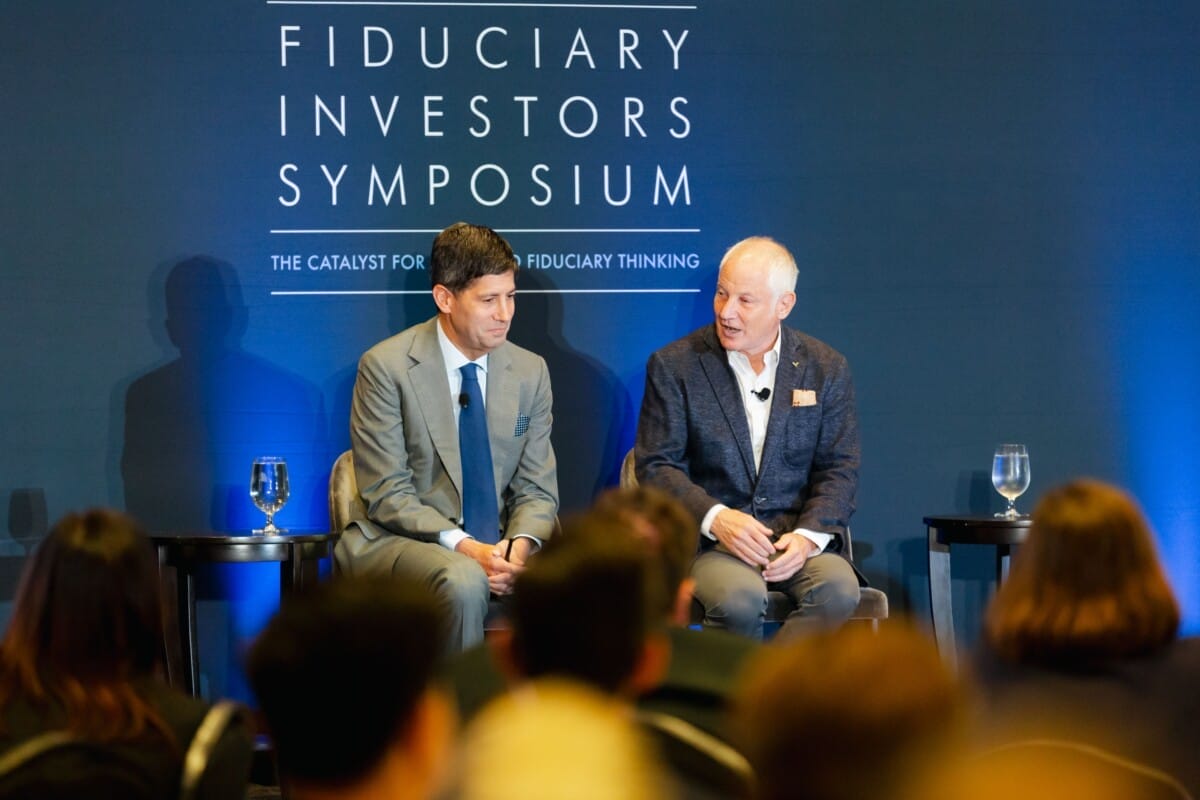
Standing tall with a swagger befitting the youngest ever member of the Federal Reserve Board Kevin Warsh took the stage of the Top1000funds.com Fiduciary Investors Symposium at Stanford University last September.
A confident and powerful communicator, he spoke to the audience for an hour about the vulnerabilities in the economy, the importance of strong economic institutions, trust and reform, intellectual freedom and central bank legitimacy.
Not just Fed independence, but the nature of the institution and its remit, were core messages to investors and a sign of the focus of his tenure as Fed chair.
In particular, Warsh has criticised the Fed, and other central banks, for blurring the line between monetary and fiscal policy, calling it out as a looming threat and making the economy more vulnerable to shocks.
“Each time the Fed jumps into action, the more it expands its size and scope, encroaching further on other macroeconomic domains. More debt is accumulated…more capital is misallocated…more institutional lines are crossed… risks of future shocks are magnified…and the Fed is compelled to act even more aggressively the next time,” he said in an April speech to the G30 reinforcing the comments he gave in September.
Warsh was speaking at the Top1000funds.com Stanford event thanks to Conexus Financial’s relationship with Professor Stephen Kotkin, the Klein
heinz Senior Fellow at the Hoover Institution and a colleague of Warsh.
Warsh, who among other appointments is the Shepard Family Distinguished Visiting Fellow in Economics at Hoover, and a colleague of both Professor Kotkin and Condoleezza Rice who leads the Hoover Institution.
“Kevin cuts an impressive figure. And he has his work cut out for him. Forget about interest rate controversies: the challenges for the Fed, which Kevin and others have pointed out, are far deeper, from its non-statutory mission creep to its ballooning balance sheet and besieged models for how the economy operates,” Kotkin told Top1000funds.com following Warsh’s appointment as the President Trump’s nominee for Federal Reserve chair on Friday. “And then there’s the matter of how banking regulations perversely incentivise the very systemic risk they are supposed to limit. Godspeed!”
In his work and public comments Warsh stresses the importance of credible monetary policy, clear rules, honest communication with the public, and institutional accountability.
At the core of Warsh’s comments on stage at Stanford, and in speeches since, is economic governance.
In his widely-touted G30 speech in April, underlining his views at the FIS event, he said that strengthening economic performance requires significant improvement in the government regime. And that means new ideas and reforming key economic institutions.
“Changes in the role of the US central bank have been so pervasive as to be nearly invisible. The Fed has assumed a more expansive role inside our government on all matters of economic policy. And moved into matters of statecraft and soulcraft, too. In my view, forays far afield—for all seasons and all reasons–have led to systematic errors in the conduct of macroeconomic policy. The Fed has acted more as a general-purpose agency of government than a narrow central bank,” he said in the speech.
“Institutional drift has coincided with the Fed’s failure to satisfy an essential part of its statutory remit, price stability. It has also contributed to an explosion of federal spending. And the Fed’s outsized role and underperformance have weakened the important and worthy case for monetary policy independence.”
A student of the late Milton Friedman while completing his undergraduate degree at Stanford, Warsh went on to work at Morgan Stanley, served as special assistant for economic policy to the president and as executive secretary of the White House National Economic Council for George W Bush. He was appointed by President Bush to serve on the Fed board in 2006, aged only 35, making him the youngest member in the history of the Federal Reserve.
“Kevin is the definition of precocious, having studied with Milton Friedman, George Shultz, and Condoleezza Rice as an undergraduate at Stanford University, before earning a degree at Harvard Law School, working on Wall Street, serving in the George W. Bush White House, and initially joining the Federal Reserve for a term at just 35 years old,” said Kotkin.
In a piece published by Hoover Institution on Saturday, Hoover director Condoleezza Rice – who has also spoken at the Top1000funds.com Stanford event the past three years – praised Warsh’s leadership saying: “We will benefit from his steady, principled leadership.”
“Kevin is a dedicated public servant with the intellect, experience, and judgment to lead the Federal Reserve. He understands the central bank’s key role for the United States and our allies around the world. We will benefit from his steady, principled leadership,” she said.
Reforming economic institutions
Warsh has long been critical of the Fed for being involved in the “messy political business” of fiscal policy, putting his money where his mouth is and resigning from the Fed board shortly after the QE2 announcement in 2010, a decision he publicly disagreed with.
Of that time, he has said that cutting interest rates to near zero in response to the 2008 crisis and seeking new ways to make monetary policy looser and bring liquidity to illiquid markets, was an appropriate “crisis-time innovation” that he strongly supported. But he criticises the Fed for not correcting the position and continuing with QE, now a feature of central banks around the world.
“It’s no longer obvious whether monetary policy is downstream or upstream from fiscal policy. Irresponsibility has a way of running in both directions,” Warsh said in his April speech to the G30.
“Fiscal dominance – where the nation’s debts constrain monetary policymakers – was long thought by economists to be a possible end-state. My view is that monetary dominance – where the central bank becomes the ultimate arbiter of fiscal policy – is the clearer and more present danger.”
In a 2022 paper with Hoover colleague John Cogan, Warsh set out an economic governance framework that “befits the country’s new challenges”.
The paper, Reinvigorating economic governance: A framework for American prosperity, outlines potential economic reform and questions whether extreme action – such as constitutional reform – are necessary to help restore fiscal prudency and limit federal spending.
The proposed framework advocates for putting the creation and diffusion of ideas at centre stage, including subjecting monetary policy to strict scrutiny. In particular the paper calls for an assessment of the Fed’s regime change where it has extended the scale and scope of its activities, all the while running inflation far outside the Fed’s price-stability objective.
The paper says that a chasm between the current economic regime and a sound economic governance plan is large and growing, and recent Warsh speeches have reinforced the view that strengthening economic performance requires significant improvement in the government regime. And that means new ideas and reforming key economic institutions.
“Some may believe the biggest threat to our economy comes from outsiders who seek to change the status quo…I don’t agree…I believe the predominant risk come from choices made inside the four walls of our most important economic institutions,” he said in the April speech.
“My view, strengthening economic performance requires significant improvement in the governance regime. That means new ideas.”