



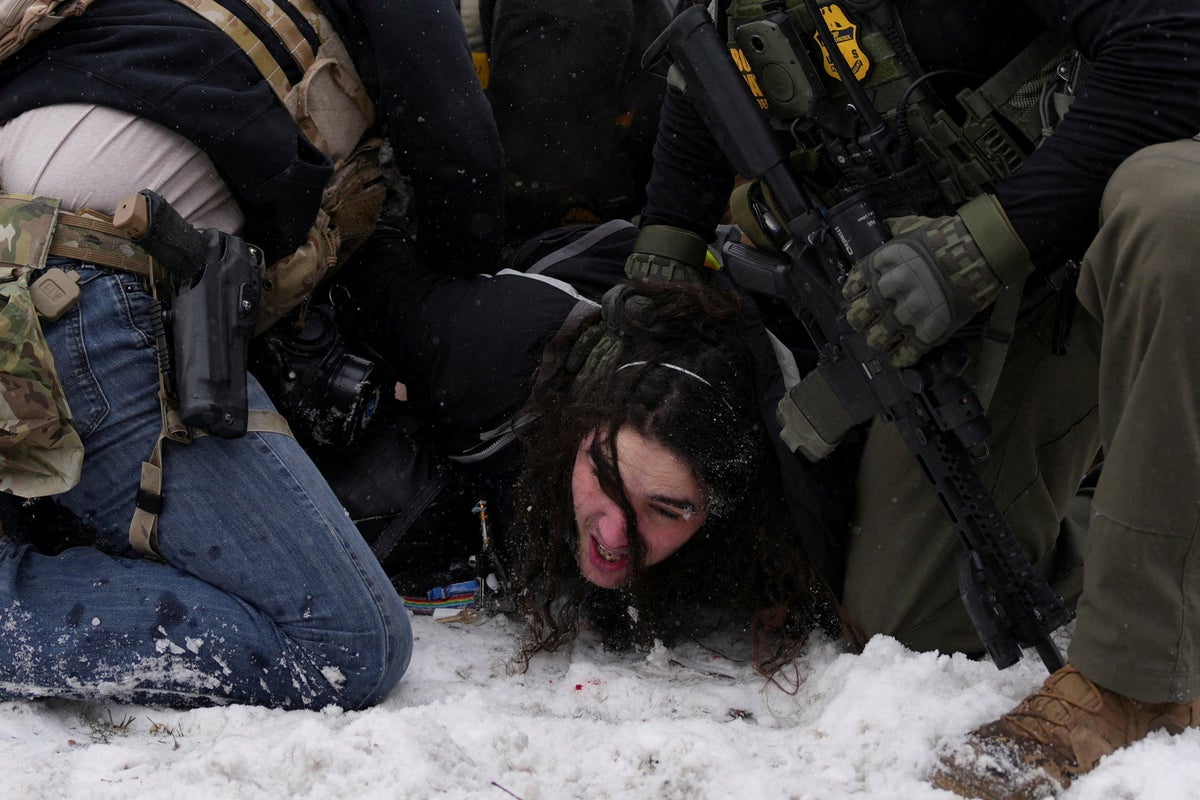
Lawmakers in at least eight states are trying to enact legislation that would allow people to sue federal immigration law enforcement officers when their rights are violated, ending longstanding protections for federal employees.
Following the fatal shootings of two citizens from Minnesota, 37-year-olds Renee Good and Alex Pretti, lawmakers in predominantly Democratic states are seeking to provide people a mechanism to hold immigration officers more accountable.
State lawmakers in California, Colorado, New York, Minnesota, Rhode Island, Oregon, Virginia and Washington have introduced legislation seeking to limit civil lawsuit protections for Immigration and Customs Enforcement agents by scaling back qualified immunity.
“Government officials are subject to the law,” Colorado state Senator Mike Weissman told News From the States this week.
“When we have rights, we also need to have remedies when those rights are violated, or can we truly be said to have rights at all?” Weissman added. He is leading the push for Colorado to enact legislation that would allow civilians injured during immigration arrests to sue for two years.

Qualified immunity is a sweeping legal protection for government officials that protects them from civil lawsuits alleging they violated a person’s rights. Under the principle, a person can only bring a civil lawsuit when an official violates a “clearly established” constitutional right that a “reasonable person” would have known.
However, it’s a high bar to clear because the “clearly established” language means a plaintiff must prove that a court has previously ruled in a case that contains nearly identical facts.
Antonio Romanucci, a Chicago-based lawyer hired to represent Good’s family, told the Wall Street Journal they would likely sue the U.S. government for negligence under the Federal Tort Claims Act – which allows people to sue the government for personal injury, death or property damage due to negligent acts.
“They want justice,” Romanucci said.
While the Federal Tort Claims Act allows for lawsuits, it protects government employees from being held personally financially responsible. It also has a tight timeline, requiring plaintiffs to file an administrative claim within two years of the incident and then wait for the government agency to respond before filing a lawsuit within six months of the response.

In addition to state-level legislation, several congressional Democrats are hoping to end, or limit, qualified immunity for immigration enforcement officers at the federal level.
“ICE is not invincible,” California Rep. Eric Swalwell said in a press release announcing legislation that would strip ICE of qualified immunity, co-sponsored with New York Rep. Dan Goldman.
“Civil rights laws exist; now Congress must step in to defend the rights of the most vulnerable in our communities,” Swalwell added.
Stripping federal law enforcement of qualified immunity is a massive hurdle that likely wouldn’t receive bipartisan support. Other lawmakers have sought other ways to limit qualified immunity for immigration enforcement officers.
Texas Rep. Julie Johnson has proposed rewording qualified immunity protections to remove the need for “clearly established” cases in order for a person to bring a lawsuit against federal officers.
Even if states pass laws limiting qualified immunity, it’s likely to face challenges from the government itself. The Department of Homeland Security has been adamant that officers follow the law and the Constitution.
Illinois recently passed its own law allowing residents to sue federal officers who “knowingly” violate their rights during civil immigration enforcement. The Department of Justice has already filed a lawsuit challenging the state law.
The Independent has asked the Department of Homeland Security for comment.