


UK TimesUK Times
  • Home
  • News
  • TV & Showbiz
  • Money
  • Health
  • Science
  • Sports
  • Travel
  • More
    • Web Stories
    • Trending
    • Press Release
What's Hot

A34 southbound exit for A415 | Southbound | Congestion

13 January 2026
World-class beaches, breathtaking nature, delicious cuisine and rich heritage: why the Costa de la Luz is ideal for your next holiday – UK Times

World-class beaches, breathtaking nature, delicious cuisine and rich heritage: why the Costa de la Luz is ideal for your next holiday – UK Times

13 January 2026

M25 clockwise within J24 | Clockwise | Congestion

13 January 2026
Facebook X (Twitter) Instagram
UK TimesUK Times
Subscribe
  • Home
  • News
  • TV & Showbiz
  • Money
  • Health
  • Science
  • Sports
  • Travel
  • More
    • Web Stories
    • Trending
    • Press Release
UK TimesUK Times
Home » Sound stimulation can flush out toxic Alzheimer’s proteins from brain, scientists find – UK Times
News

Sound stimulation can flush out toxic Alzheimer’s proteins from brain, scientists find – UK Times

By uk-times.com13 January 2026No Comments3 Mins Read
Facebook Twitter LinkedIn Telegram Pinterest Tumblr Reddit WhatsApp Email
Sound stimulation can flush out toxic Alzheimer’s proteins from brain, scientists find – UK Times
Share
Facebook Twitter LinkedIn Pinterest Email

Sign up for our free Health Check email to receive exclusive analysis on the week in health

Get our free Health Check email

Get our free Health Check email

Health Check

Scientists have shown that a non-invasive sound stimulation of the brain at a specific frequency can clear toxic proteins linked to Alzheimer’s disease, an advance that could lead to low-cost therapy.

Alzheimer’s disease symptoms, including memory loss and problems with language and thinking, are known to be linked to elevated levels of abnormal proteins in the brain called amyloids, which form plaque around cells.

These proteins can build up gradually in the brain and kill the junctions between nerve cells known as synapses, eventually strangling the neurons and causing brain tissue death.

While current treatments improve some symptoms, there are no long-term cures for the debilitating condition.

Now, for the first time, scientists have demonstrated that auditory stimulation at 40Hz can significantly alter amyloid protein levels in the brain of aged rhesus monkeys, with this effect persisting for over five weeks.

The findings suggest 40Hz stimulation could be developed into a non-invasive physical therapy for Alzheimer’s disease (AD) patients.
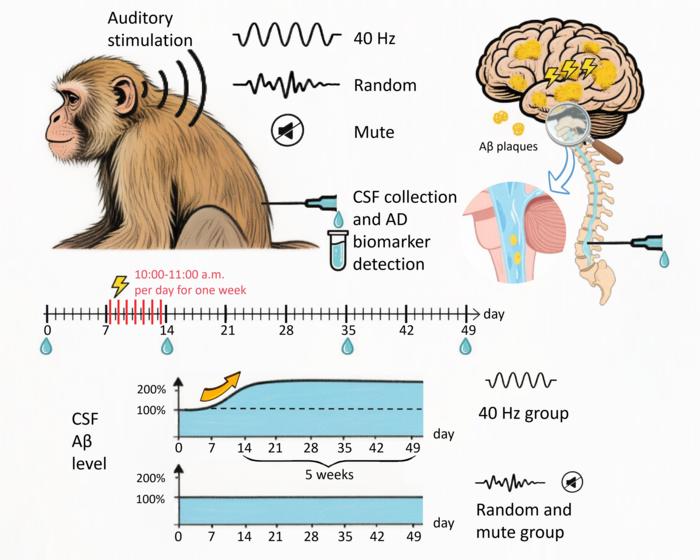
Illustration of 40Hz auditory stimulation of aged monkeys
Illustration of 40Hz auditory stimulation of aged monkeys (KIZ)

In the study, researchers from the Chinese Academy of Sciences tested the auditory stimulation technique in nine rhesus macaques aged 26–31 years.

The monkeys had developed widespread spontaneous amyloid-β (Aβ) protein clusters in their brains, effectively mimicking the pathological feature of human Alzheimer’s disease, making them an ideal animal research model.

One group of monkeys in the study received an hour of 40Hz auditory stimulation daily for seven consecutive days.

Researchers found that after the sound stimulation, levels of the key amyloid proteins in the monkeys’ spinal fluid (CSF) increased by three times the initial levels.

“Seven days’ stimulation triggered a rapid CSF Aβ increase by more than 200 per cent,” they wrote in the study published in the journal PNAS.

The results are also consistent with previous findings in mouse models, scientists say, suggesting that 40Hz sound stimulation facilitates the clearance of toxic Alzheimer’s-related amyloid proteins from the brain into the spinal fluid.

Scientists found that the amyloid protein levels in the spinal fluid remained elevated when measured five weeks after the stimulation ended, showing there’s a sustained long-term effect from the therapy.

Compared to current antibody treatments to slow early-stage Alzheimer’s disease, researchers say sound stimulation could be developed into a non-invasive, low-cost physical intervention.

“This study provides the first primate evidence that 40Hz auditory stimulation can sustainably modulate the Aβ metabolism in the brain, supporting its potential as a noninvasive AD treatment method,” researchers wrote.


Share. Facebook Twitter Pinterest LinkedIn Tumblr Telegram Email

Related News

A34 southbound exit for A415 | Southbound | Congestion

13 January 2026
World-class beaches, breathtaking nature, delicious cuisine and rich heritage: why the Costa de la Luz is ideal for your next holiday – UK Times

World-class beaches, breathtaking nature, delicious cuisine and rich heritage: why the Costa de la Luz is ideal for your next holiday – UK Times

13 January 2026

M25 clockwise within J24 | Clockwise | Congestion

13 January 2026

M3 eastbound between J4 and J3 | Eastbound | Accident

13 January 2026
Experts warn of the health consequences of ‘bed rotting’ – UK Times

Experts warn of the health consequences of ‘bed rotting’ – UK Times

13 January 2026

A19 southbound within the A1046 junction | Southbound | Road Works

13 January 2026
Top News

A34 southbound exit for A415 | Southbound | Congestion

13 January 2026
World-class beaches, breathtaking nature, delicious cuisine and rich heritage: why the Costa de la Luz is ideal for your next holiday – UK Times

World-class beaches, breathtaking nature, delicious cuisine and rich heritage: why the Costa de la Luz is ideal for your next holiday – UK Times

13 January 2026

M25 clockwise within J24 | Clockwise | Congestion

13 January 2026

Subscribe to Updates

Get the latest UK news and updates directly to your inbox.

© 2026 UK Times. All Rights Reserved.
  • Privacy Policy
  • Terms of use
  • Advertise
  • Contact Us

Type above and press Enter to search. Press Esc to cancel.

Go to mobile version