

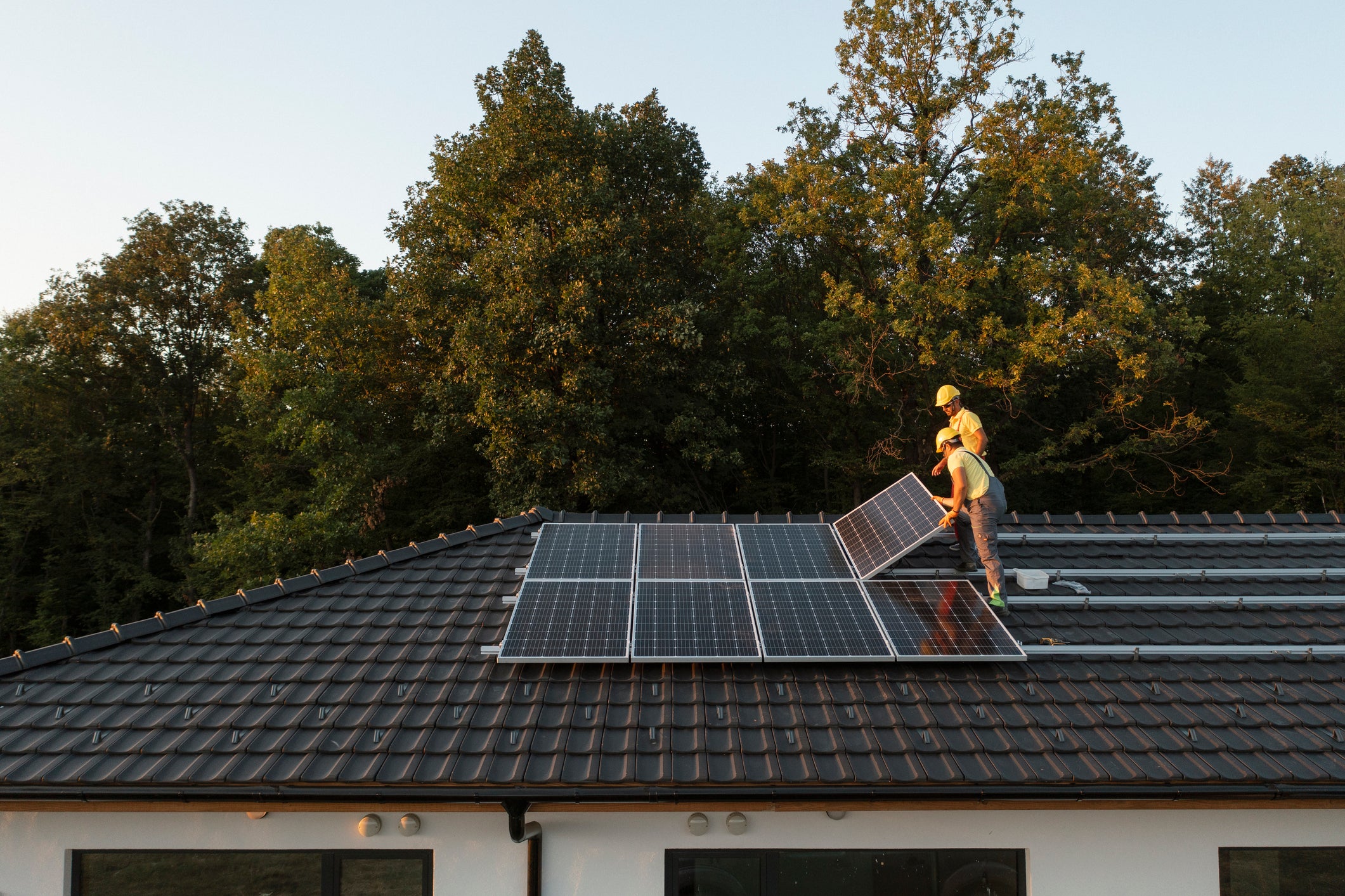
Walk down almost any UK street today and you’ll see them. Sleek, black rectangles nestled on rooftops, quietly soaking up whatever sunlight our indecisive skies can muster. And in an increasingly uncertain world, their appeal is growing.
Beyond the cost of setup and maintenance, solar panels can provide you with free electricity and a greater sense of control over how your home uses energy. The energy you generate but don’t use can be either stored for later use with a battery or sold back to the National Grid. At the same time, you’re making a positive contribution to tackling the climate crisis; it’s estimated a solar panel system can save up to upwards of 900kg of carbon per year depending on system size, location and grid carbon intensity.
But once you’ve had panels installed, what actually happens? Understanding how these systems generate, store and sell electricity is the key to maximising your investment.
How solar panels work
Solar panels are made up of photovoltaic (PV) cells, usually made from silicon. When sunlight hits these cells, it generates electricity, giving you visibility and control over your home’s power.
Because most UK home appliances use alternating current (AC), the electricity from the panels – which is direct current (DC) – needs to be converted. This is done by an inverter, which makes the power usable for your lights, appliances, and other devices.
A typical domestic solar setup can vary in size and output. Octopus Energy’s most popular system includes 8 panels with a 5 kWh battery and a smart battery, costing £8,518. To explore the right setup for your home and see estimated costs and potential savings, you can use their online solar calculator.
On a bright day, that set up should provide enough electricity to power your lighting, your appliances, and your home office. While it’ll generate less power on gloomy days, the efficiency of modern solar panels means that even grey skies can still contribute meaningfully to your energy needs.
The role of battery storage
One of the big challenges of solar panels is a potential mismatch in timing. By definition, they only generate electricity during daylight hours, normally producing peak power between 10am and 3pm. But most households use the bulk of their electricity during the morning rush and evening hours; precisely when panels produce little or nothing.
This mismatch creates a daily rhythm, though, that solar panel households quickly learn to navigate. The washing machine starts at 11am instead of 8pm; the dishwasher runs after lunch rather than before bed.

Save on your electricity bills with Octopus solar and battery
GO TO WEBSITE
Advertisement
Save on your electricity bills with Octopus solar and battery
GO TO WEBSITE
Advertisement
The timing issue is why many households choose to include a battery; storing excess electricity not only saves money but also gives you more control over when and how you use power.
A typical storage unit is slightly taller than a washing machine but much slimmer, making it easy to tuck into a garage or utility room. A 5–10 kilowatt-hour battery can store enough power to run an average home through the evening and overnight, significantly reducing the amount of grid electricity you need to buy. What’s more, with a battery and a smart tariff like Intelligent Octopus Flux, if and when you need to buy electricity from the grid you can do it when it’s cheaper and greener, and it’s exported when it’ll make customers the most money.
Selling back to the grid
But what happens to the electricity you neither use nor store? This is handled by the Smart Export Guarantee (SEG), a government-backed initiative that ensures your energy supplier will pay you for the surplus electricity you feed back into the national grid.
However, not all export tariffs are equal. Companies are allowed to set their own payment rates, and according to Which?, they can be as low as 1p per kWh. By contrast, tech-led providers such as Octopus Energy have helped to reshape the market. With smart tariffs, such as Intelligent Octopus Flux, customers could make up to £300 more than they pay for electricity.
Why solar pays for itself
When all these savings and potential earnings are combined, the economics of solar panels start to look increasingly attractive.
The Energy Saving Trust estimates that, through reduced bills and export payments, a typical household will see a combined benefit of £600 to £1,000 per year, allowing most systems to pay for themselves within seven to nine years.
It’s worth remembering that solar and battery savings depend on things like your roof size, angle and location, how much electricity you use, when you use it, the system you choose, and the tariff you’re on. After a free consultation, Octopus can provide a tailored estimate based on your home and habits so you have a clearer idea of what you might expect.
Beyond direct savings, there are additional ways to make the upfront investment easier. Some banks and mortgage lenders offer green mortgages or cashback incentives for homes with renewable energy systems. Finance options are also available to spread the cost of installation, making it simpler to access solar without a large initial outlay.
After that, you’re essentially getting free power for the remainder of the panels’ typical 25-year lifespan, providing a useful hedge against future energy price changes.
Sleeping better at night
That said, for many people, the appeal of solar panels isn’t just financial; it’s psychological. They change the way you think about energy, and as a result, the way you actually use it. You start noticing when it’s sunny. You check your generation apps. You time your appliances around daylight. Energy stops being an abstract monthly bill and becomes something visible and tangible.
Research shows that over 80% of UK households adapt their behaviour due to energy pressures, such as modifying how and when they use power – and solar ownership is part of this dynamic shift towards active energy management and control.
More broadly, there’s the feeling of being on the right side of history, and of protecting your family against an uncertain future. As the UK works towards around 70 gigawatts of solar capacity by 2035, putting solar panels on your roof means you’re no longer a passive consumer. You become an active part of the UK’s energy network.
Explore Octopus solar panels or verify our claims on the Octopus Energy website.